AI for Citizen Participation: What Switzerland Can Learn
International Study Analyzes 50 Use Cases from 22 Countries – Implications for Direct Democracy.
How AI Could Change Democracy – And What It Means for Switzerland
Artificial Intelligence could make political participation simpler, faster, and more widely accessible. A new study by the OECD and Bertelsmann Stiftung examines 50 concrete use cases in 22 countries. This is particularly relevant for Switzerland: In a political system that relies heavily on direct democracy and participation, AI could create new opportunities – but also new risks for trust, data protection, and free opinion formation.
Can artificial intelligence help more people participate in political processes? Can it support authorities in evaluating thousands of comments or proposals? A joint study by the OECD and the Bertelsmann Stiftung demonstrates that such applications are no longer mere future concepts.
The OECD report «Artificial Intelligence and the Future of Citizen Participation,» published in June 2026, examines 50 concrete applications from 22 OECD member and partner states. The Bertelsmann Stiftung summarized the findings in a policy brief.
AI Is Already Used for Political Participation
The study reveals: Governments and other public actors already deploy AI in various phases of participation processes. Applications range from analyzing large volumes of citizen opinions to supporting individual participants.
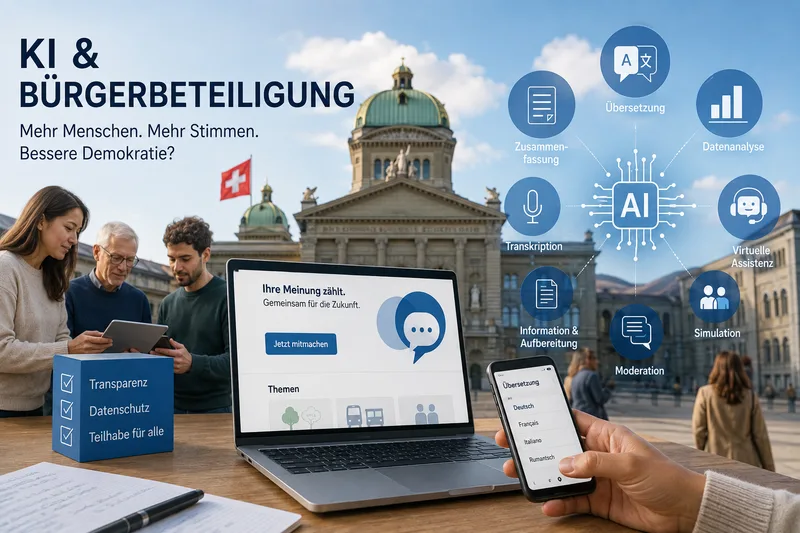
The OECD distinguishes nine application areas: Information Development, Sense-making, Translation, Transcription, Virtual Assistance, Moderation, Facilitation, Simulation, and Participation Architecture. These range from preparing political information, translations, and transcriptions, to supporting and designing entire participation procedures.
Currently, AI systems for analyzing large volumes of feedback, virtual assistants, and automatic translations are particularly widespread. The technology can thus take on tasks that would be time-consuming for authorities in large-scale participation processes.
When Thousands of Voices Need to Be Evaluated
One example comes from Cambridge in the United Kingdom. An AI tool was used there to evaluate qualitative contributions from a public consultation. According to the Bertelsmann Stiftung, the time required for evaluation was reduced by approximately 50 percent.
Finland also demonstrates the potential of such systems. The Finnish innovation agency Sitra used the AI-powered platform Polis in 2024 for the consultation «What do you think, Finland?» More than 18,000 people participated.
However, such examples do not mean that AI takes over political decisions. Instead, the goal is to support the processing and structuring of citizen contributions.
The Crucial Limit: AI Must Not Replace Democracy
This is precisely where a central warning of the study comes in. AI can process large amounts of data, recognize patterns, or make information more understandable. However, the democratic evaluation of this information remains a human task.
The OECD warns, among other things, about biased data, lack of transparency, erroneous results, data protection issues, and an over-reliance on automated systems. So-called hallucinations – AI-generated but false information – can also impair the quality of political participation processes.
It would be particularly problematic if citizens could no longer understand how their contributions are processed or what influence an AI system has on the evaluation.
The study therefore also mentions the risk of digital exclusion. Those without access to digital services or who cannot handle AI systems could fall behind other participants. The OECD therefore explicitly recommends offering low-threshold alternatives for people with limited digital access.
What Does This Mean for Switzerland?
For Switzerland, this question is particularly relevant. Hardly any other political system offers citizens so many direct opportunities to influence political decisions. Initiatives, referendums, votes, and various forms of consultation are part of daily political life.
However, the study does not examine Switzerland as a separate case. Therefore, it would be incorrect to conclude from the international examples that Swiss authorities are already extensively using AI for political participation procedures.
Instead, it is more interesting to consider what opportunities could arise for Switzerland from international experiences.
Multilingualism as a Swiss Use Case
An obvious example is multilingualism. According to the OECD, automatic translation is one of the most widespread AI applications in citizen participation. In a country with German, French, Italian, and Romansh, such technology could fundamentally help reduce linguistic access barriers.
Large consultations could also benefit from AI. When thousands of people express their opinions on a political project, manual evaluation can be very laborious. AI could categorize contributions by topic, highlight recurring arguments, or create summaries.
Crucially, however, the machine must not decide which opinion is politically «important.» The selection of criteria, the control of results, and the political evaluation must remain transparent and ultimately human responsibilities.
Switzerland Is Already Discussing AI and Democracy
This question is by no means new in Switzerland. The Bundesamt für Justiz (Federal Office of Justice) already conducted a participatory process in 2025 on the future regulation of artificial intelligence. Representatives from civil society, politics, business, science, and administration were involved.
Swiss authorities also explicitly address the possible effects of AI on democracy. Documents from the Bundesamt für Justiz mention disinformation, deepfakes, political targeting, and potential impacts on free opinion formation as risks.
At the same time, the federal government is working on general AI regulation. The Bundesamt für Justiz is to prepare a consultation draft by the end of 2026. Key aspects include transparency, data protection, non-discrimination, and oversight.
A Possible Advantage of Swiss Federalism
Switzerland's federal structure could be an advantage when testing such technologies. Municipalities and cantons could initially test new forms of digital participation in limited projects, gather experience, and develop rules for later implementation.
Switzerland is also gaining experience with other digital political procedures. For instance, the federal government and cantons have been testing electronic voting since 2004. More than 300 trials have been conducted so far. The principle of «security over speed» explicitly applies here.
This principle could also apply to the use of AI in political participation processes: The speed of the technology would not be decisive, but rather whether it truly improves democratic processes while maintaining trust and comprehensibility.
Three Conditions for Using AI
The OECD essentially summarizes its recommendations in three areas: Guardrails, Enablers, and Public Engagement.
First, clear guardrails are needed. Citizens must be able to know when and how AI is used. Data protection, transparency, and non-discrimination must be ensured.
Second, authorities must possess the necessary knowledge. Employees must understand the capabilities and limitations of AI systems and how their results can be controlled.
Third, citizens themselves should be involved in the development and design of such systems. AI for democracy should therefore not be developed solely by authorities or technology companies. Those who will later interact with it should have a say in its design.
The Real Question Is Not Human or Machine
The study by the OECD and Bertelsmann Stiftung neither paints a picture of an impending AI democracy nor calls for a comprehensive automation of political processes. Its approach is decidedly more sober.
AI can be helpful where humans currently face limitations – for example, in processing large amounts of information, in translations, or in organizing complex participation procedures. At the same time, new risks arise if the technology is used non-transparently or if people delegate too much responsibility to it.
For Switzerland, this could open up an interesting perspective: AI might contribute to making political participation more accessible and efficient, without automating the decision-making itself.
Conclusion
Artificial Intelligence will likely not replace political participation. However, it could change how people are heard and how authorities handle large volumes of political feedback.
International examples show that the technology is already in use. Experiences from the UK and Finland demonstrate that AI can provide significant support in evaluating and organizing participation processes. Simultaneously, the OECD warns against biases, lack of transparency, data protection issues, and digital exclusion.
This presents both an opportunity and a constitutional challenge for Switzerland. In a direct democracy, participation must not only be as simple as possible. It must also remain transparent how political insights emerge from the voices of citizens.
Therefore, the decisive question will not be whether AI should be used in democracy. The crucial point will be under what conditions it may be used – and who ultimately bears the responsibility.
Sources
- OECD: Artificial Intelligence and the Future of Citizen Participation: Typology of Applications, Opportunities and Challenges for Democratic Innovation, June 30, 2026.
- Bertelsmann Stiftung: Policy Brief 07/2026: Artificial Intelligence and the Future of Citizen Participation, August 19, 2026.
- Bertelsmann Stiftung: Media Release «Artificial Intelligence Can Strengthen Citizen Participation,» August 26, 2026.
- Bundesamt für Justiz: Participatory Process for AI Regulation in Switzerland.
- Bundeskanzlei: Information on the Regulation of Artificial Intelligence in Switzerland.
- Bundeskanzlei: E-Voting – Experiences with Electronic Procedures for Political Rights.