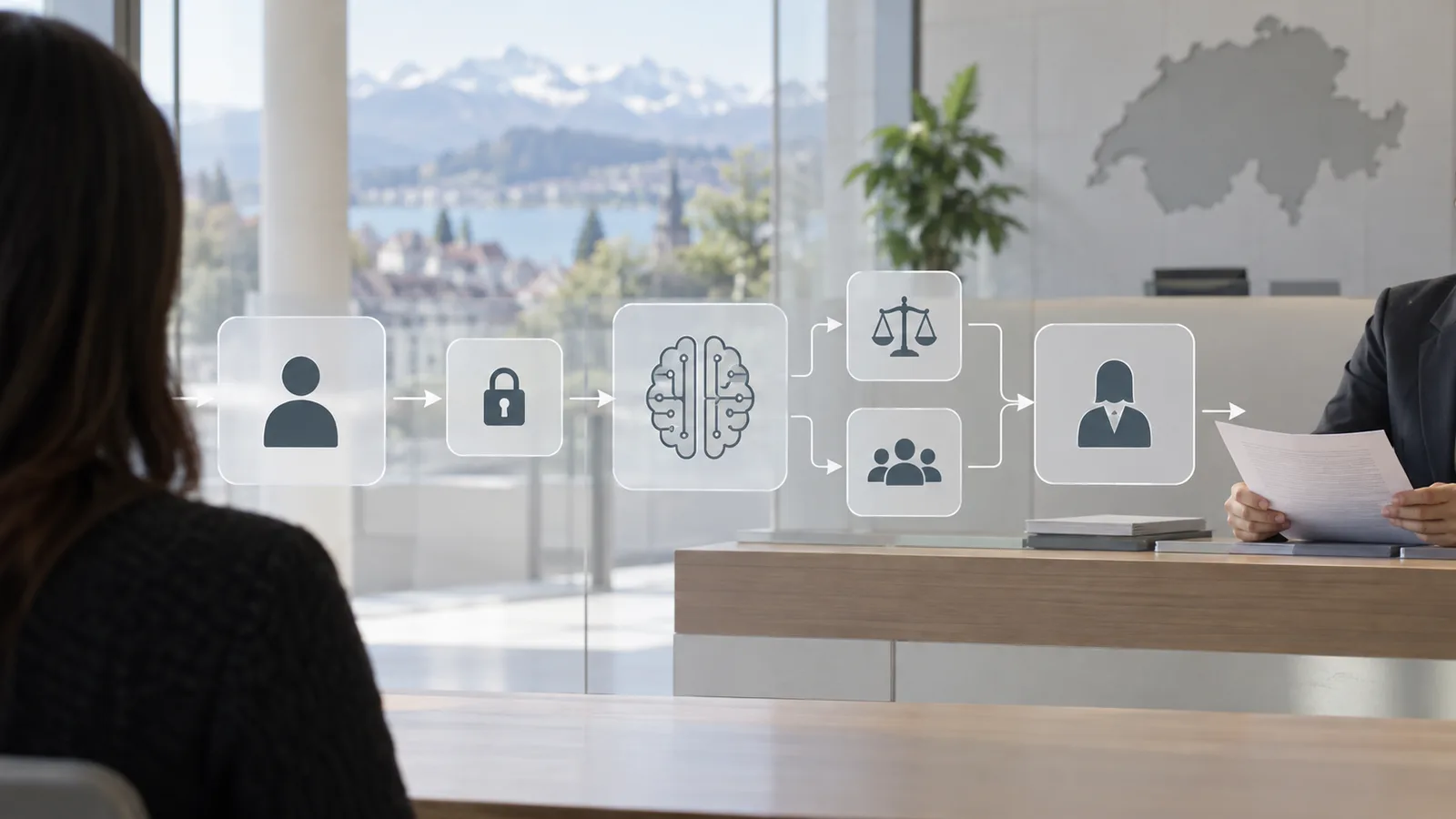
AI in everyday life: How human rights protect against algorithms
Switzerland has pointed to risks such as discrimination and deepfakes at the UN Human Rights Council. What will be decisive is whether those affected can be informed in everyday life, lodge an objection and demand a human review.
A job application is pre-sorted, a credit score estimated, a video judged to be real or manipulated: artificial intelligence has long ceased to be a topic only for research labs. It intervenes in decisions that can influence access to work, housing, credit or information. That is precisely why Switzerland put the risks and opportunities of AI at the centre of the most recent session of the UN Human Rights Council. The decisive question is now no longer merely whether algorithms are permitted. It is: what can an affected person do when an automated system disadvantages them?
The Swiss position at the Human Rights Council names concrete risks: deepfakes and online harassment, intrusions into privacy and discrimination, for instance in human resources or in the allocation of housing. This is not a forecast that every AI system causes such harm. It is a call to recognise risks in each field of use before they become entrenched.
Swiss law does not start from zero
The Data Protection Act is technology-neutral. It therefore also applies when data is processed with AI. Article 21 is particularly important for automated individual decisions: if exclusively automated data processing leads to a decision with a significant impact on a person, that person must in principle be informed. They can set out their position and demand a review by a human being.
For those affected, this distinction can determine whether they can exercise their rights in practice.

That is concrete protection, but not a blanket green light or a blanket ban for AI. Not every software recommendation is automatically an «automated individual decision» in the legal sense. What matters is whether a judgment or decision about a person is actually made without human involvement and whether a significant disadvantage can arise from it. Exceptions also exist, for example where a person has given explicit consent or where a contract is performed entirely automatically in their favour.
For Swiss citizens and residents this leads to a simple practical point: anyone who receives an unexpected automatic rejection should ask whether an automated individual decision was involved, what data was processed and how a human review can be requested. That does not solve every problem. But it does not shift the burden of proof and explanation entirely onto the person affected.
From technical function to responsibility
The Federal Data Protection and Information Commissioner stresses that high-risk AI may require a data protection impact assessment. Companies and authorities therefore do not have to address risks to privacy and informational self-determination only after a complaint. They must take them into account already when developing, purchasing and deploying a system.
This concerns more than lines of code. Training data can carry over biases. An easy-to-understand user interface can obscure the fact that an algorithm is deciding. And a formal complaints body helps little if no one can explain which factors were relevant in a specific case. Responsibility therefore lies with the organisations that select and use a system – not with the machine.
The federal government has set out for the federal administration that employees may and should use AI, but that information security and data protection must be upheld. At the same time, responsibility for the content produced remains with the human being. For private providers this is not a one-to-one rule. As a guiding principle it is nonetheless relevant: automation must not be an excuse for handing over responsibility.
International rules, national implementation
Switzerland has signed the Council of Europe framework convention on AI, human rights, democracy and the rule of law. The convention requires, among other things, transparency, oversight, accountability, data protection and non-discrimination. It also obliges states to carry out risk and impact assessments and provides for procedural guarantees where AI can significantly affect fundamental rights.
A signature, however, does not replace implementation. The Federal Council has commissioned a consultation draft for ratification by the end of 2026. Whether and how individual obligations will be specified in Swiss law therefore remains open. That is an important difference between a political commitment and an applicable rule.
Quality shows itself in a dispute
AI does not become compatible with human rights by being called «ethical». What matters is whether a person learns when they are interacting with a system, whether they can challenge an adverse decision and whether a responsible human being remains in charge. For Switzerland this is also a question of standing as a business location: trust in digital services does not arise from as few rules as possible, but from rules that work in a concrete dispute.
Sources
- FDFA: Effects of artificial intelligence on human rights, 7 October 2026
- FDPIC: AI and data protection
- FDPIC: Rights in automated individual decisions
- Federal Office of Justice: Artificial intelligence
- Federal Chancellery: Use of AI in the federal administration
- Council of Europe: Framework Convention on Artificial Intelligence, Human Rights, Democracy and the Rule of Law


