AI Layoffs at Insurers? What the Facts Really Show
Raiffeisen announces job cuts, Swiss Life considers savings – but a direct link to AI is unconfirmed. An analysis of the labor market implications.
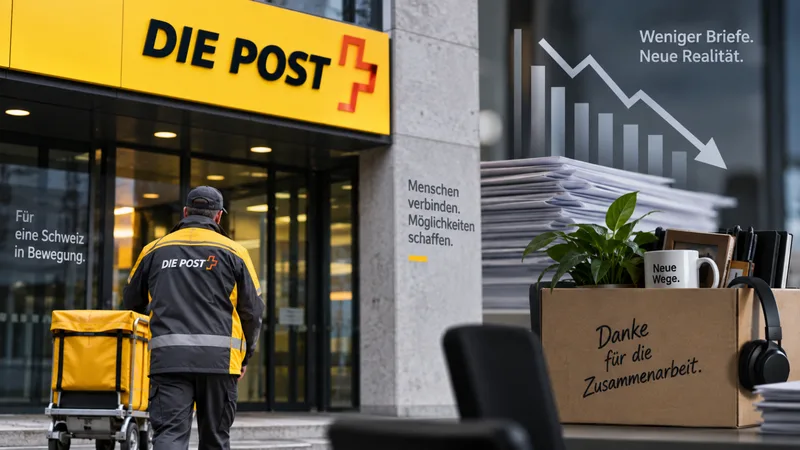
Raiffeisen Schweiz announced on August 26, 2026, plans to cut up to 180 jobs. While public discussion often links this to Artificial Intelligence, the bank cites efficiency and cost reduction, not machines, as reasons.
Despite a 659.3 million Swiss franc profit in the first half of 2026, Raiffeisen plans a 60 million franc savings program and reorganization. Job cuts will occur via natural attrition, unfilled roles, reduced external staff, and early retirements. Gabriel Brenna, CEO of Raiffeisen Schweiz, stated: "Our business developed very successfully, expanding volume and significantly increasing both interest and commission income."
Raiffeisen Saves Without Mentioning AI
Raiffeisen's official statement omits "Artificial Intelligence," instead citing a leaner organization and lower costs. This highlights that not all restructuring is AI-driven. While automation grows in finance, decisions often follow business goals, not solely technology.
Swiss Life also indicates cost-cutting. Media reports from March 2026 revealed an internal savings program, with McKinsey reviewing back-office processes. While a job cut announcement date is unknown, Swiss Life faces cost pressure. AI's role remains unconfirmed.
What is Really Proven – and What Isn't
Social media and press claims regarding AI use, such as Swica and Generali employing it in telephone customer service or AI answering emails at a Swiss insurer, lack verification. The editorial team found no evidence. Such reports require caution.
AI will undoubtedly transform the labor market. An Angestellte Schweiz study indicates 28% of Swiss jobs (around 850,000 positions) are significantly impacted by AI, especially administrative and office roles, including those in banking and insurance. The study stresses that AI primarily transforms job profiles, requiring new skills, rather than automatically leading to layoffs.
AI Changes Work, Not Necessarily Staff Numbers
Marco Huwiler, Head of Accenture Schweiz, comments: "In specific areas, this will happen. For example, call center employees are already heavily supported and sometimes replaced by AI." This assessment aligns with the study. The Swiss labor market will see fewer routine tasks but new roles, with the shortage of skilled workers remaining a challenge, particularly in technical fields.
Further training is therefore crucial. An Accenture survey shows a wide gap: 94% of executives see their companies as AI-ready, but only 27% of employees agree. This disparity must be reduced. Companies must prepare their workforce for new demands, preventing a divide between those benefiting from AI and those displaced.
The insurance industry is highly susceptible to automation, with standardized processes from claims to customer service. While companies focus on these areas, job cut decisions are not solely technology-driven. Swiss social partnership and dismissal protection are crucial, requiring careful communication even from cooperative-based firms like Raiffeisen.
For insurers, Raiffeisen's and Swiss Life's job reductions stem from concrete financial reasons. AI currently plays no driving role. The editorial team will monitor developments and report on specific decisions. Until then, an AI-driven layoff wave remains an unproven hypothesis.
Sources
- Donnerschlag bei Raiffeisen: Massen-Entlassung – Inside Paradeplatz (Secondary source, 2026-08-26, researched on 2026-08-30)
- Raiffeisen legt guten Abschluss vor und kündigt Stellenabbau an (Secondary source, 2026-08-26, researched on 2026-08-30)
- Veränderungen in der Organisationsstruktur von Raiffeisen Schweiz (Primary source, 2026-08-26, researched on 2026-08-30)
- Raiffeisen Schweiz baut bis zu 180 Stellen ab - News - SRF (Secondary source, 2026-08-26, researched on 2026-08-30)
- Swiss Life setzt Job-Messer an: Vollbremsung im Backoffice – Inside Paradeplatz (Secondary source, 2026-03-13, researched on 2026-08-30)
- Künstliche Intelligenz und Jobs: Vernichtet KI Arbeitsplätze? - 20 Minuten (Secondary source, 2026-01-24, researched on 2026-08-30)
- Studie zeigt: Ein Viertel der Arbeitsplätze von KI betroffen - News - SRF (Secondary source, 2026-06-17, researched on 2026-08-30)
- KI und Stellenabbau: Vorsicht und Konzepte sind gefragt (Secondary source, 2026-08-24, researched on 2026-08-30)