Electricity Prices Decline, Consumption Rises Again
Swiss electricity becomes cheaper, but consumption levels are increasing.
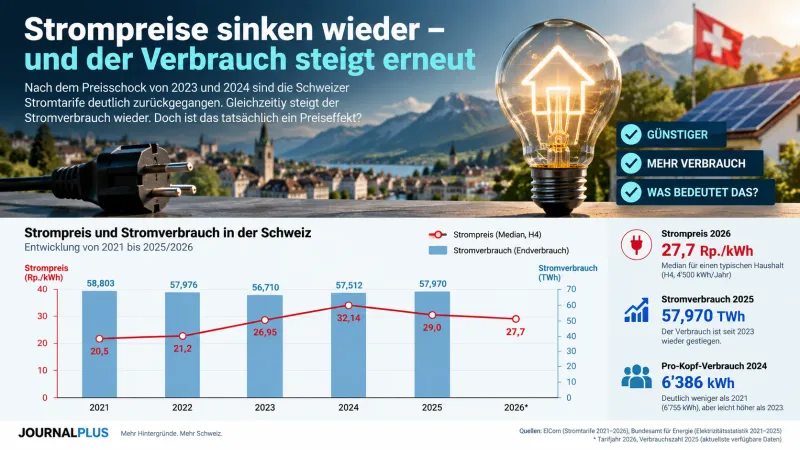
Swiss electricity prices have shown a notable development in recent years. After a period of relatively stable tariffs, a sharp price increase began in 2023. In 2024, electricity tariffs for households reached a peak.
Since then, the situation has eased. Simultaneously, Swiss electricity statistics indicate that electricity consumption has also increased again after a decline. The two developments thus run partially parallel in terms of timing.
Major Price Jump Occurred in 2023
Tariff data published by the Swiss Federal Electricity Commission (ElCom) illustrates the significant change in electricity costs. For a typical H4 category household with an annual consumption of 4500 kilowatt-hours, the median tariff in 2022 was 21.2 Swiss cents per kilowatt-hour.
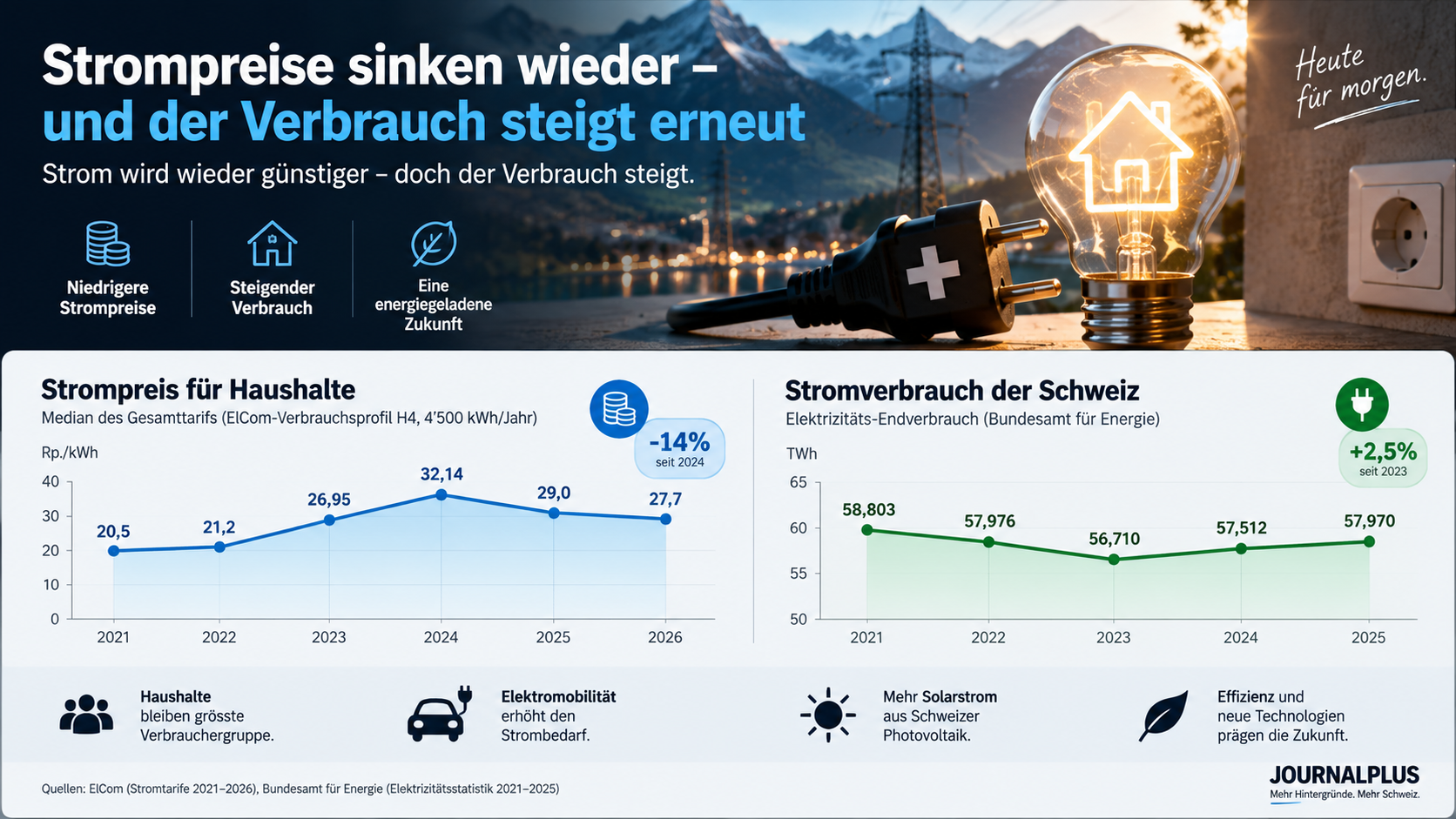
In 2023, this value rose to 26.95 Swiss cents. 2024 saw another sharp increase to 32.14 Swiss cents per kilowatt-hour.
For a household with an annual consumption of 4500 kilowatt-hours, this meant a significant rise in the yearly electricity bill. The price surge primarily resulted from high procurement costs in energy markets.
Prices Trending Downward Since 2025
The 2024 peak was not sustained, however. In 2025, the median tariff decreased to 29.0 Swiss cents per kilowatt-hour. For 2026, ElCom reports a median of 27.7 Swiss cents.
A typical H4 household will thus pay an estimated 1247 Swiss francs per year in 2026. This is about 58 Swiss francs less than the previous year, and approximately 199 Swiss francs less than the 2024 peak.
However, this represents a Switzerland-wide median. The actual electricity bill depends on the place of residence and the responsible grid operator. Switzerland has approximately 590 grid operators, with tariffs that sometimes differ significantly.
Electricity Consumption Also Changed
The development becomes interesting when looking at actual electricity consumption. According to the Federal Office of Energy, final consumption in 2021 was 58.803 Terawatt-hours.
Consumption then initially decreased:
- 2021: 58.803 TWh
- 2022: 57.976 TWh
- 2023: 56.710 TWh
- 2024: 57.512 TWh
- 2025: 57.970 TWh
Thus, 2025 consumption remains below the 2021 level. However, there is no continuous decline. After the 2023 low point, electricity consumption has risen for two consecutive years.
Cheaper Electricity, Higher Consumption?
This is precisely where the development becomes interesting. The most expensive electricity tariffs were in 2024. In the same year, electricity consumption began to rise again. The increase continued in 2025, while tariffs simultaneously decreased significantly.
This could indicate that high prices triggered at least some of the consumption decline. Households and businesses might have used electricity more sparingly or postponed energy-intensive activities due to higher costs.
However, statistics alone do not prove this correlation. Too many other factors play a role.
Efficiency and Economy Also Play a Role
Electricity consumption is not solely dependent on price. Important factors include, for example, more efficient appliances, energy-efficient renovations, changes in the industrial and service sectors, and weather conditions.
Concurrently, the structure of electricity consumption is changing. The expansion of electromobility, for instance, increases electricity demand. In 2025, approximately 1.414 Terawatt-hours of electricity were used for electromobility in Switzerland, including non-public vehicles. In 2024, this figure was 1.111 Terawatt-hours.
Photovoltaics are also growing strongly. In 2025, Switzerland produced approximately 7.95 Terawatt-hours of solar power. However, more self-generated electricity does not automatically mean less electricity consumption.
Per Capita Consumption Lower Than 2021
A look at per capita consumption also reveals a long-term change. In 2021, the average electricity consumption per inhabitant was approximately 6755 kilowatt-hours. In 2022, it was 6605, and in 2023, 6380 kilowatt-hours.
In 2024, the value slightly increased to 6386 kilowatt-hours. This indicates that while consumption is significantly lower than in 2021, the decline is not linear.
What the Figures Actually Show
The data reveals a clear trend: electricity tariffs rose sharply after 2021, reached their peak in 2024, and then decreased again. Simultaneously, electricity consumption fell until 2023 and subsequently increased.
The temporal pattern is striking. However, it would be too simplistic to conclude that electricity prices alone are responsible for this development.
Instead, it is clear: Switzerland consumes less electricity today than in 2021, even though consumption has been growing again since 2023. Simultaneously, electricity tariffs have significantly decreased after the price shock.
Price Remains Crucial for Households
For consumers, this development initially means relief. A typical household will pay less for electricity in 2026, based on the median, than at the 2024 peak.
However, whether lower prices will genuinely lead to significantly increased electricity consumption in the future can only be assessed over a longer period.
Therefore, the crucial question is not only whether electricity becomes cheaper or more expensive. It also concerns how energy efficiency, electromobility, heat pumps, economic development, and the expansion of renewable energies collectively impact Swiss electricity consumption.
Conclusion
Swiss electricity prices have significantly decreased following the sharp rise in 2023 and 2024. Concurrently, electricity consumption has been increasing again since 2023.
However, the figures do not prove a direct cause-and-effect relationship between price and consumption. Instead, they reveal an interesting pattern: electricity is cheaper again – and Switzerland is consuming more. Whether this is coincidental, a reaction to prices, or the result of multiple factors will only become clear with further data.
Sources
Swiss Federal Electricity Commission (ElCom): Electricity Tariffs and Tariff Data 2022–2026 Federal Office of Energy (BFE): Swiss Electricity Statistics 2021–2025 Federal Office of Energy (BFE): Total Energy Statistics and Data on Electromobility and Photovoltaics