ETH Zurich’s LIFE project: How it could search for alien life
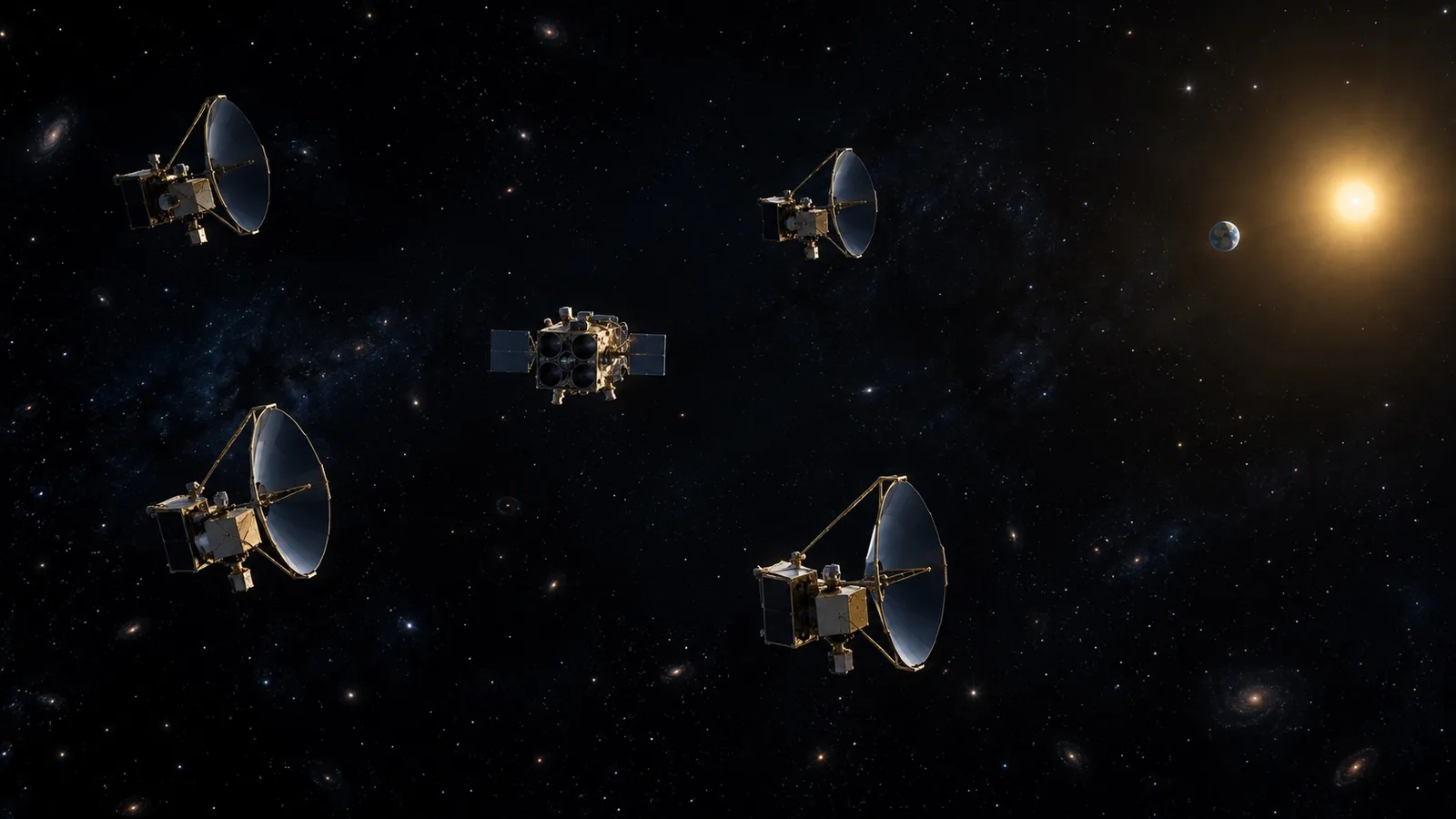
Four collector telescopes and a central combiner would suppress the light of distant stars to analyse the atmospheres of Earth-like planets. But LIFE has not yet been approved.
One of astronomy’s biggest questions may be answered by a faint heat signal: radiation from a small planet orbiting a nearby star. The ETH Zurich-led LIFE initiative aims to capture such a signal and split it into a spectrum. Researchers could then investigate whether the planet has an atmosphere, whether liquid water might be possible and whether several chemical clues together point to biological activity.
That capability does not exist yet. LIFE—short for “Large Interferometer for Exoplanets”—is an international mission concept and technology programme, not a mission that the European Space Agency (ESA) has already selected or funded. The distinction matters: the science case is concrete and key components are being tested, but construction and launch have not been approved.
Five spacecraft would form one virtual telescope
LIFE’s baseline design uses four free-flying collector telescopes separated by tens to hundreds of metres. A fifth spacecraft at the centre would combine their light. Working as a formation, the five satellites would provide the resolving power of a much larger virtual telescope.
The observatory is designed for the mid-infrared, roughly 4 to 18.5 micrometres. Temperate planets emit much of their detectable thermal radiation at these wavelengths, while molecules leave characteristic absorption features. A spectrum could therefore reveal information about a planet’s temperature, surface conditions and atmospheric composition.
The main targets would be nearby rocky worlds roughly comparable in size and temperature to Earth. “Earth-like” does not automatically mean habitable—and certainly not inhabited. LIFE would first measure the physical and chemical conditions on those planets.
The key technique: cancelling the star’s light
The central problem is contrast. Even a nearby Earth-sized planet is extraordinarily faint beside its star. LIFE therefore relies on nulling interferometry. In the combiner spacecraft, the light waves collected by the four telescopes would be shifted so that the on-axis starlight largely cancels itself through destructive interference. Light from a planet at a slight angular offset would arrive with a different phase and remain partly detectable.
Put simply, the instrument would create an artificial blind spot at the position of the bright star. Only then could the much weaker thermal signal from a planet emerge. Achieving this requires the spacecraft to hold a precise formation and the optical path lengths to remain stable to tiny fractions of a wavelength.

A test with Earth data provides a reality check
A team from ETH Zurich and the University of Zurich tested whether the proposed method could recognise a habitable world by using the only inhabited planet we know: Earth. For a 2024 study in The Astrophysical Journal, the researchers used real measurements from NASA’s Aqua Earth-observation satellite. They converted the data into an averaged infrared spectrum resembling what LIFE might receive from a “second Earth” about 30 light-years away.
Their analysis recovered carbon dioxide, water, ozone and methane, along with surface conditions compatible with liquid water. The result was robust across different viewing geometries. The test also exposed a limitation: seasonal changes were difficult to detect at the simulated data quality.
This does not prove that LIFE will be built, nor that every inhabited world would be recognised unambiguously. It does show that simulated LIFE observations based on real Earth data can retrieve essential properties of our planet.
NICE shows both the progress and the remaining gap
The next question is whether the required starlight suppression can be achieved with sufficient stability and sensitivity. ETH Zurich is addressing this with the NICE test bench—the “Nulling Interferometry Cryogenic Experiment”. Its long-term operating target is 15 kelvin, about minus 258 degrees Celsius. Cooling the instrument reduces its own unwanted thermal radiation.
ETH’s current project page reports an instantaneous null depth of about 2 × 10⁻⁵ and a one-minute average of roughly 5 × 10⁻⁵. The smaller the number, the more completely the starlight is suppressed. The target is below 10⁻⁵, with optical path-length stability better than one nanometre.
Those figures mark an interim result, not a completed demonstration of a flight-ready instrument. The remaining work includes improving optical throughput, suppressing both polarisation states simultaneously, operating over a broad wavelength range, closing the control loop for beam positioning, injecting a realistic planet signal and moving to cryogenic operation. ETH is also studying integrated photonic chips that could replace some of the bulkier optical components.
Why LIFE would complement today’s telescopes
The James Webb Space Telescope can already study some exoplanet atmospheres spectroscopically, often when a planet transits in front of its star. Small, cool rocky planets around Sun-like stars are particularly difficult targets for that method.
LIFE would take a different route by measuring the direct thermal emission of nearby planets in the mid-infrared. It would therefore complement rather than replace Webb, the Extremely Large Telescope and future observatories. Other instruments could identify promising planets and constrain their orbits; LIFE could then compare the atmospheres and surface conditions of dozens of nearby worlds.
A biosignature is not proof of life
Water, carbon dioxide, ozone and methane are scientifically important, but no single molecule proves the existence of extraterrestrial life. Gases may also be produced by geological, photochemical or other non-biological processes. Conversely, an inhabited planet might have signatures too weak to measure from far away.
Astrobiologists therefore look for several mutually consistent clues: combinations of molecules in chemical disequilibrium, plausible temperatures and pressures, the possible presence of liquid water and the radiation environment created by the host star. Even a spectacular candidate would require repeat observations, atmospheric modelling and confirmation by independent instruments.
The 2040 date is a goal, not a launch promise
ETH Zurich cites 2040 as a planning target for LIFE. It is not a binding launch date. In its Voyage 2050 programme, ESA identified the direct mid-infrared characterisation of temperate exoplanets as an especially valuable scientific theme. ESA has not, however, selected LIFE as the mission that will implement that theme.
Before launch could become realistic, the partners would need to reduce the technical risks, master formation flying, secure funding and succeed in a formal mission-selection process. The sober assessment is therefore: LIFE is scientifically compelling and technically becoming more tangible, but it remains a long way from the launch pad.
What the search is already changing
LIFE’s value would not depend solely on a positive detection. A sufficiently large survey that found no convincing biosignatures could still show how rare certain atmospheric conditions are. The question “Are we alone?” would become measurable not through one dramatic picture, but through spectra, comparison samples and probabilities.
Whether LIFE will ever detect signs of biological activity remains open. What is already remarkable is that ETH Zurich and its partners are turning a centuries-old question into a concrete measurement programme. For now, the crucial advance is not the discovery of life, but a clearer definition of what convincing evidence would have to look like.
Sources and further reading
- LIFE Initiative: mission concept and technology
- ETH Zurich: NICE—Nulling Interferometry Cryogenic Experiment
- Mettler et al. (2024): “Earth as an Exoplanet. III”
- ETH Zurich: “The quest to explore space”
- ESA: Voyage 2050 science themes
- NASA: limits and validation of potential biosignatures
Research status: 9 September 2026. Technical performance figures may change as work on the NICE test bench progresses.