Palantir Co-founder Funds Space Research in Switzerland
Nathan Gettings Supports ETH and EPFL Projects Through His Chiwi Foundation
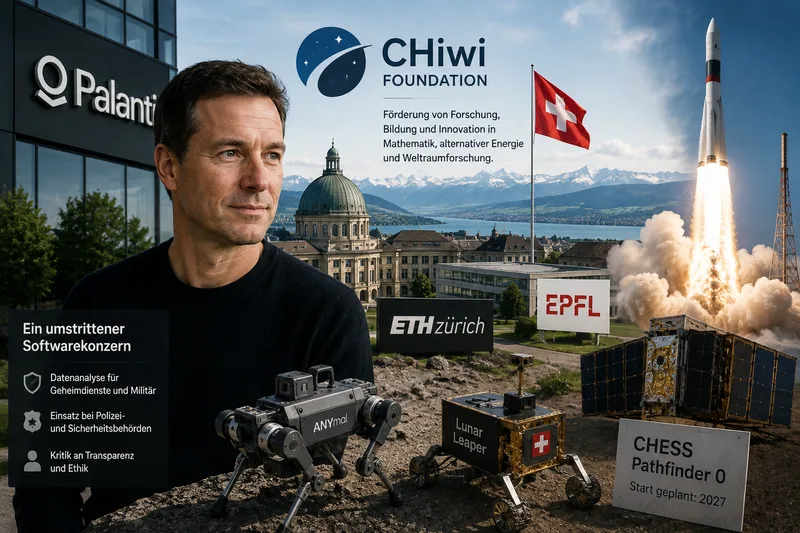
Palantir Co-founder Funds Space Research at Swiss Universities
Palantir co-founder Nathan Gettings has lived in Switzerland for several years, supporting research projects at ETH Zurich and EPFL through his CHiwi Foundation. The foundation funds, among other things, a lunar robot, satellites, and quadrupedal robots for challenging terrain. A "Republik" investigation offers the first detailed insight into the activities of the largely reclusive entrepreneur.
A Discreet Tech Entrepreneur
Nathan Gettings is one of the five co-founders of the US software company Palantir. The company develops systems for integrating and analyzing large amounts of data, working with authorities, security organizations, and the military, among others.
Gettings was instrumental in Palantir's early technical development. According to "Republik," he developed initial prototypes that gave the young company access to US defense and intelligence circles. His technical work includes the concept of mapping different data sources into a linked digital model. This so-called ontology concept later formed an important basis for Palantir's platforms.
Gettings is also considered one of the company's most discreet founders. Public appearances and personal statements are rare. The exact date he left Palantir cannot be definitively determined: various sources cite 2012 or 2016.
While at Palantir, Gettings co-founded the robotics company Robotex with his brother Adam. In 2012, he also co-founded the fintech company Affirm with Max Levchin.
In Switzerland Since 2021
According to registry data evaluated by "Republik," Gettings lives in Hergiswil in the canton of Nidwalden. The Maltese national has reportedly resided there since 2021. The CHiwi Foundation, however, is based in Zug.
The foundation was established in 2022. According to the commercial register, its purpose is to promote research, education, and innovation in space exploration, alternative energies, and advanced mathematics. It can conduct projects itself or support third parties and other organizations.
Gettings chairs the foundation as President of its Board. Other members include astrophysicist Stephen Myers, former CERN Director for Accelerators and Technology, and Daniel Bock, co-founder of the space company Morpheus Space.
Millions for Research? Known Contributions to Date
The foundation has already supported several projects at Swiss universities. The publicly known amounts to date are in some cases significantly higher than the original JournalPlus article suggested.
At EPFL, a student team for rockets and liquid-propellant engines received 10,000 Swiss francs in funding in 2025. According to EPFL, this support was not extended in 2025.
Another project at EPFL received 100,000 Swiss francs in 2026. The team is working on small satellites for the Chess mission, which aims to investigate Earth's outer atmosphere. The launch is scheduled for 2027.
At ETH Zurich, CHiwi supported the development of a robot concept for exploring particularly challenging lunar regions, including lava tubes and underground cave systems, with 160,000 Swiss francs.
According to "Republik," an additional 260,000 Swiss francs are going into a two-year fellowship. This fellowship involves developing quadrupedal robots capable of navigating difficult terrain and industrial facilities.
Thus, the specifically mentioned grants in the investigation total at least 530,000 Swiss francs. Not all of the foundation's activities may be covered by this; CHiwi also supports projects outside Switzerland, according to its own statements.
Unconventional Access to Research Funding
The foundation employs a comparatively unconventional approach in allocating its funds. Researchers can apply with topics including gravitational waves, physical cosmology, or alternative theories of dark matter and dark energy.
Unlike traditional research grants, the application process requires relatively few formal details about an applicant's academic career, according to "Republik." Instead, applicants' LinkedIn profiles are requested, among other things.
The foundation justifies this approach with its openness to ambitious and unconventional research ideas. Prerequisites include a credible scientific basis and a comprehensible justification for the potential scientific contribution.
ETH and EPFL Reviewed the Foundation
However, the founder's connection to the controversial technology sector raises questions. Palantir is highly controversial internationally due to its collaboration with government agencies, militaries, and security organizations. Political statements by individual Palantir co-founders have also repeatedly sparked controversy.
ETH Zurich and EPFL stated to "Republik" that they had reviewed the foundation before accepting the funding.
EPFL refers to a standard due diligence process, as is carried out for such grants. This review led to a positive assessment.
ETH Zurich also confirmed that both the professional background and potential political affiliations of the individuals involved were considered. The foundation was reviewed as part of the standard due diligence procedures.
Why Gettings Lives in Switzerland Remains Largely Unclear
Why the Palantir co-founder chose to settle in Switzerland is only partially clear to the public. A foundation representative told "Republik" that Gettings values Switzerland's discretion and innovative strength and wishes to give back through his foundation.
Gettings himself does not publicly comment on his motives. There is also no extensive public statement regarding the political significance of his foundation or his current relationship with Palantir.
The CHiwi Foundation emphasizes its philanthropic orientation. Its official purpose includes research, education, and innovation. The foundation states on its website that it aims to promote knowledge in advanced mathematics, alternative energies, and space research.
Between Philanthropy and Transparency
This case highlights a tension that is increasingly important for universities: private foundations can fund research for which public resources are scarce. At the same time, questions arise about the interests behind such funding and the transparency of the money's origin and decision-making processes.
In CHiwi's case, ETH Zurich and EPFL reportedly conducted reviews. The funding amounts known to date also indicate that these are not merely symbolic contributions. Particularly the 260,000 Swiss francs for the robotics fellowship and the 160,000 Swiss francs for the lunar robot project represent substantial research contributions.
At the same time, this does not automatically imply the founder's influence on the research. The current investigation does not provide concrete evidence of such influence.
A New Private Funding Source for Swiss Space Research
For the Swiss university landscape, CHiwi is primarily one thing: an additional private funding source for technically demanding research projects. The promotion of satellites, robotics, and lunar research particularly aligns with the foundation's stated focus.
However, the founder's background ensures that the activities are observed more closely. Nathan Gettings comes from a company whose technology is used in government and military applications and whose business practices are internationally controversial.
To date, primarily CHiwi's philanthropic side is publicly documented. How the foundation develops long-term, which projects it will support in the future, and whether it expands its scientific focus will therefore remain interesting for Swiss universities and the public debate on private research funding.