First Positrons Generated for Future Circular Collider
Cern initiates next phase for planned LHC successor.
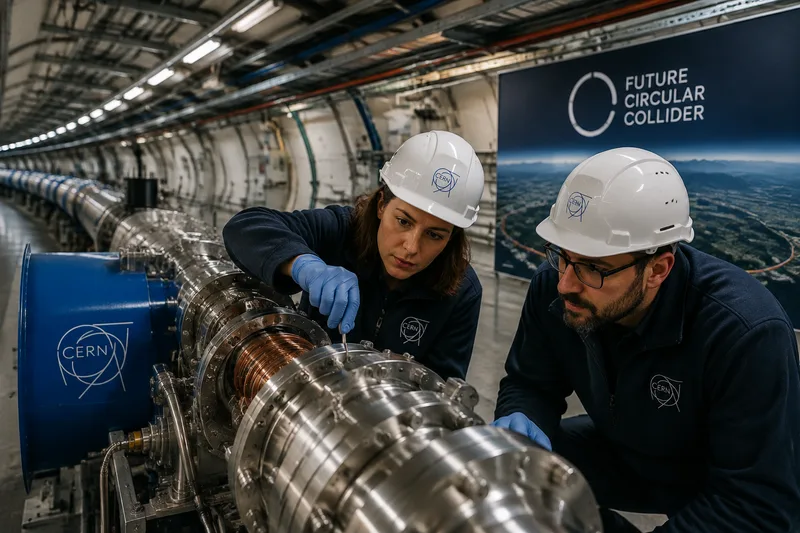
At Cern in Geneva, the first positrons were generated as part of the development for the planned Future Circular Collider (FCC). The research center calls this a significant step for the particle physics field.
A New Milestone for the FCC
The FCC will be built in two stages. First, an electron-positron collider is planned, enabling precise measurements of the Higgs boson. A proton-proton collider with even higher energy will follow later. The positrons now generated for the first time are central to the first stage.
Positrons are the antiparticles of electrons. In a future storage ring, they will collide with electrons. Researchers hope the collision data will provide answers to open questions in physics – such as the nature of dark matter.
A Project of Large Dimensions
The FCC would replace the LHC, which discovered the Higgs boson in 2012. The new ring is planned to have a circumference of about 91 kilometers. In comparison, the LHC measures 27 kilometers. Costs are estimated at several billion Swiss francs. Switzerland, as the host country of Cern, is directly affected.
Swiss universities and industry are involved from the outset. The Federal Council has repeatedly supported the FCC. At the same time, questions of financing and underground construction are under discussion. The cantons of Geneva and Vaud would benefit from the project.
What Positrons Mean for Physics
The first positrons provide technical proof. They show that the infrastructure for electron-positron collisions works. This will allow the Higgs boson and other particles to be measured with a precision currently unattainable with the LHC. This could open insights into new forces in the universe.
Years will pass until the FCC is fully operational. The official decision on its construction rests with the Cern member states. Further tests are planned until then. Today's step boosts the project – extending beyond Swiss research.