FMCH Demands Moratorium for TARDOC Upper Limit
Umbrella Organisation for Invasive Medicine Criticises Tariff Cap
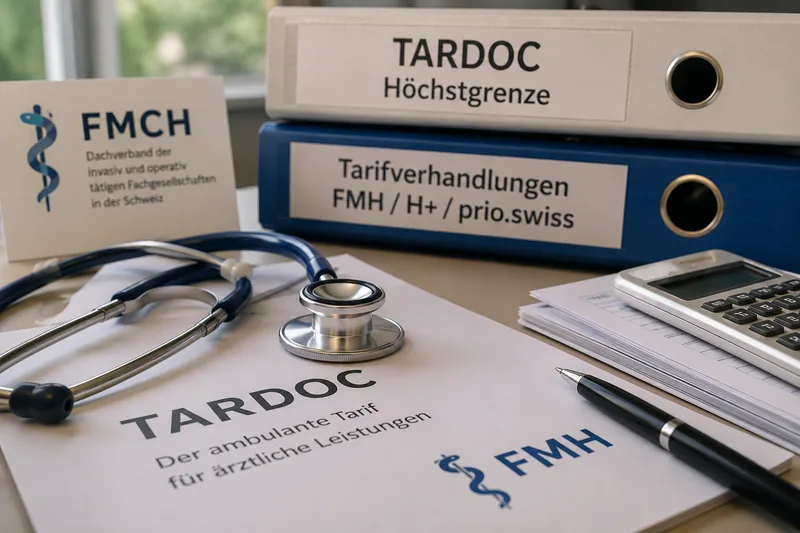
FMCH Medical Association Demands Moratorium for TARDOC Upper Limit
The discussion about the upper limit for medical services in the TARDOC outpatient tariff is intensifying. The FMCH umbrella organisation demands that new flat-rate limits only be implemented after the tariff evaluation basis has been reviewed and the effects on various specialities investigated.
This demand comes from the presidents of the FMCH specialist societies, who met for a retreat in Bern at the end of August. According to the association, reliable data and an appropriate tariff are first needed. A cap must not cause medically sound services to come under pressure due to tariff misjudgements.
Upper Limit Stems from Parliamentary Mandate
The planned limit was not solely devised by the tariff partners. It originates from a political decision. As part of cost-reduction package 2, Parliament demanded an upper limit for the tax points of medical services billable per working day in the outpatient doctor's tariff.
The Bundesrat therefore requested the tariff partners FMH, H+, and prio.swiss to jointly develop a corresponding regulation. The three organisations submitted their concept to the Bundesrat on June 2, 2026, as part of tariff version 2027. The Bundesamt für Gesundheit is currently reviewing the proposal. A decision is expected in the fourth quarter of 2026, according to current information.
Therefore, the specific design of the upper limit is not yet fully finalised. While the legal basis is established, the approval of the submitted concept and its concrete implementation have not yet been definitively decided.
1,577 Tax Points as the Planned Upper Limit
According to the concept submitted by the tariff partners, the upper limit is 1,577 tax points for medical services (AL) per working day. However, it is not crucial whether a doctor exceeds this value on a single day.
The calculation is based on an average over a calendar month. For this, the sum of the relevant AL tax points is divided by the number of working days or relevant days in the respective month. This regulation aims to capture particularly high billing volumes that do not appear medically or temporally plausible.
The limit exclusively affects the medical portion of a TARDOC service. The infrastructure and personnel service portion (IPL) is not included. Also excluded are, among other things, outpatient flat rates, certain surcharges for emergencies and urgency, and services for reports and expert opinions.
FMCH First Demands Better Data
The FMCH's criticism focuses precisely on the question of the correct assessment basis. The association of invasively active specialist societies fears that a flat-rate upper limit insufficiently accounts for different medical activities.
According to the FMCH, it must first be clarified whether conspicuous billing volumes are indeed due to an excessively high number of services provided. Differences in tariff valuations or specific structures of individual specialities are also possible.
FMCH President Michele Genoni therefore warns against basing an upper limit on evaluation metrics that, from the association's perspective, still need to be reviewed. The association demands that the data from individual specialist societies be evaluated and the effects on care analysed.
Not All Specialities Are Affected Equally
This question is particularly relevant for specialities where many complex outpatient procedures are performed on a single working day. The FMCH represents 17 specialist societies of invasive medicine with approximately 8,000 doctors.
Therefore, a flat-rate limit can have different effects depending on the speciality. The FMH itself has now started evaluating billing data and identifying particularly affected specialities and practice constellations.
According to the FMH, the upper limit is expected to affect only a small portion of doctors. The ongoing data evaluation should reveal which specialities would actually be more impacted.
What Happens Upon Exceeding the Limit Remains Undecided
A central point has not yet been definitively clarified: exactly how an exceeding of the upper limit will be handled. The FMH notes that the specific procedure is currently still open.
Therefore, it cannot be stated at this time that services above the limit would automatically no longer be reimbursed. First, the Bundesrat must decide on the concept. After that, further questions of practical implementation need to be clarified.
FMCH Seeks Moratorium for Further Caps
The FMCH's demand extends beyond the specific TARDOC upper limit. The association fundamentally calls for a moratorium on new flat-rate caps and limits in the outpatient tariff.
New limits should only be introduced when open tariff questions are clarified, potential misvaluations corrected, and the consequences for individual specialities investigated. Cost control is necessary but must be based on reliable data.
Thus, the FMCH is not fundamentally opposed to controlling conspicuous billing. On the contrary: abuse must be controlled and consistently sanctioned. The dispute revolves instead around the question of whether a flat-rate upper limit is the appropriate instrument for this.
Bundesrat Reviews Tariff Partners' Concept
The Bundesrat therefore faces a difficult decision. On the one hand, the new tariff structure aims to prevent the billing of medically or temporally implausible service volumes via the individual service tariff. On the other hand, the regulation must not unnecessarily impair outpatient care.
The Bundesamt für Gesundheit is therefore examining the tariff partners' proposal, especially to determine whether it complies with the legal requirements for efficiency and fairness. A decision is expected in the fourth quarter of 2026, according to current information.
The discussion is therefore unlikely to be over. Even after approval, questions remain regarding practical implementation and the impact on individual specialities. The FMH plans to evaluate further data and, if necessary, introduce adjustments into the tariff partnership negotiations.
A Debate Between Cost Pressure and Provision of Care
The dispute over the TARDOC upper limit reveals a fundamental problem in Swiss health policy: costs must be limited, while outpatient care must remain efficient.
A flat-rate upper limit can be a tool against obviously excessive billing. However, it can also have undesirable effects if the differences between specialities and practices are not sufficiently considered. What the data actually shows will therefore be crucial.
For the Bundesrat, the coming months are not just about whether 1,577 tax points are the correct limit. It is also about whether the regulation in practice targets the cases for which it is intended – without hindering care where high service volumes are medically justified.
Sources
- Medinside: TARDOC Upper Limit: FMCH Demands Moratorium, August 27, 2026.
- Bundesamt für Gesundheit: Information on the Upper Limit for Billable Tax Points per Working Day, July 7, 2026.
- FMH: Upper Limit for Medical Services in TARDOC, updated August 2026.
- Bundesamt für Gesundheit: Outpatient Doctor Tariff TARDOC and Outpatient Flat Rates.