Food Initiative: What 70 Percent Self-Sufficiency Means for Switzerland
70 Percent Self-Sufficiency in Ten Years: The Initiative Aims to Fundamentally Change Agriculture and Food.
What Exactly Does 70 Percent Self-Sufficiency Mean?
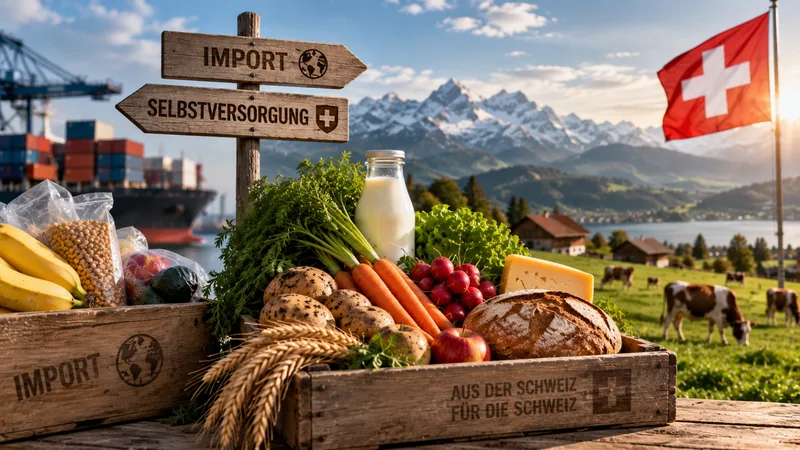
The number initially sounds simple: 70 percent of food consumed in Switzerland should come from domestic production. However, the calculation is not that straightforward.
The degree of self-sufficiency is not calculated based on the weight or quantity of food, but on its calorie content. The key factor is how much of the Swiss population's energy needs can be met by domestic agriculture.
Furthermore, a distinction is made between gross and net self-sufficiency rates. The net value considers that part of Swiss animal production relies on imported feed. The resulting food products are accounted for accordingly.
The net self-sufficiency rate averaged around 45 percent between 2022 and 2024. The initiative aims to increase this figure to at least 70 percent.
Why the Proponents Want More Plant-Based Foods
The central idea of the initiative is: The same agricultural area can feed more people if a larger portion of plants is used directly for human consumption instead of first feeding animals.
Therefore, more cereals, legumes, vegetables, and other plant-based foods should be produced in the future. At the same time, the production of meat, milk, and eggs should relatively decrease in importance.
However, the initiative does not mandate that Swiss farms must cultivate specific crops or that consumers must eat certain foods. Instead, it sets a goal and obliges the Confederation to create the appropriate framework conditions.
For the proponents, this is precisely the crucial point: current agriculture is too focused on production that partly depends on imported animal feed. More plant-based foods from Swiss soil could reduce dependence on foreign countries.
The Historical Comparison with World War II
One argument from opponents refers to history. Switzerland last achieved a net self-sufficiency rate of 70 percent during World War II.
At that time, around 4.5 million people lived in Switzerland. Today, there are significantly more. At the same time, part of the arable land has been lost.
Swiss Farmers' Association President Markus Ritter therefore considers the historical comparison problematic. From his perspective, the production level of the war years cannot simply be used as a goal for today's Switzerland.
Proponents, however, argue that agriculture has fundamentally changed since then. Higher yields, different cultivation methods, and especially a stronger focus on plant-based foods could alter the productivity of existing areas.
This is where the real dispute begins: Is Switzerland capable today, despite less land and more inhabitants, of significantly increasing its food supply from its own production?
Corn for Animals or Food for Humans?
A significant part of the debate revolves around the use of arable land. Proponents of the initiative point out that a large portion of arable land serves animal production directly or indirectly.
Their conclusion: If less fodder and more food for humans were grown on part of these areas, Switzerland could cover more of its food needs from its own production.
Examples include legumes like lentils, as well as vegetables and grains. From the proponents' perspective, it is therefore not necessarily about creating more agricultural land, but about which foods are produced on the existing land.
The Farmers' Association disputes this simplified representation. Not every area is suitable for arable farming. Furthermore, certain crops are part of crop rotation, and some fodder comes from meadows and areas that cannot easily be used for growing food.
Demand also plays a role: Swiss households continue to consume meat, dairy products, and eggs. Agriculture therefore produces a significant portion of what the market demands.
What Would Need to Change in the Diet?
This is precisely where the initiative becomes particularly far-reaching.
According to the Federal Council's assessment, a net self-sufficiency rate of 70 percent cannot be achieved solely through different land use. The composition of the Swiss diet would also have to change significantly.
The proportion of plant-based foods would have to increase, while the consumption of meat, milk, and eggs would have to decrease. Simultaneously, agricultural production would need to be adjusted accordingly.
The Federal Council therefore warns of significant state influence on agriculture and food. However, the specific instruments to be used after a 'yes' vote would only be decided during implementation. The initiative itself does not stipulate that the state would have to ban or ration the consumption of individual foods.
The crucial point: The 70 percent is not a goal that can be achieved solely through additional production. The calculation also depends on what Switzerland produces, how the land is used, and what foods the population consumes.
The Initiative Wants More Than Just Self-Sufficiency
The vote is therefore not solely about the number 70. The initiative links higher self-sufficiency with several other goals.
The Confederation should ensure that production becomes more sustainable, drinking water resources are protected, and soil fertility and biodiversity are maintained. Simultaneously, environmental targets for pesticides and fertilizers should be met.
This creates an additional conflict of goals: Agriculture should produce more food, but at the same time cause less environmental impact.
The proponents see no contradiction in this. A stronger plant-based production can be combined with more sustainable agriculture. The Federal Council, however, argues that combining these goals within just ten years would be very demanding.
Why the Federal Council and Parliament Say No
The Federal Council and Parliament reject the initiative. While the Federal Council acknowledges the concerns of the proposal – particularly stronger food security and more sustainable agriculture – it deems the combination of goals and the ten-year deadline unrealistic.
According to the government's assessment, profound changes in agricultural production, food processing, and consumption would be necessary. At the same time, existing agricultural investments would need to be considered.
A rapid transition could also incur additional costs. The Federal Council estimates that the Confederation would have to financially support agricultural businesses to ensure the necessary transition is socially acceptable.
Instead of an abrupt change of course, the Federal Council advocates a gradual evolution of agricultural policy. It aims to increase the net self-sufficiency rate in the long term while simultaneously reducing the environmental impact of agriculture.
Proponents See This As The Very Problem
The initiative committee considers previous steps insufficient. From their perspective, Switzerland is too dependent on imports and thus vulnerable to international crises, disrupted supply chains, and rising food prices.
Higher domestic production should therefore not mean that Switzerland becomes completely independent from foreign countries. Rather, the aim is to reduce dependence and make supply more resilient in times of crisis.
Proponents also link this to the protection of natural resources. Fertile soils, clean drinking water, and biodiversity are prerequisites for Switzerland to be able to produce food in the long term.
Agriculture Itself Is Divided
Agriculture does not speak with one voice. The Swiss Farmers' Association opposes the initiative and leads the 'no' campaign. It considers the 70 percent target within ten years unrealistic.
At the same time, individual farmers support the proposal. Bio Suisse and the Small Farmers' Association have decided on a free vote, thus recommending neither a 'yes' nor a 'no'.
Other producer organizations reject the initiative. The conflict therefore extends beyond agriculture and environmental organizations. It also concerns the question of how agriculture itself should develop in the coming decades.
What a 'Yes' Vote Would Specifically Change
A 'yes' vote would first amend the Federal Constitution. The Confederation would then have to adjust the legal and agricultural policy framework conditions so that the net self-sufficiency rate increases to at least 70 percent within ten years.
For this, politicians would have to decide which instruments to use to achieve the goal. Possible changes include direct payments, production incentives, research, advisory services, processing, and sales promotion. The promotion of plant-based foods could also play a larger role.
However, the initiative does not prescribe every single instrument. The extent to which the state would actually have to intervene would therefore only become clear with subsequent legislation.
What is certain, however, is that a 'yes' would not be a minor change of course. Agriculture, food processing, and consumption would have to focus much more strongly on domestic supply within a relatively short period.
The Decisive Question Is Not Just: Can We Do It?
The vote cannot therefore be reduced to the question of whether 70 percent is technically possible.
Crucially, it is also about what price Switzerland would be willing to pay for this goal.
Stronger domestic production could reduce dependence on imports. However, it could simultaneously incur higher production costs, thus impacting food prices and federal expenditures.
A stronger plant-based focus could increase calorie production per area. However, it would also change the current structure of animal husbandry and parts of the food industry.
And a rapid restructuring could pose significant investment and adaptation challenges for agriculture.
70 Percent Is Therefore Primarily a Political Decision
On September 27, Switzerland does not have to vote on whether food security is important. Proponents and opponents largely agree on this.
The actual decision is: How much more self-sufficiency does Switzerland want – and how quickly should it achieve this goal?
Proponents say: Dependence on foreign countries is too great, and agriculture must be more focused on feeding the population. The necessary restructuring is possible and sensible given crises and climate change.
Opponents say: Food security is already a goal of Swiss agricultural policy. However, a jump from around 45 to at least 70 percent within ten years goes too far and requires too much intervention in production and consumption.
Ultimately, It Is About How Much Self-Sufficiency Switzerland Wants
The Food Initiative poses a fundamental question: Should Switzerland orient its agriculture more strongly towards producing as many calories as possible domestically for its own population – even if this requires significant changes to production, consumption, and agricultural policy?
The starting point is clear: The net self-sufficiency rate is around 45 percent. The targeted goal of 70 percent would be a significant leap. That a stronger plant-based focus can increase food security is the central approach of the proponents. Whether this transformation is realistic and economically viable within ten years, however, is the core of the political dispute.
On September 27, Switzerland will therefore not only decide on a number. It will decide on the future importance of its own food production – and to what extent the state should intervene in agriculture and food for this purpose.
Sources
- Federal Chancellery: Explanations of the Food Initiative, Vote of September 27, 2026
- Federal Council: Federal Council Rejects Food Initiative, August 11, 2026
- Federal Office for Agriculture (FOAG): Food Initiative Dossier
- SRF: "Food Initiative – Self-Sufficiency Rate: Calories Determine the Value", August 12, 2026
- SRF: "Food Initiative – What Should Grow on Swiss Fields?", September 7, 2026