France Before the 2027 Presidential Election: Who Follows Macron?
New Candidates, New Perspectives – Switzerland Follows the Race
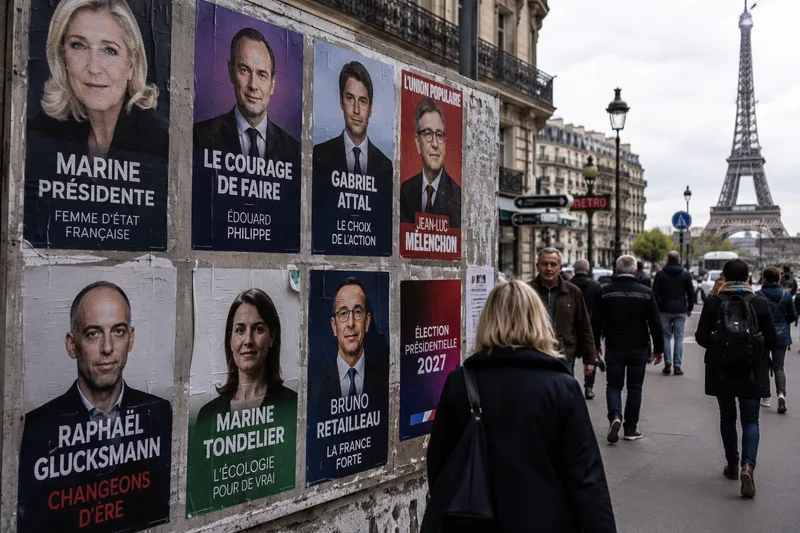
France is preparing for a presidential election without Emmanuel Macron. The incumbent president cannot run again after two terms. The first major political exchange at the end of August already showed what the 2027 election campaign will likely be about: France's high national debt, the future of pensions, economic growth, and the country's political direction.
On Thursday evening, seven promising politicians met for a debate hosted by the French employers' association MEDEF. Among them were Marine Le Pen from Rassemblement National, former Prime Minister Édouard Philippe, former Prime Minister Gabriel Attal, the left-wing populist Jean-Luc Mélenchon, the social democrat Raphaël Glucksmann, Green politician Marine Tondelier, and the conservative Bruno Retailleau. This does not mean the French presidential campaign is decided – but it has visibly gained momentum. SRF described the debate as the start of the campaign. citeturn0view0
Macron Cannot Run Again
Emmanuel Macron was first elected president in 2017 and confirmed for a second term in 2022. A third immediately consecutive term is excluded under Article 6 of the French Constitution. The president is elected for five years and may serve a maximum of two consecutive terms. citeturn1search1
The exact election date is not yet set. The presidential election will take place in 2027; the French Constitution stipulates that the election of a successor must occur between 20 and 35 days before the end of the incumbent president's term. If no absolute majority is achieved in the first round, a run-off election follows two weeks later. citeturn1search1turn1search0
Marine Le Pen Remains the Central Figure of the Right
One of the key questions of the campaign is whether Marine Le Pen can indeed run for president again. She has announced her candidacy and is currently among the most promising contenders.
Le Pen was convicted of embezzling European Parliament funds. An appeals court upheld the verdict but shortened the duration of the ban on holding public office. This currently allows her candidacy for the 2027 election. At the same time, Le Pen has appealed the verdict to the French Court of Cassation. The outcome of this proceeding therefore remains politically relevant. citeturn1news44turn1news45
In current polls, Le Pen and Rassemblement National are leading. However, her strongest competitor in the first round is not yet clear. Depending on the field of candidates, both Édouard Philippe and Jean-Luc Mélenchon are considered possible opponents in a run-off election. A recent Reuters poll even shows Mélenchon in a potential second round against Le Pen. citeturn1news38turn1news40
The Centre Seeks Its Candidate
The political camp around Macron faces a complicated situation. The president himself cannot run again, and his political record is controversial among the population. At the same time, his potential successors do not want to completely distance themselves from his policies.
Gabriel Attal and Édouard Philippe are particularly in focus. Both served as Prime Ministers under Macron. According to SRF, they have agreed that only one of them should run: if one is clearly ahead in the polls, the other should step aside. citeturn0view0
This could allow the bourgeois camp to focus on one candidate in the coming months. However, it is still uncertain who will take on this role.
The Left is Also Far from Reaching an Agreement
On the left, the field of candidates is even broader. Jean-Luc Mélenchon is running again for La France insoumise. Raphaël Glucksmann has also declared his candidacy and is trying to build a social democratic alternative to the radical left. The Socialists and the Greens also still need to clarify their path. citeturn0news41turn0view0
The question of a common candidate could prove decisive. If the left runs with multiple contenders, their votes could be split in the first round. Mélenchon, however, hopes to play a central role again with his strong personal following.
Economy and Public Finances Will Be Central Issues
The first major debate also revealed the themes that could dominate the campaign. France is struggling with high national debt and a large budget deficit. At the meeting with the MEDEF employers' association, the candidates therefore debated taxes, pensions, government spending, and the competitiveness of the French economy. citeturn0news37turn1news42
Le Pen is trying to sharpen her economic policy profile. Among other things, she promises savings and stronger budgetary discipline. Mélenchon, in contrast, advocates a fundamentally different economic policy course and recently even suggested cancelling part of France's national debt held by the central bank. The proposal triggered fierce criticism. citeturn1news39
Migration, internal security, France's relationship with the European Union, Ukraine, and defense policy are also likely to shape the election campaign.
Why the Election is Important for Switzerland
For Switzerland, the outcome of the French presidential election is particularly relevant. France is a neighboring country, an important trading partner, and a central actor within the European Union. The two countries share a border nearly 600 kilometers long. At the end of 2025, more than 239,000 cross-border commuters from France worked in Switzerland. citeturn0search1
Relations are particularly close in the Lake Geneva region, the Jura arc, and the Upper Rhine. Changes in French economic, labor market, or European policy can therefore have direct effects on Switzerland.
France is Important for Switzerland's EU Course
The significance extends beyond bilateral relations. France is one of the most important political actors within the EU. This is particularly relevant for Switzerland given the new package of agreements with Brussels.
Switzerland and the EU signed their package for the stabilization and further development of bilateral relations on March 2, 2026. The Federal Council then submitted the agreements to parliament. This includes an electricity agreement, which aims to improve cooperation and Switzerland's integration into the European electricity market. citeturn0search2turn0search3
How a future French government positions itself on this relationship could therefore also be significant for Bern. A France that prioritizes national sovereignty would set different priorities within the EU than a government striving for closer European integration.
Everything is Still Open
It would currently be too early to predict the outcome of the election. While Marine Le Pen is ahead in polls, the field of candidates is not yet definitively set. The question of who will prevail in the bourgeois camp and whether the left will find a common candidate can fundamentally change the starting position.
However, one thing is already clear: with the end of the Macron era, France faces a political turning point. For the first time in ten years, the country will get a new president. For France itself, this is a directional decision – and for Switzerland, an election whose consequences can extend far beyond the French border.
Sources
- SRF: The Post-Macron Era Begins Soon – Campaign Kick-off in Paris, August 28, 2026
- Élysée: Constitution of the Fifth French Republic, Articles 6 and 7
- Reuters: Marine Le Pen Announces Candidacy for 2027, July 2026
- Reuters: Le Pen at First Presidential Debate Before Business Representatives, August 27, 2026
- Le Monde: Raphaël Glucksmann Announces Candidacy, August 24, 2026
- EDA: Bilateral Relations Switzerland–France, July 31, 2026
- Federal Council: Switzerland–EU Package
- Federal Office of Energy: Switzerland–EU Electricity Agreement