Iceland Says No to New EU Talks – What Does This Mean for Switzerland?
Narrow No in Iceland: Swiss European Policy Gains No Proven Lessons.
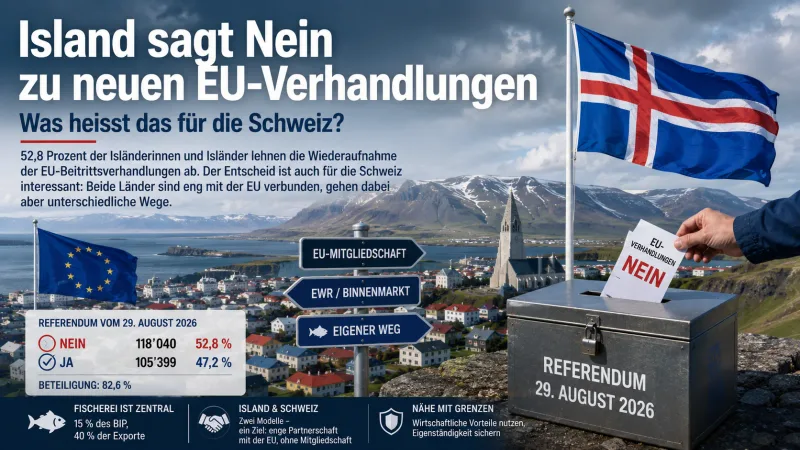
52.8 percent of Icelanders rejected the resumption of EU accession negotiations. This decision is also interesting for Switzerland: both countries have close ties with the EU but pursue different paths.
Iceland will not resume new negotiations on EU membership for now. In the referendum held on August 29, 2026, 118,040 people voted against resuming talks, while 105,399 voted in favour. This corresponds to 52.8 and 47.2 percent, respectively. Voter turnout was 82.6 percent.
It is important to note: The vote was not about EU membership itself. Icelanders decided whether to resume accession negotiations, which had been dormant for years. Even with a "yes" vote, another referendum on actual EU membership would have been planned later.
Iceland Had Negotiated Before
Iceland applied for European Union membership in 2009 during the financial crisis. Accession negotiations began shortly thereafter but were put on hold in 2013 after a change of government. The application was not formally withdrawn.
Prime Minister Kristrún Frostadóttir's government sought to put the question to a vote again. She argued, among other things, that the security situation in Europe had changed. Iceland is a founding member of NATO and has no army of its own, but it faces new security policy challenges.
After the "no" vote, Frostadóttir declared the result a "victory for democracy." The government must now accept that there will be no new accession negotiations.
Fisheries Were a Decisive Issue
Fisheries played a particularly important role in the campaign. Many opponents of resuming negotiations feared that Iceland might lose some control over its fishing resources if it later joined the EU.
The economic significance is substantial: Fisheries contribute around 15 percent to Iceland's Gross Domestic Product and account for about 40 percent of exports. For a country with just over 400,000 inhabitants, control over its fishing grounds is therefore not only a political but also an economic issue.
Frostadóttir had also pledged to halt negotiations if Iceland could not secure control over its fishing resources. A "yes" vote to resume talks would therefore by no means have automatically led to EU membership.
Iceland Remains Very Close to the EU
The "no" vote does not mean Iceland is turning away from Europe. The country is a member of the European Economic Area (EEA) and is thus closely integrated into the European single market. Iceland also belongs to the Schengen Area.
Iceland thus benefits from extensive access to the European market but has no voting rights on many EU decisions. This is precisely where the political tension lies: The country is economically closely linked to the EU but wishes to maintain its political and economic independence.
What Does This Mean for Switzerland?
This is where the decision becomes relevant for Switzerland. Switzerland is also not an EU member but maintains close relations with the European Union. The main difference lies in the model.
Iceland is integrated into the European single market through the EEA. Switzerland, however, is not part of the EEA. Its relations with the EU are based on an extensive network of bilateral agreements.
Both countries thus demonstrate different ways a small European state can be closely connected to the EU economically and politically without becoming a member of the Union.
Swiss Interest in the Icelandic Decision
Therefore, the referendum provides no direct instruction for Swiss European policy. However, it shows that the question of the appropriate proximity to the EU remains controversial even in a small, prosperous European state.
Iceland faces a particular conflict of objectives: The country benefits from European integration but simultaneously wants to retain as much control as possible over key areas such as fisheries. Switzerland faces a similar fundamental question, albeit within a different institutional framework.
The difference is crucial: While fisheries were among the central arguments against new negotiations in Iceland, Swiss debates revolve around, among other things, access to the EU single market, free movement of persons, research, energy, and the institutional development of bilateral relations.
A Narrow Result
The referendum also shows how divided the Icelandic population is on the EU question. The margin was only 12,641 votes. Almost half of the voters would have wanted to resume negotiations.
The result is therefore less a definitive break with the European Union than a decision against a new attempt at potential EU membership. Close economic cooperation with Europe remains.
For Switzerland, the most important takeaway is that proximity to the EU and political independence do not necessarily have to be opposites. Iceland and Switzerland have developed different models for this. However, the referendum in Iceland also shows: The closer the ties to the EU become, the more questions of sovereignty, economic interests, and national control can move into focus.
Sources
- Island.is: Official Results of the Referendum Held August 29, 2026
- Icelandic Ministry of Foreign Affairs: Referendum on Resuming EU Accession Talks
- Reuters: Iceland votes on whether to start EU membership talks
- Deutsche Welle: Iceland Votes on EU Accession Negotiations
- EDA: Switzerland's European Policy