ICJ Examines German Arms Exports to Israel – Why Switzerland is Affected
Nicaragua accuses Germany of violating the Genocide Convention. Initially, the court's jurisdiction is in question. A later decision could still become relevant for other arms exporters.
Nicaragua Takes Germany to the ICJ
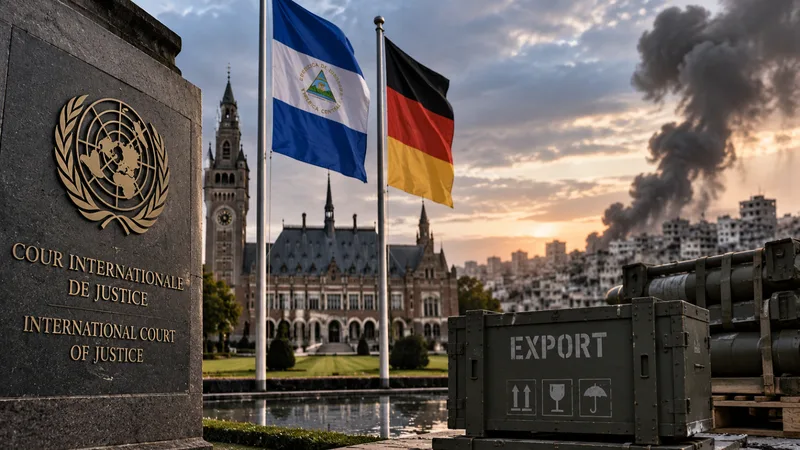
Nicaragua filed its lawsuit against Germany at the International Court of Justice in March 2024. The country accuses the Federal Republic of contributing to the risk of genocide against the Palestinian population through its supply of war materiel to Israel.
Among other things, Nicaragua demanded provisional measures that would oblige Germany to cease certain arms exports and resume funding for the UNRWA Palestinian relief agency.
The ICJ rejected the request for provisional measures in April 2024. However, this did not definitively conclude the proceedings. The lawsuit itself remained, and the case moved to the next phase.
Initially, the Court's Jurisdiction is Key
The current hearing is therefore of particular importance because Germany first aims to prevent the ICJ from pursuing the case in whole or in part.
This places a procedural question at the forefront: Does the ICJ even have jurisdiction to rule on the allegations made by Nicaragua?
This distinction is important. The ongoing hearings are not yet proceedings in which the court definitively determines whether Germany violated the Genocide Convention through its arms deliveries.
Only if the ICJ affirms its jurisdiction and deems the claim admissible could the proceedings move to a later phase where the substantive allegations would be thoroughly examined.
Germany Rejects the Accusations
Germany refutes the allegations made by Nicaragua. The Federal Government refers, among other things, to its national review and approval procedures for arms exports.
Berlin also questions the international legal and procedural prerequisites for Nicaragua's claim. From Germany's perspective, it is not solely about whether individual arms deliveries are politically or morally justifiable. Rather, the crucial point is whether Nicaragua can derive a claim against Germany before the ICJ from the Genocide Convention at all.
Germany's position is thus largely argued through the question of the court's jurisdiction.
The Decisive Legal Question: How Far Does the Duty to Prevent Extend?
The Genocide Convention obliges its signatory states not only to punish genocide. It also includes an obligation to prevent genocide.
This is precisely where Nicaragua's argument begins. The country believes that a state must not contribute to increasing the risk of genocide through arms deliveries.
This raises a fundamental question of international law: How far does a state's responsibility extend for the actions of another state when it supports that state with weapons or other goods?
An ICJ ruling could therefore gain significance beyond the specific dispute between Nicaragua and Germany.
The Case is Not the Same as the Proceedings Against Israel
The case must not be equated with South Africa's ongoing proceedings against Israel, also before the ICJ.
The proceedings between South Africa and Israel directly concern the question of whether Israel has violated its obligations under the Genocide Convention. In contrast, the Nicaragua v. Germany proceedings focus on the responsibility of another state that supplies arms to the affected state.
This broadens the legal perspective: not only the conduct of an alleged perpetrator could be the subject of international jurisprudence, but also the responsibility of other states that support them.
Why This Is Relevant for Switzerland
Switzerland is not a party to the proceedings. Therefore, a judgment against Germany would not automatically alter Swiss war materiel law.
Nevertheless, Bern is following developments for a specific reason: Switzerland is also a signatory state to the Genocide Convention and is thus subject to its international legal obligations.
At the same time, Switzerland has its own, partially stricter rules for war materiel exports. According to federal authorities, definitive war materiel exports to Israel have not been approved for several years.
This means: Switzerland currently does not export war materiel to Israel in the same manner as Germany. The initial legal situation is therefore not identical.
Switzerland Itself Discussed Stricter Export Rules in 2026
The Swiss relevance extends further, however. In 2026, the Federal Council itself had to clarify how neutrality law and war materiel exports apply in the context of the war between the USA, Israel, and Iran.
In March, the government stated that during the conflict, no war materiel exports could be approved for states involved in the international armed conflict with Iran. A restrictive practice for Israel was already in place prior to this.
The Federal Council also regularly reviewed existing permits and other war-related exports through an interdepartmental expert group.
Switzerland is therefore already addressing, independently of the German proceedings, the question of how export control, neutrality, and international law can be reconciled.
In 2025, Switzerland Exported War Materiel Worth Almost One Billion Francs
The importance of export control is also not insignificant economically. In 2025, Swiss companies exported war materiel worth 948.2 million Swiss Francs to 64 countries. This represented an increase of almost 43 percent compared to the previous year.
The largest recipient was Germany, with deliveries worth 386.4 million Swiss Francs. This was followed by the USA with 94.2 million, Hungary with 63.4 million, Italy with 62.2 million, and Luxembourg with 47.4 million Swiss Francs.
The ICJ case is therefore also relevant for Switzerland because extensive international legal jurisprudence on the responsibility of exporting states could long-term influence the framework for international arms deals.
A Possible Ruling Would Not Automatically Oblige Switzerland
Caution is advised here, however. Even if the ICJ later makes a broad interpretation of the prevention obligation from the Genocide Convention, this would not automatically lead to an amendment of Swiss war materiel law.
Such a judgment could, however, establish international legal guidelines relevant to other signatory states as well. Switzerland would then have to examine the significance of the jurisprudence for its own international obligations and export control.
Whether this would actually necessitate an adjustment of Swiss practice could only be assessed based on the specific judgment and its reasoning.
The True Significance Lies in the Responsibility of the Exporting State
The Nicaragua v. Germany case thus goes beyond the question of individual arms deliveries.
It touches upon a fundamental problem of international law: states can make decisions regarding their foreign and security policy that have effects far beyond their own borders. Arms exports are among the areas where this responsibility becomes particularly clear.
If the ICJ addresses the merits of the claim, its later jurisprudence could more precisely determine when an exporting state must act under the Genocide Convention and what risks it must consider when delivering weapons.
This would be an important development for European arms exporters. For Switzerland, it would be particularly crucial how such international legal requirements relate to its own war materiel law and neutrality.
The Decisive Question Remains Open
Currently, however, no final assessment of German arms exports by the ICJ is pending. First, the court must decide on Germany's objections to jurisdiction and admissibility.
Only after that will it become clear whether the court will even investigate Nicaragua's substantive allegations.
For Switzerland, the case is therefore primarily a look at a potential development in international law. The broader the ICJ interprets states' responsibility for supporting potential violations of international law, the more significant this jurisprudence will be for countries like Switzerland.
No immediate need for action arises for Bern from this at present. Switzerland has its own export rules and has not approved definitive war materiel exports to Israel for years. The further developments in The Hague will nevertheless be closely observed.
Sources
- International Court of Justice (ICJ): Nicaragua v. Germany, Proceedings concerning Alleged Breaches of International Obligations in relation to the Occupied Palestinian Territory
- Federal Department of Foreign Affairs (FDFA): Export Control and War Materiel Exports
- Federal Council/FDFA: Iran Conflict – Impact on War-Relevant Exports, March 20, 2026
- Federal Council: Export of War Materiel in 2025, March 10, 2026