F-35 Without Fixed Price: GPK-N Censors Serious Procurement Errors
No fixed price, deficient negotiations, and delayed information: The GPK-N sharply criticizes F-35 procurement.
No Lump-Sum Fixed Price Agreed
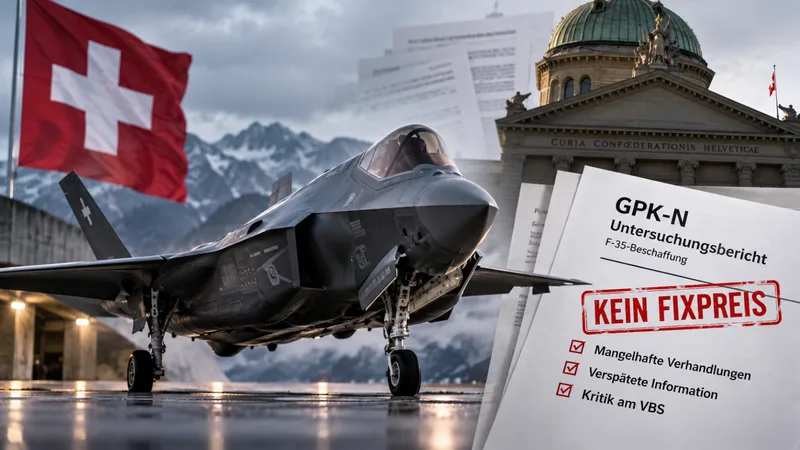
The much-discussed fixed price for the purchase of Switzerland's F-35A fighter jets was never contractually guaranteed, according to the National Council's Control Committee (GPK-N). The committee concluded in its investigative report, published on September 8, 2026, that no lump-sum fixed price was agreed with the USA.
The report contradicts the assertion that the price for the originally planned 36 aircraft had been firmly agreed upon. The GPK-N particularly criticizes the Federal Department of Defence, Civil Protection and Sport (DDPS) for repeatedly communicating an absolute price guarantee to parliament and the public. This representation is not comprehensible given the actual contractual situation.
The committee therefore not only examined what was actually in the contract. It also aimed to clarify when the responsible bodies learned of possible additional costs and why the existing price uncertainty was not identified or communicated earlier.
Parliament Approved Around Six Billion Swiss Francs
The Federal Council decided in 2021 to acquire the F-35A from US manufacturer Lockheed Martin. In September 2022, Parliament approved around six billion Swiss francs for 36 aircraft.
Meanwhile, the situation has changed. Costs have increased by several hundred million Swiss francs. The Federal Council therefore requested an additional credit of 394 million Swiss francs in March 2026. Based on current knowledge, this will likely only cover 30 F-35A aircraft. The final number is not yet determined.
There were also delays in the timeline. According to current planning, the first aircraft are to be delivered to Switzerland from 2027.
Negotiations Not Appropriately Organized, Says GPK-N
Criticism of the organization of contract negotiations is particularly pronounced. According to the GPK-N, the so-called multi-eye principle was not sufficiently applied. Only a few of the people involved had read the contract in its entirety.
The committee also criticizes the DDPS for engaging an external law firm for the negotiations. The internal legal service of armasuisse was barely involved. The external firm primarily assessed the documents under Swiss law; no review under US law took place. The GPK-N describes this organization of negotiations as inappropriate.
Especially with a contract involving a US manufacturer and potential significant cost risks, the legal review should have been particularly thorough, in the committee's view.
Doubts About Fixed Price Not Sufficiently Questioned
According to the GPK-N's assessment, the Swiss Federal Audit Office (EFK) should have provided reason for a new review at the latest. The EFK had already expressed doubts that a lump-sum fixed price was truly guaranteed.
The GPK-N concludes that these doubts should have led to a critical review and, if necessary, to renegotiations with the USA. At a minimum, the DDPS should have considered the risk of possible additional costs and reflected it accordingly in risk management.
Instead, the idea of a fixed total price continued to be conveyed to parliament and the public.
Viola Amherd Also Sharply Criticized
The GPK-N's criticism is not only directed at the administration. The then-head of the DDPS, Viola Amherd, is also sharply criticized in the report.
The committee assesses her leadership and oversight in connection with the F-35 procurement as insufficient. It accuses her of not monitoring the negotiations closely enough and of not adequately fulfilling her oversight and management duties.
Particularly relevant is the question of informing the entire Federal Council. According to the GPK-N, armasuisse received initial indications of possible additional costs as early as August 2024. Amherd was informed about this. However, she only informed the Federal Council later, after the USA had confirmed the additional costs in writing. The committee considers this information to be too late.
Amherd is no longer a Federal Councillor. Therefore, the report has no immediate political consequences for her in office. However, it sheds new light on her role in one of Switzerland's largest arms deals.
Did the Confederation Mislead Parliament and the Public?
Particularly sensitive is the question of whether the misleading fixed-price communication was merely due to errors and misunderstandings, or whether those responsible consciously accepted the existing ambiguity.
The GPK-N explicitly raises this question. It considers it possible that closely involved persons