Is Climate Change Making Flights Over Switzerland More Turbulent?
Global studies indicate rising clear-air turbulence. Switzerland has incident data, but a climate trend in its airspace remains unconfirmed.
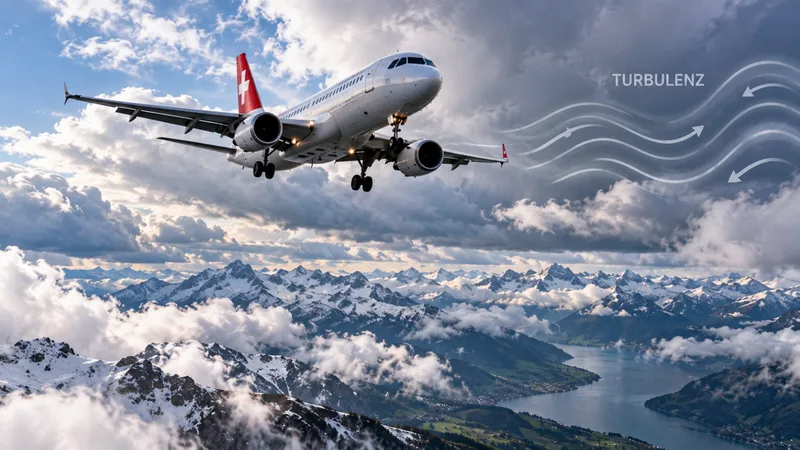
Turbulence is measurable in Switzerland
The statement that there are no figures for turbulence in Switzerland would be incorrect. The Federal Office of Civil Aviation (BAZL) records reports of wind shear and turbulence.
In 2023, 6.0 such events per 10,000 flight movements were registered. For comparison: in 2021, it was 6.1, and in 2022, the value was 5.6. The figures thus remained at a similar level over this period.
The distribution is also revealing: approximately 98 percent of reports in 2023 came from commercial air traffic. About 65 percent of events occurred during approach and landing, 31 percent during cruise flight.
These data show that turbulence and wind shear are systematically recorded in Swiss aviation. However, they do not yet answer the crucial question regarding climate change.
A stable number does not automatically mean: no climate change
A comparison of reports per 10,000 flights can show whether the number of reported events changes. However, this statistic alone is not sufficient to make a statement about climate change.
For this, one would need to investigate which types of turbulence occur, at what altitude they originate, how strong they are, and under what weather conditions they happen. At the same time, it would be necessary to consider that flight routes, flight movements, measurement methods, and reporting behavior can change over the years.
This is precisely the scientific challenge: a short-term increase in turbulence is not yet proof of a long-term climatic change.
Clear-Air Turbulence is particularly interesting
So-called Clear-Air Turbulence, or CAT for short, is particularly relevant for climate research. It occurs at high altitudes and is not necessarily associated with visible clouds or thunderstorms.
Strong wind gradients and jet streams play an important role. When different air masses and wind speeds meet, unstable currents can form. For a commercial aircraft, this can suddenly turn into clearly perceptible turbulence.
This is particularly uncomfortable for passengers because clear-air turbulence is not always detectable early with the naked eye. However, this does not automatically put the aircraft itself in a dangerous situation.
International research finds a clear trend
International research is now more advanced than a few years ago. A widely recognized study investigated the development of clear-air turbulence between 1979 and 2020.
Over a reference area in the North Atlantic, the duration of light or stronger clear-air turbulence increased by 17 percent during this period. For moderate or stronger turbulence, the increase was 37 percent. Particularly severe turbulence increased by as much as 55 percent.
Increasing values were also found over the continental USA. The authors see the results as a clear indication that clear-air turbulence has already increased in several important flight regions.
Important: These results cannot be simply transferred to Switzerland. A global or North Atlantic trend is not proof that Swiss airspace is affected to the same extent.
ETH also investigates the phenomenon
Swiss research now also contributes to a better understanding of how clear-air turbulence occurs.
A study published in 2025 with the participation of ETH Zurich analyzed 4,880 moderate or stronger clear-air turbulence events from 2019 to 2022. The researchers combined measurements from commercial aircraft with meteorological reanalysis data.
The investigation shows, among other things, that different weather conditions favor different types of clear-air turbulence. Large-scale atmospheric structures, strong horizontal deformations of the airflow, and processes in the vicinity of warm front systems play an important role.
However, the study examines the Northern Hemisphere and is not a series of measurements of Swiss airspace. For this reason, it cannot be concluded that Swiss flights are more frequently turbulent today than in the past.
Why Switzerland is particularly difficult to assess
Switzerland has a peculiarity: the Alps.
Mountains can significantly alter air currents. In addition, there are Foehn conditions, thunderstorms, strong upper-level winds, jet streams, and other meteorological processes. Therefore, turbulence can arise for very different reasons.
A long-term climate analysis would have to distinguish these natural fluctuations from a possible climate signal.
A single turbulent year would therefore be no more proof of climate change than a year with particularly calm flights would be proof against it.
More turbulence does not automatically mean more accidents
For passengers, an important distinction is crucial: turbulence and danger are not the same.
BAZL points out that turbulence normally does not pose a critical problem for the aircraft structure. The greater risk is for people on board if they are not buckled up.
Therefore, a simple rule applies regardless of whether climate change affects turbulence frequency: the seatbelt should remain fastened as much as possible, even during cruise flight.
What could change for flight operations
Should it be confirmed in the future that certain forms of turbulence become more frequent or stronger, this could have implications for flight operations.
Airlines might adjust routes and altitudes more, further develop weather forecasts and turbulence models, and avoid certain areas more often. Flight planning could also become more complex as a result.
However, this does not mean that flights will generally become more dangerous in the future. Aviation already has procedures, weather data, and technical systems to react to difficult conditions.
Delays are another matter
The common assumption that more turbulence would automatically lead to more delays cannot currently be reliably quantified for Switzerland.
Turbulence can cause an aircraft to change its altitude or route. However, many other factors are crucial for a delay: thunderstorms, fog, snowfall, strong winds, capacity bottlenecks at airports, technical problems, or restrictions in European airspace.
A Swiss statistic that clearly attributes the share of delays to turbulence and simultaneously depicts a long-term climate trend is currently not available.
What the data actually say today
The factual situation can therefore be divided into three levels.
What we know
- Turbulence and wind shear are recorded in Swiss air traffic.
- BAZL publishes corresponding incident data.
- Clear-air turbulence can occur without visible clouds.
- International studies show increasing clear-air turbulence in several regions.
- Swiss, or ETH, research investigates the physical causes of the phenomenon.
What we do not know yet
- Whether clear-air turbulence over Switzerland is becoming more frequent in the long term.
- Whether it is becoming stronger in Swiss airspace.
- How large the proportion of climate change is compared to natural fluctuations.
- Whether this results in measurably more flight delays in Switzerland.
The crucial data series is still missing
For a reliable answer, a long-term Swiss time series would need to combine several data sources: turbulence measurements from aircraft, meteorological observations, upper-level wind data, weather models, and flight movements.
Only then could it be distinguished whether a change is actually related to climate change or, for example, is caused by changed flight routes, weather conditions, or reporting behavior.
This is precisely why it would be premature to speak of a "more turbulent Swiss airspace" today.
The answer currently is: possible, but not proven for Switzerland
Research now provides clear indications that clear-air turbulence has increased in several regions of the world. Climate change is considered an important factor because changes in temperature differences and atmospheric currents can alter the conditions for certain types of turbulence.
For Switzerland, the situation is more complicated. There are measurements and reporting data, but so far, they do not show a clearly proven long-term climate trend. The Alps, different weather conditions, and changes in air traffic make a clear attribution difficult.
The statement "Climate change is making Swiss flights more turbulent" would therefore be too broad today. However, claiming there is no scientific evidence for it would be equally incorrect.
The current state of research is more sober: Globally, there is increasing evidence of more clear-air turbulence. Whether this trend has also reached Swiss airspace still needs to be shown by long-term evaluation.
Sources
- Federal Office of Civil Aviation (BAZL): Wind Shear and Turbulence
- Federal Office of Civil Aviation (BAZL): Flight Operations Annual Report 2025
- ETH Zurich / Weather and Climate Dynamics: Clear-Air Turbulence, 2025
- Prosser et al.: Evidence for Large Increases in Clear-Air Turbulence Over the Past Four Decades, Geophysical Research Letters, 2023
- MeteoSchweiz: Fundamentals and Formation of Turbulence