Israeli Settlements: Switzerland's Position on Trade Curbs
Twelve states aim to restrict trade of goods from Israeli settlements or support corresponding European measures. Switzerland condemns settlement construction, but has not gone as far in trade policy.
Twelve States Increase Pressure
The joint declaration of September 8 is politically clear. However, the individual legal and trade policy steps are not identical.
Canada, Denmark, Finland, France, Iceland, Ireland, Norway, Poland, Portugal, Spain, Sweden, and the United Kingdom declared their intention to introduce national restrictions on trade in goods from Israeli settlements and/or support European restrictions. They also noted that individual states are still reviewing such measures.
The United Kingdom, France, and Canada explicitly announced national measures in the declaration. They join states that have already taken steps against trade in settlement products. The joint declaration specifically names Ireland, Spain, the Netherlands, Norway, and Belgium in this context.
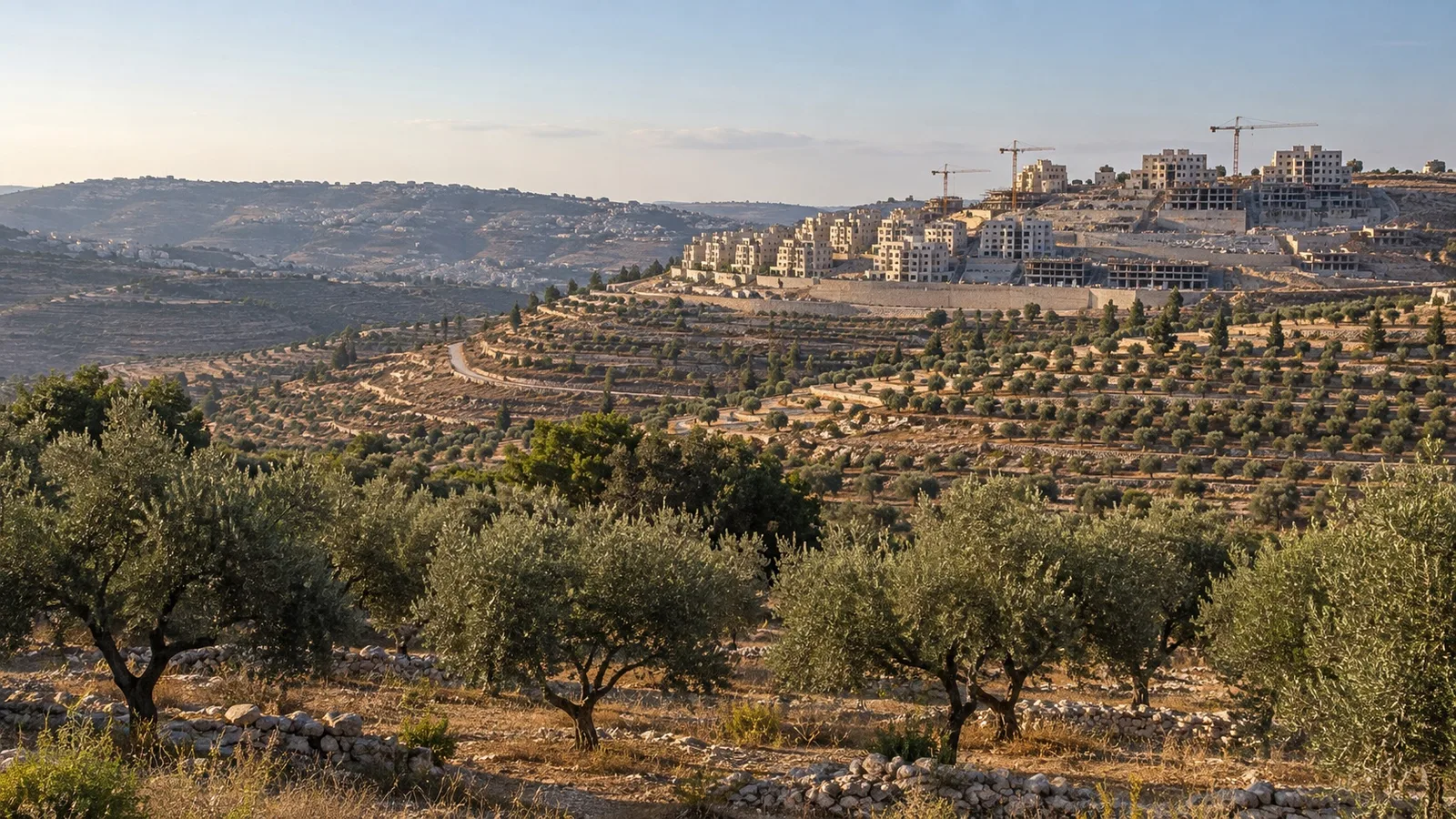
The twelve governments justify their move with the increasing settlement expansion and escalating settler violence in the West Bank. The settlement project in the E1 area is particularly contentious. Its further development, according to the signatories, further jeopardizes the prospect of a two-state solution.
No General Embargo Against Israel
The planned measures are explicitly directed against goods from Israeli settlements in the occupied territories. They differ from a general trade boycott against Israel.
This distinction is crucial under international law and trade policy. Many states treat Israel within its internationally recognized borders and the territories occupied since 1967 differently under law.
The twelve countries justify their initiative with the aim of protecting the two-state solution and preventing further settlement expansion. They simultaneously urge the Israeli government to halt settlement construction and act against settler violence.
United Kingdom Goes Further
The United Kingdom is among the states now announcing concrete national steps. London intends to ban trade in goods from Israeli settlements in the West Bank.
France and Canada also announced national bans. However, the details of their respective regulations and implementation timelines differ.
France had previously pushed for a common European solution. Since an EU-wide regulation has not materialized, individual states are now increasingly pursuing national measures.
EU Remains Divided on Joint Ban
Within the European Union, the issue has also been contentious for months. The EU already treats goods from Israeli settlements differently from goods from Israel: products from settlements do not receive preferential treatment under the EU-Israel agreement.
A full import ban is different, however. No such common EU regulation exists yet. In early September, EU High Representative Kaja Kallas stated that there was no consensus among member states on the question of a ban.
This creates an unusual situation: several EU states are moving forward nationally, while a common regulation at the European level remains undecided.
Switzerland's Position
Switzerland is not party to the new declaration by the twelve states. It has also not yet adopted a general import ban on goods from Israeli settlements.
Politically, Bern's stance on settlement construction is clear. The Federal Department of Foreign Affairs considers Israeli settlement construction in the occupied Palestinian territories illegal under international law and continues to support the two-state solution.
Switzerland nonetheless takes a more nuanced trade policy approach than a quick glance at the current debate might suggest.
Settlement Products Receive No Tariff Preferences in Switzerland
Goods from the occupied Palestinian territories – including goods from Israeli settlements in the West Bank, East Jerusalem, and the Golan Heights – do not receive preferential treatment in Switzerland under the free trade agreement between the EFTA states and Israel.
Specifically, this means importers cannot simply claim the tariff reductions applicable to goods of preferential Israeli origin for such products.
Swiss customs authorities differentiate based on information about the place of production. There are corresponding lists and verification procedures for specific locations and industrial areas in the occupied territories.
However, this is not an import ban. Goods from Israeli settlements can generally still enter Switzerland. They merely do not receive the preferential tariff treatment reserved for goods originating from Israel within its recognized borders.
Switzerland Also Distances Itself from Settlement Activities Under International Law
The Swiss position is not limited to customs issues. In an EDA analysis of the legal situation following the International Court of Justice's advisory opinion of 2024, Switzerland states that it does not support economic and financial activities related to Israeli settlements in the occupied territories.
The EDA also declares that Switzerland discourages natural and legal persons from supporting settlement activities.
At the same time, the analysis states that the free trade agreement between the EFTA states and Israel applies to Israeli territory within the 1967 borders. Therefore, no corresponding Swiss preferential regime exists for the occupied territories.
The Difference from an Import Ban
This is precisely the crucial difference between Switzerland's current policy and the measures now announced by individual states.
Switzerland states, in simpler terms: Settlement products should not benefit from the customs advantages of the free trade agreement with Israel.
An import ban would go significantly further: Certain goods would no longer be permitted for import at all.
The new international initiative aims for this second step in several countries. Therefore, Bern now faces the question of whether its current differentiation is sufficient or if additional trade policy measures will become necessary.
Why Switzerland Has Not Followed Suit So Far
One explanation lies in Swiss trade policy. Switzerland is neither an EU member nor bound by its common trade policy. An EU regulation would therefore not automatically apply to Switzerland.
At the same time, Bern already has an instrument to distinguish between goods from Israel and goods from the occupied territories: the rules on preferential origin.
An additional import ban would therefore be an independent political decision. It would not merely technically extend an existing Swiss customs rule, but create a new trade restriction.
Question of a Swiss Ban Remains Open
Whether the Federal Council plans its own measures in response to the initiative of the twelve states is currently unknown.
It cannot be inferred from the EDA's current position that Bern will immediately decide on an import ban. Switzerland has repeatedly condemned settlement construction politically and has already clearly differentiated economic activities related to settlements from its normal relations with Israel.
A complete trade ban would therefore represent a new level in Swiss policy. It would need to be politically and legally justified and implemented accordingly.
Why Pressure Is Increasing Now
The current initiative by the twelve states comes against the backdrop of increasing international criticism of Israel's settlement policy.
In their joint declaration, the governments refer to what they see as a significantly aggravated situation in the West Bank. They specifically cite the expansion of settlements, increasing settler violence, and the planned tenders for the E1 project.
For the signatories, it is therefore not just about trade issues. They view economic restrictions as a tool to make further settlement expansion difficult and to preserve the prospect of a two-state solution.
Differentiation Becomes More Important for Switzerland
This development presents Bern with a political deliberation. On the one hand, Switzerland maintains a clear position against settlement construction and in favor of a two-state solution. On the other hand, its trade policy instruments distinguish between Israeli territory and the occupied territories.
This differentiation could come under increased pressure in the coming months if more European states introduce national bans.
At the same time, a Swiss import ban would not only need political approval but also practical implementation. This would require reliable control of the goods' origin. This very question already plays a central role in the existing rules on tariff preferences.
What Would Change for Swiss Consumers and Businesses
For Swiss consumers, any potential import ban would likely affect only a limited part of overall trade with Israel, as it would specifically target products from settlements.
For businesses, however, origin control would be crucial. Importers would need to prove where a product was actually manufactured. For goods with production chains spanning multiple locations, determining the origin can be complex.
This is precisely why existing Swiss rules on origin and customs are relevant to the current discussion: they show that Switzerland already distinguishes between Israeli territory and the occupied territories.
Switzerland Is Not Facing a Choice Between "Doing Nothing" and "Import Ban"
The current debate is sometimes presented as a dichotomy between states taking action against settlement products and countries doing nothing. For Switzerland, this portrayal is insufficient.
Bern already has its own policy: settlement activities are not supported, settlement products receive no tariff preferences under the EFTA-Israel agreement, and Switzerland adheres to the goal of a two-state solution.
The open question is therefore not whether Switzerland distinguishes between Israel and the occupied territories at all. It already does.
The real question is whether Bern wants to take the next step and transform the existing customs-related differentiation into a genuine import ban for settlement products.
International Pressure Changes the Situation
The declaration by the twelve states shifts the political debate. The United Kingdom, France, and Canada intend to introduce national bans, while other states are reviewing or supporting similar measures. Simultaneously, a common EU solution remains blocked.
Switzerland does not automatically have to participate. It is neither an EU member nor a signatory to the declaration.
However, its current policy is already more closely aligned with international legal norms than a general "no" to trade restrictions might suggest.
Whether this will lead to a complete import ban in the future remains open. But one thing is clear: The question of how to handle goods from Israeli settlements is becoming politically more challenging for Bern.
Sources
- Joint Declaration by the Foreign Ministers of Canada, Denmark, Finland, France, Iceland, Ireland, Norway, Poland, Portugal, Spain, Sweden, and the United Kingdom, September 8, 2026.
- Federal Department of Foreign Affairs (EDA): Analysis of the Legal Situation following the International Court of Justice's Advisory Opinion of July 19, 2024.
- Federal Office for Customs and Border Security (BAZG): Preferential Rules of Origin and Goods from the Occupied Palestinian Territories.
- European Commission: EU-Israel Technical Arrangement and Treatment of Goods from Israeli Settlements.
- Federal Department of Foreign Affairs: Swiss Position on the Situation in the Middle East.