Learning without constant stress: why self-tests beat re-reading
Exam stress is widespread among Swiss adolescents. A realistic study plan protects free time – if it relies on retrieval, spacing and sleep.
Many study hours fail not because of a lack of diligence, but because of false feedback: a text read for the third time suddenly feels familiar. Familiarity, however, is not the same as retrievable knowledge. In an exam, what counts is whether an answer is available without a template. That is exactly why self-tests and repetitions spread over several days are among the best-supported study methods.
Exams are themselves a stress factor
The topic is not marginal in Switzerland. In the representative Pro Juventute youth study of 2024, 48.2 percent of girls and young women and 35.5 percent of boys and young men named tests or exams as a frequent or very frequent stressor. Time pressure and general performance pressure also ranked high.
A study plan cannot fully remove this pressure. But it can prevent uncertainty from growing until the evening before. What matters is starting early enough with small units – not scheduling every free evening.
The two methods with the strongest evidence
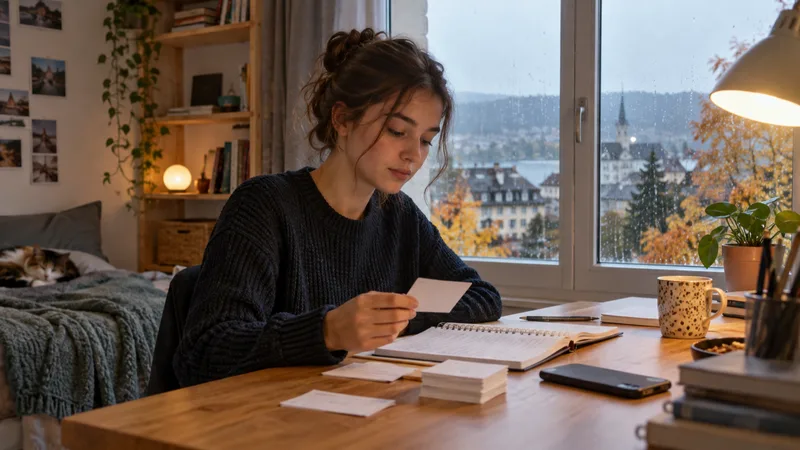
A broad review of learning research rates practice tests and distributed practice particularly highly. A practice test does not necessarily mean a mock exam: flashcards, self-formulated questions or explaining a topic without notes force the brain to retrieve. Afterwards, the learner checks what was missing.
Distributed practice means working on the same material briefly on several days. A recent systematic review of educational contexts found significant advantages of distributed learning and/or retrieval practice in 43 of 63 experiments. The studies were designed differently; an exact formula for success cannot be derived from them. The direction is nevertheless clear.
A plan that does not eat up free time
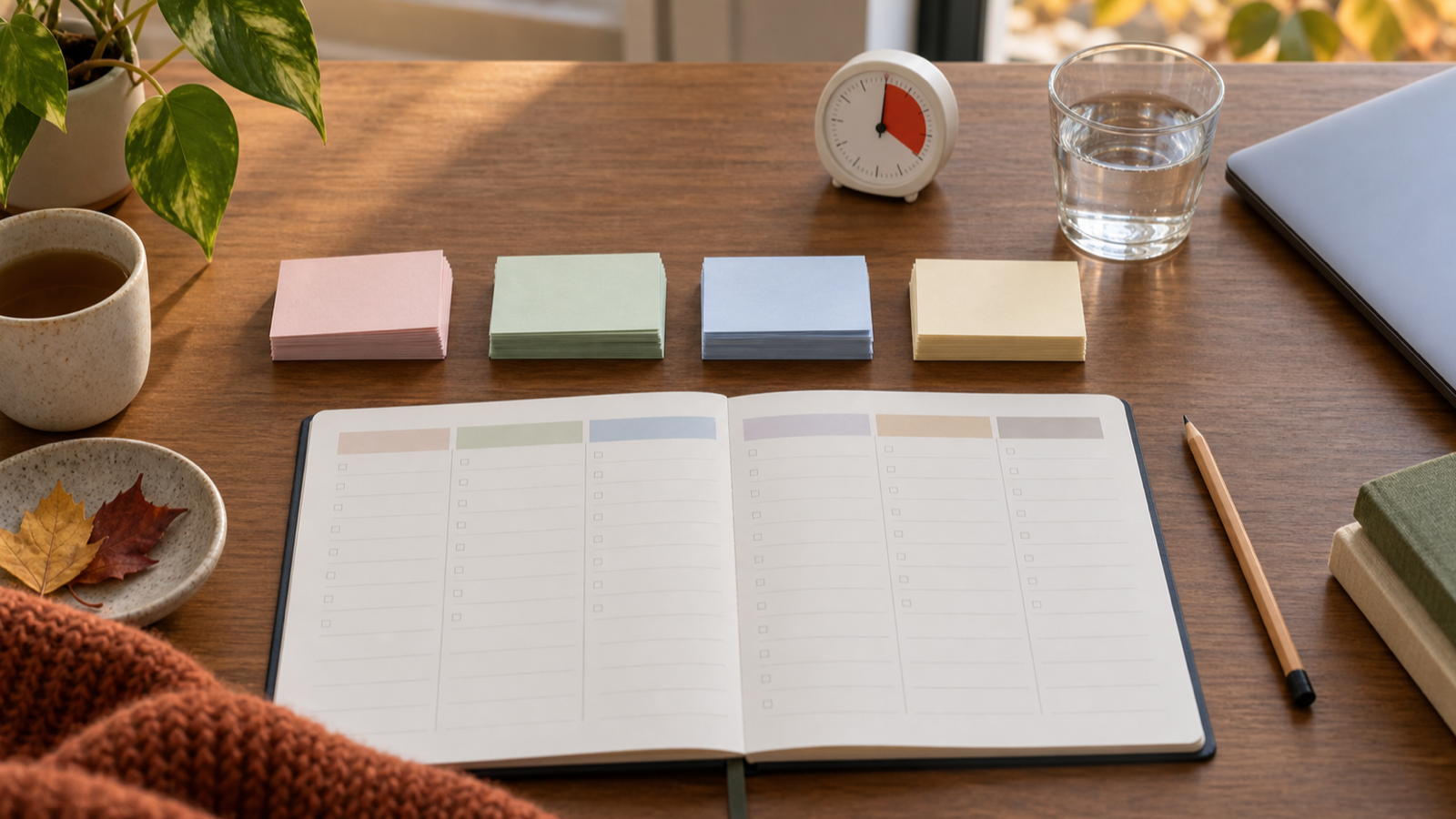
For an exam on Friday, a realistic schedule can look like this:
- Monday, 25 minutes: narrow down the material and formulate five to ten questions.
- Tuesday, 30 minutes: answer the questions without notes; mark gaps.
- Wednesday, 25 minutes: work only on the gaps and solve two tasks under time pressure.
- Thursday, 20 minutes: short overall retrieval, then stop.
- Friday: at most a short review, no new chapter.
After each unit, the next concrete starting point is noted down. That lowers the hurdle the next day. Writing "study maths" in the calendar creates a diffuse task. "Solve tasks 4 to 8 without the solution" is actionable.
Breaks are not failure
A break only works if it actually interrupts. Five minutes with short videos can easily become 25 minutes and capture attention again. Getting water, moving briefly, airing the room or listening to a song is better. After two focused units, a longer break should follow.
Sleep is also not a negotiable residual quantity. An experimental study with 15- to 19-year-olds showed that sleep restriction worsened memory, especially with crammed learning; distributed learning offered some protection. That does not prove that a single long night decides every exam. But it shows why trading sleep for extra cramming is a risky strategy.
When self-management is not enough
Strong, persistent stress is not purely an organisational problem. If sleep, mood or daily life suffer over a longer period, adolescents should talk to parents, teachers, school social work or a counselling centre. Study techniques can reduce strain, but cannot plan away a psychological crisis.
The most effective study week therefore often feels unspectacular: short starts, honest self-tests, repeated encounters with the material – and a clear end to the day. More time is not the goal, but more feedback about what already sticks and what does not yet.
Digital tools can help, as long as they support a method and do not replace it. A flashcard app can schedule repetitions; a chatbot can formulate additional practice questions. Answers must, however, be checked against school materials, because AI systems can produce errors. The moment in which a pupil derives, explains and corrects a solution themselves remains particularly effective. Automatically generated summaries may save time, but they do not automatically provide the necessary retrieval practice.