
Fewer marriages, later divorces: what money and law have to do with it
In 2025, 35,900 marriages were registered in Switzerland – 2.3 percent fewer than the previous year. Taxes and AHV create real incentives, but they do not explain the decline on their own.
Marriage is becoming less common in Switzerland. In 2025, the Federal Statistical Office (BFS) recorded 35,900 marriages, 2.3 percent fewer than the previous year. At the same time, 15,800 marriages were divorced, also fewer than in 2024. Yet the two declines prove neither a general «marriage crisis» nor that financial risks alone keep people from marrying.
The bigger story lies in the combination of several developments: couples marry later, live together unmarried more often, and separate partnership, parenthood and marriage certificate more sharply than earlier generations. At the same time, tax and social insurance law create financial differences that can be considerable depending on income, care arrangements and age.
The decline does not begin with taxes
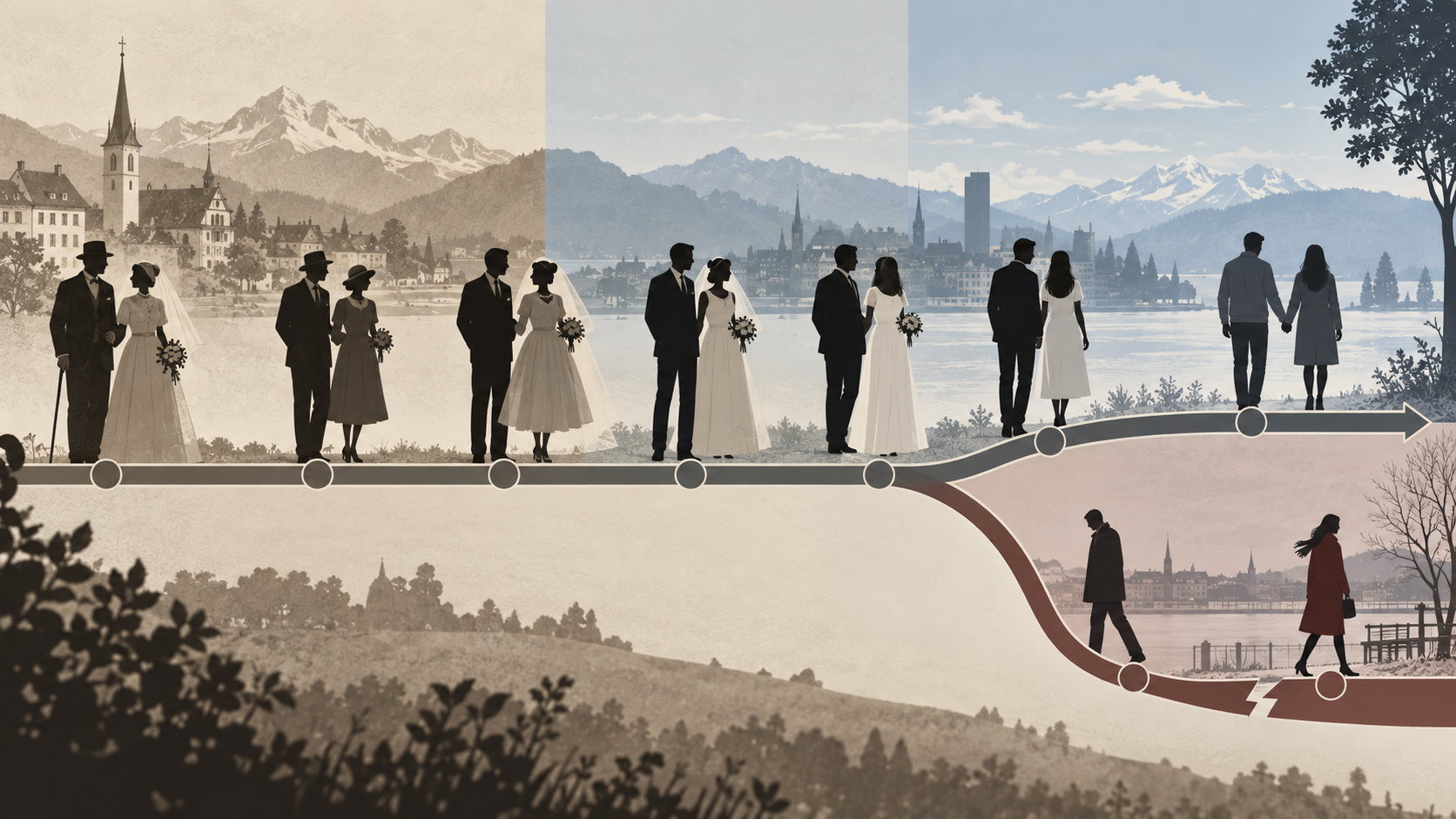
BFS analyses show that young adults today marry less often and later. Since 1970, the number of first marriages has fallen despite a growing population. Non-marital partnerships and relationships with separate households have become more widespread in society. Among couples with joint children, marriage remains dominant, but unmarried parents are more common in younger generations.
The long-term trend therefore cannot be reduced to a single cause. Statistics record decisions, but not their motives. Statements such as «the marriage penalty is the reason» or «men no longer marry for fear of divorce» go beyond what is documented.
The tax consequences are real – but not the same for everyone
Today, married couples are taxed jointly, unmarried partners separately. Under direct federal tax, married dual earners with similarly high incomes can pay more than two unmarried persons. A married couple with only one income, or with a markedly lower second income, can fare better instead. So there is no question of a uniform tax disadvantage for all marriages.
On 8 March 2026, voters approved individual taxation with 54.23 percent. It takes effect in 2032 at federal, cantonal and municipal level. From then on, each person files their own tax return, regardless of marital status. For couples considering marriage today, nothing changes until then. And the reform removes neither the private consequences of divorce nor the AHV cap.
Divorce law does not favour either sex
Swiss divorce law has been no-fault since 2000. Post-marital maintenance is based on criteria such as the division of tasks during the marriage, duration, age, health, income, assets and future earning capacity. The law does not tie this assessment to sex. Child maintenance is moreover a right of the child and must be distinguished from maintenance between former spouses.
Since 2014, joint parental responsibility has been the rule. Since 2017, authorities must examine alternating care if a parent or the child requests it; the decisive factor remains the best interests of the child. These reforms do not guarantee equal care in every case, but they have changed the legal starting point.
Blanket claims that women are favoured or men financially exploited cannot be derived from this. Unequal outcomes often arise because paid work and care work were already unequally distributed during the marriage. Whoever carried the larger share of paid work is more likely to owe maintenance; whoever took on care work often has lower incomes and lower pension entitlements. This can affect men and women differently, but it is not a statutory gender rule.
Divorces are shifting into older ages
In 2024, a marriage lasted an average of 15.8 years until divorce. Men were on average 50.8 years old at divorce, women 46.2; at the same time, the significance of divorces after at least 20 years of marriage has grown over the long term. The term «grey divorce» should not obscure the fact that many of those affected are still in working life.
Nor can there be any talk of a current divorce explosion: in 2025, the number of divorces fell by 2.2 percent. What matters more is that a late separation leaves less time to close pension gaps, and that one household becomes two.
The AHV cap is a genuine consequence of marriage
Under the AHV, the two individual pensions of a married couple are capped together at 150 percent of the maximum individual pension. In 2026, that is at most 3,780 francs per month. Two unmarried persons can receive up to 5,040 francs combined. According to a parliamentary committee, in 2023 almost nine out of ten married pensioner couples were affected by the cap; without the cap, their pensions would have been around 300 francs higher on average.
At the same time, marriage brings advantages in the AHV, for example contribution protection for a non-working spouse and survivor benefits. A popular initiative to abolish the cap is still in parliamentary deliberation; entry into force is not fixed. Individual taxation from 2032 does not change this pension rule.
Divorce is not a reliable route out of old-age poverty
On divorce, AHV income earned during the marriage is in principle split in half. Occupational pension savings accumulated during the marriage are also divided according to statutory rules. This protects the economically weaker person, but does not offset every gap. Federal analyses continue to show markedly lower occupational pension annuities for women, especially after part-time work and career breaks for family reasons.
Two separate households also usually cost more than one shared household. For the risk of poverty in old age, what counts is therefore not only marital status and the AHV cap, but also lifetime income, care work, occupational pension coverage, assets, housing costs and supplementary benefits.
Fewer marriages thus have no single financial trigger. From 2032, individual taxation removes one important difference, while the AHV question remains open. For couples, the decisive calculation is individual: income, childcare, retirement provision and legal safeguards weigh more heavily than blanket judgments about who «benefits» from a marriage or a divorce.
Sources
BFS: Population change 2025 – marriages and divorces
BFS: Couple relationships and forms of living in Switzerland
ESTV: Taxation of married couples and families
EFD: Vote on individual taxation
Federal Council: Individual taxation takes effect in 2032
BJ: Joint custody and alternating care
AHV/IV: Capping of married couples' pensions
Parliament: Consequences of abolishing the AHV married couple cap