Mediterranean Tropicalization: Warming Transforms Ecosystem
How Climate Change Reshapes Biodiversity in the Mediterranean Sea
The Mediterranean Sea is getting warmer – and the consequences are no longer just visible in water temperature. In summer 2026, surface temperatures in parts of the Mediterranean reached exceptional values. In some regions, they were more than six degrees above the long-term average during the most intense heat period. A recent analysis also concludes that human-induced climate change amplified the extreme warming of the Mediterranean Sea this summer by about two degrees.
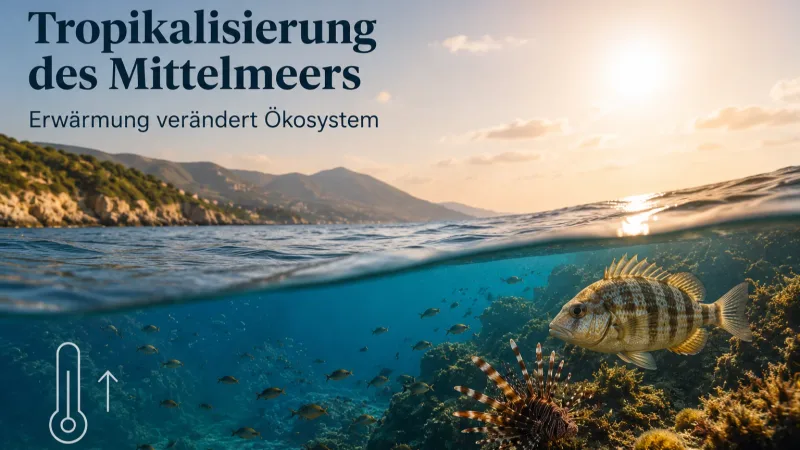
This development is increasingly altering underwater living conditions. Heat-loving species are expanding, while species dependent on cooler conditions are coming under pressure. Experts refer to this as the “tropicalization” of the Mediterranean Sea.
The Mediterranean Sea Becomes a Marine Warming Hotspot
The warming affects more than just the Mediterranean Sea. According to the EU climate service Copernicus, global sea surface temperatures reached a record for July 2026 this month. European seas were also exceptionally warm. The Atlantic along the European coast and the Western Mediterranean were particularly affected.
On August 22, the average global sea surface temperature between 60 degrees South and 60 degrees North latitude reached 21.1 degrees Celsius, according to Copernicus – the highest daily value ever recorded. The record values show that the current warming is not limited to individual coastal regions.
For the Mediterranean Sea, this development is particularly pronounced. A study by World Weather Attribution (WWA) concludes that climate change increased the intensity of extreme marine heat in the Eastern and Western Mediterranean this summer by approximately two degrees Celsius.
Extremely Warm Seas Transform Entire Ecosystems
High water temperatures are more than a short-term weather phenomenon for marine ecosystems. Species adapted to specific temperature ranges come under pressure. Other species, however, find better conditions to proliferate.
The WWA analysis shows that the distribution of marine heatwaves has significantly changed due to warming. In the Western Mediterranean, approximately 80 percent of the examined region was affected by a marine heatwave. In a hypothetical climate without the current human-induced warming, modeling suggests this would have been only about 40 percent.
Such heatwaves can lead to mass mortality among corals, sponges, and algae. When such species disappear, this has consequences for other parts of the food chain. Fish, invertebrates, and marine mammals can also be affected.
Why More Tropical Species Are Appearing
The change is particularly visible in species. Biologist Guido Gnone from the Aquarium of Genoa describes this development as tropicalization. This refers to a gradual shift in species composition favoring heat-loving species.
The Suez Canal plays an important role here. Since its opening in 1869, species from the Red Sea and the Indo-Pacific can more easily enter the Mediterranean Sea. For a long time, the differing environmental conditions acted as a natural barrier. With the warming of the Mediterranean, this barrier is weakening.
Today, lionfish, rabbitfish, flutemouths, and silver-cheeked toadfish, among others, can be found in the Mediterranean Sea. Some of these species can establish themselves in the warming waters, displacing native species or competing with them for food and habitat.
Gnone therefore does not expect a return to the former state. “The Mediterranean Sea will not be as it once was,” the biologist tells SRF.
Native Species Also Under Pressure
The change affects more than just newly immigrated species. Animals that have belonged to the Mediterranean for centuries also need to adapt to the new conditions.
One example is the Common Bottlenose Dolphin. If its prey retreats to deeper areas due to higher water temperatures, foraging becomes more difficult for the dolphin. Its habitat thus changes not only geographically but also in terms of food availability.
Other species, however, benefit, at least temporarily. The Loggerhead Sea Turtle, for example, is expanding its range northward. It now nests in the Ligurian Sea, although its traditional breeding grounds are further southeast.
This development does not mean that every species is equally harmed by climate change. Instead, a new composition of the ecosystem emerges – with winners and losers.
Swiss Researcher Investigates Changes
Swiss research is also involved in examining this development. Climate researcher Thomas Frölicher from the University of Bern is among the authors of the current WWA analysis.
The researchers compared observational data with climate models to investigate the extent of human-induced warming's contribution to the exceptional sea temperatures. The result is clear: In the two Mediterranean regions studied, the additional warming attributed to human climate change is approximately two degrees.
Frölicher's warning is not about an isolated Mediterranean development. The changes extend from the Atlantic off Ireland to the Mediterranean Sea. According to the researchers, European seas have warmed faster than could be expected from natural fluctuations alone.
Consequences Reach the Coasts
Sea warming affects more than just fish and other marine animals. Warmer seawater can also alter conditions on land. A higher sea surface temperature leads to more evaporation and can heat the air over coastal regions and enrich it with additional moisture.
Thus, marine warming can also influence human health and coastal economies. Additionally, there are potential consequences for fishing, aquaculture, and tourism. Prolonged marine heatwaves are particularly problematic because ecosystems recover slowly from extreme temperatures.
No Return to the Former Mediterranean in Sight
Current data paints a clear picture: The Mediterranean Sea is warming, and climate change is intensifying extreme temperatures. Simultaneously, the composition of species is changing.
How strongly this development continues depends significantly on further climate warming. The WWA analysis concludes that the extreme sea temperatures studied could be an additional 1.3 to 1.9 degrees higher in a world that is 1.4 degrees warmer.
Protection and adaptation can limit the consequences. This includes protecting sensitive habitats, adapting fishing and aquaculture practices, and improving monitoring systems for marine heatwaves. However, these measures do not eliminate the fundamental cause of warming.
The Mediterranean Sea is thus not only a popular holiday destination but also a visible indicator of climate change. What appears today as unusually warm bathing water can signify a profound change in marine life beneath the surface.
Sources
- SRF: “Ever warmer oceans – How tropicalization is changing the Mediterranean Sea”, August 27, 2026.
- World Weather Attribution: “Climate change is driving unprecedented European ocean temperatures, with severe impacts for marine life”, August 19, 2026.
- Copernicus Climate Change Service: Sea surface temperatures July and August 2026.
- Copernicus Marine Service: Current measurement and observation data on Mediterranean Sea surface temperature.
- University of Bern, Oeschger Centre: Research by Thomas Frölicher on ocean warming and climate change.