Messi Says Goodbye to Argentina: The End of an Era
World champion ends international career after 207 games.
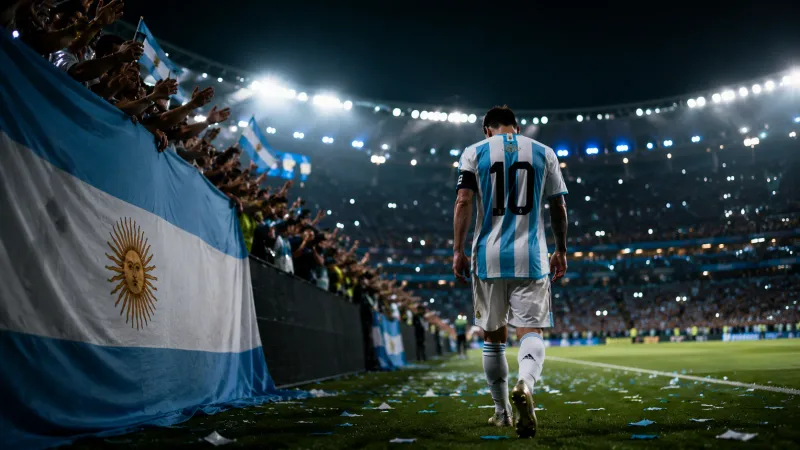
Lionel Messi ends his career with the Argentine national team. The 39-year-old announced his retirement on Monday – weeks after the lost World Cup final against Spain. Notably: Messi had already written his farewell words two days after the final match. Following the death of his father Jorge, he felt even more resolute in his decision.
It is the end of an era. Lionel Messi will no longer play for Argentina. The 39-year-old captain of the "Albiceleste" announced his retirement from the national team on Monday. His last appearance was the World Cup final on July 19 in New York, which Argentina lost 0-1 to Spain.
Messi chose no grand stage or press conference for his farewell. Instead, he published a personal text on Instagram. In it, he writes that the decision "hurt and still does," but he understood that the right time had come.
It is a remarkably sober farewell for a player whose national team career spanned over two decades, marked by extraordinary highs and painful defeats.
The Farewell Was Decided Long Ago
A note at the end of Messi's Instagram post says much about his current phase of life. He had already written the words on July 21 – two days after the World Cup final. The public announcement, however, took more than a month.
During this time, his father Jorge Messi died. He succumbed to a prolonged illness on August 8 in Rosario at the age of 68. Jorge was not only Messi's father but also an important figure in his career and his advisor for years. Messi had publicly expressed doubts about his continued football career after his father's death.
Now Messi writes that his father's death even strengthened him in his decision. The retirement is thus not only a sporting turning point. It comes at a time when much is changing personally for the Argentine.
207 Games, 125 Goals, and the One Big Dream
Messi's numbers for Argentina are historic. In 207 international matches, he scored 125 goals – both are national records. Since his debut in 2005, he developed from a highly talented young player into the central figure of an entire football generation.
For a long time, the national team seemed to remain his difficult chapter. Messi lost the 2014 World Cup final against Germany with Argentina and failed twice in the Copa América finals in 2015 and 2016.
In 2016, after another final defeat, he had already announced his retirement once before. However, he returned. What followed then definitively changed his history with Argentina.
From Eternal Loser to World Champion
In 2021, Argentina won the Copa América. A year later, the peak followed in Qatar: Messi led the "Albiceleste" to the World Cup title, becoming, after Diego Maradona, the next Argentine World Champion with his own historical significance.
In 2024, Argentina won the Copa América again. Messi had thus won the major international titles that he had long been missing.
The 2026 World Cup could also have been a perfect final chapter. Argentina again reached the final – but Spain won 1-0. Messi was thus denied a second World Cup title. At the same time, it was already clear after the match: This was his last tournament with Argentina.
Now Begins the Post-Messi Era
Argentina must now prepare for a national team without its most influential figure in years. Messi himself refers to the younger generation in his farewell. He states that excellent young players deserve their place.
This is more than a friendly gesture. It describes the next challenge for the national coach and the association: Argentina must learn to function without the player on whom the team could rely in decisive moments for years.
The new generation is already ready. Players like Julián Álvarez, Lautaro Martínez, and Enzo Fernández have gained international experience. But none of them can simply replace Messi. His role was not only sporting. He was captain, playmaker, goal scorer, and figurehead all at once.
Messi Is Not Quitting Football
His retirement from the national team does not automatically mean the end of his career as a professional footballer. Messi remains under contract with Inter Miami. He left open how long he intends to continue playing at club level in his farewell message.
This distinguishes this farewell from a complete retirement. Messi is saying goodbye to Argentina – not to football.
Perhaps this is the most fitting conclusion for his international career. Messi is not leaving because football no longer means anything to him. On the contrary: In his farewell text, he writes that he has always loved the national team. But he gave everything and now has nothing more to give.
His last appearance in an Argentine jersey was thus a defeat. But his story with the "Albiceleste" will hardly be measured by it.
It will be measured by Qatar, by the Copa América, by 207 games, 125 goals – and by a generation of Argentines who grew up with a dream and finally saw it fulfilled with Messi.
The Messi era in the Argentine national team is over. What remains is the more difficult task: figuring out how Argentina moves forward without him.
As of: August 31, 2026.