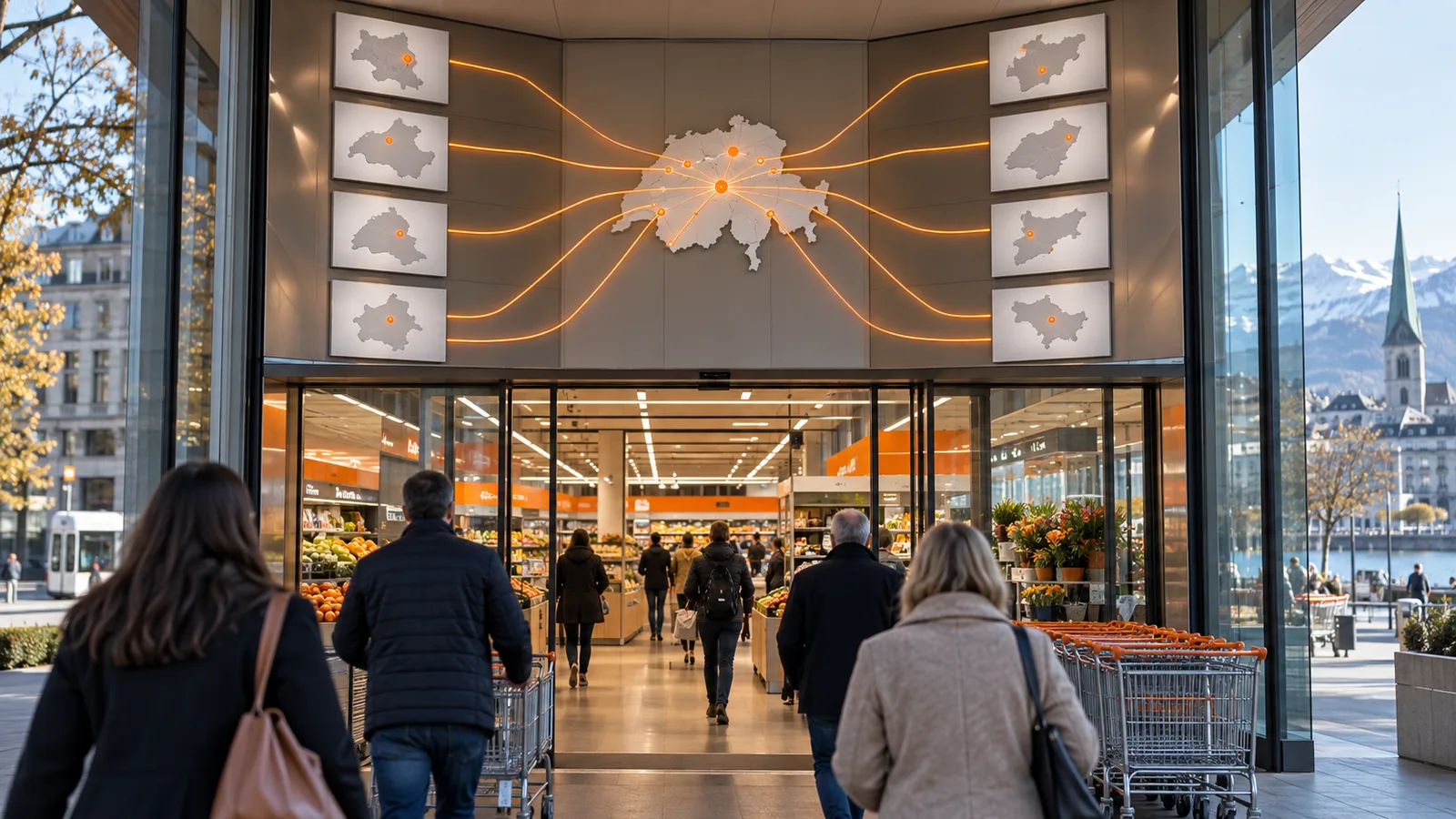
Migros weighs overhaul of its ten cooperatives: who decides
A possible centralisation would change ownership, control and regional closeness. No decision has been taken yet – but the governance questions are central.
Migros weighs a rebuild of its historic structure
Migros could be facing one of the biggest organisational changes in its history. According to information from the «NZZ am Sonntag», models are being examined that would fundamentally change today's ten regional cooperatives. Reportedly under discussion are, among other things, a reduction to three cooperatives or even a merger into a single cooperative.
No such decision has been taken so far. Migros has not published any binding target structure. This distinction matters: a variant examined internally is not a decided corporate overhaul.
The real question also goes far beyond a new organisational chart. The ten regional cooperatives are not mere sales regions of a central company. They are legally independent cooperatives and, together with the Migros-Genossenschafts-Bund (MGB), its companies and foundations, they form the Migros community.
Migros is not simply owned by a corporate centre
Today's structure distributes power across several levels. The ten regional cooperatives run their own bodies and have their own members. At the same time they are the bearers of the Migros-Genossenschafts-Bund.
The MGB's cooperative capital also sits with the regions. The shares are spread very unevenly, however: according to the 2025 annual report, Migros Zürich holds around 32.3 percent, Migros Aare 19.8 percent and Migros Ostschweiz 11.4 percent. Voting rights, though, do not simply follow these capital shares.
This makes Migros fundamentally different from a classic listed group with a central shareholder structure. A restructuring would therefore not only have to rearrange operational responsibilities. Depending on the model, ownership structures, articles of association, member rights and regional assets would also be affected.
Who decides at the Migros-Genossenschafts-Bund today?
An important centre of power is the MGB's delegates' assembly. According to its articles, it consists of 111 members. One hundred delegates are sent by the ten regional cooperatives. Added to that are one representative from each of the ten regional administrations and the independent president.
The seats of the hundred elected delegates are allocated according to membership numbers. Migros Aare currently holds 17 seats, Migros Ostschweiz 14 and Migros Zürich 12. The smaller cooperatives also have guaranteed representation.
The powers of this body are considerable. The delegates' assembly can, among other things, amend the MGB's articles, elect or remove members of the administration, decide on fundamental business policy and even resolve the dissolution of the Migros-Genossenschafts-Bund.
That does not automatically mean, however, that the delegates' assembly alone could merge ten independent regional cooperatives into a new organisation.

The decisive question: do members have to vote?
This is precisely the most interesting point in the reform debate.
The ten regional cooperatives have their own articles, administrations, cooperative councils and member rights. Which bodies would have to approve a merger therefore depends on how a concrete reform would be legally designed.
A change within the MGB is something different from the merger or dissolution of legally independent regional cooperatives. Depending on the construction, decisions could therefore be needed at several levels.
Without an official proposal, no one can currently claim credibly that all of the roughly 2.3 million cooperative members would necessarily have to vote. Equally, it cannot yet be said that the centre alone could decide on such a restructuring.
This very question is likely to become politically and cooperatively decisive: if Migros fundamentally changes its ownership structure, what direct voice will the people who back the company as cooperative members have?
Centralisation has already begun
A possible restructuring would not come out of nowhere. In recent years Migros has already bundled tasks more tightly.
Since 2024, Migros Supermarkt AG has taken on central tasks in the supermarket business. The leadership of the Migros-Genossenschafts-Bund has also changed. The MGB's administration was reduced from 23 to 13 members as of July 2024.
Regional representation is particularly notable: the current 13-member administration includes five representatives of the ten regional cooperatives. Added to that are two employee representatives and six external, independent members including the president.
The administration holds far-reaching powers. It sets Migros's strategy and its commercial and non-commercial goals, creates leadership and organisational structures and oversees the general management. Operational leadership rests with the general management.
A reform of the regional cooperatives would therefore build on a development in which more tasks and strategic decisions are already coordinated group-wide.
What three cooperatives – or one – could change
What concrete effects a reform would have on stores, product ranges, jobs or prices cannot currently be determined. There is no official proposal to go on.
In principle, fewer organisational units could reduce duplication and simplify joint decisions. On the other side, it would have to be clarified which regional responsibilities would remain and how local interests would be represented in future.
The asset question would also become relevant. Today's cooperatives differ considerably in size, membership, turnover, property holdings and economic position. A merger would therefore not simply be the merging of ten names on an organisational chart.
It would have to answer where assets and decision-making rights would lie in future and how the interests of regions of very different sizes would be taken into account.
Migros members become the decisive test
Migros traditionally describes its cooperative members as co-owners. In a fundamental structural reform, this term takes on concrete meaning.
What matters would not only be whether members can still vote. It also matters what they are allowed to vote on. Would regional bodies be merged? Would their own cooperative councils remain? How would delegates be elected in future? And which level controls the central leadership?
A single cooperative would still legally be a cooperative. It would therefore not automatically mean the end of the cooperative model. But it could change the level at which members and regions influence strategic decisions.
The most important question remains unanswered
So far there is no official proposal on which a decision could be taken. It would therefore be premature to speak of the abolition of the ten regional cooperatives as a done deal.
The scale under discussion is considerable nonetheless. A reduction from ten independent cooperatives to three or even a single organisation would be more than an operational reorganisation. It could change ownership structures, participation rights and the distribution of regional power within Migros.
Only when Migros presents its concrete model will it be possible to answer definitively who actually has the last word: the MGB's central bodies, the bodies of the regional cooperatives or the cooperative members themselves.
Sources
- Migros-Genossenschafts-Bund: Annual Report 2025 – Organisation and structure
- Migros-Genossenschafts-Bund: Annual Report 2025 – Delegates' assembly
- Migros-Genossenschafts-Bund: Annual Report 2025 – Administration
- Migros-Genossenschafts-Bund: Articles of association and regulations
- «NZZ am Sonntag»: report on the possible reform of the regional cooperatives, September 2026


