Neutrality Initiative: What a 'Yes' Would Mean
Popular Initiative on Neutrality
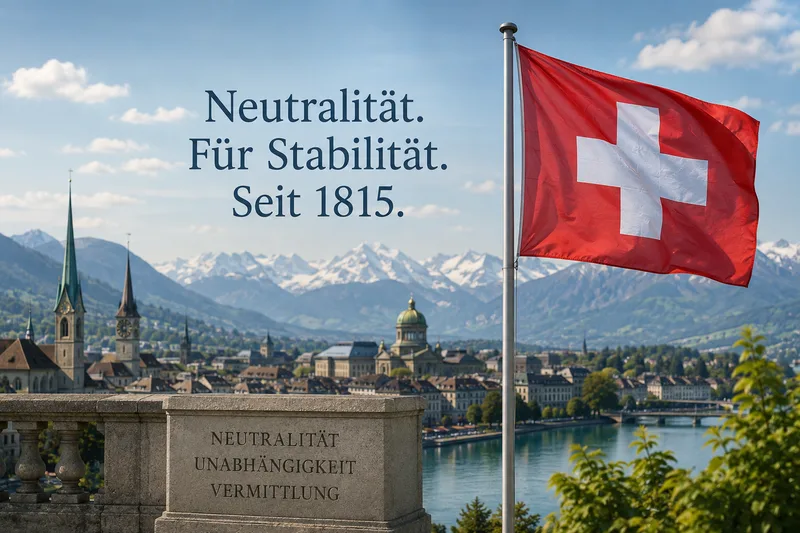
Neutrality Initiative: Between Brussels, Washington, and Moscow – Which Path for Switzerland?
On September 27, 2026, the Swiss electorate will decide on a significantly stricter anchoring of neutrality in the Federal Constitution. The initiative seeks, among other things, to prohibit Switzerland from imposing sanctions against warring states unless decided by the UN. This is not solely due to the war in Ukraine. It concerns a fundamental question: Can Switzerland remain neutral, cooperate closely with Europe and the USA, and still credibly mediate between conflicting parties in an emergency?
Switzerland has been considered a neutral country for centuries. Its permanent neutrality was internationally recognized in 1815 and enshrined in the Federal Constitution in 1848. It constitutes one of the most important elements of Switzerland's political self-conception and has long afforded the country a special international standing.
However, the world in which Swiss neutrality emerged and developed has changed. The Russian attack on Ukraine, the increasing confrontation between Russia and the West, closer European security policy cooperation, and tensions between the USA and other Western states pose new questions for traditional Swiss policy.
The Decisive Test Came in 2022
This area of tension became particularly clear after the Russian attack on Ukraine on February 24, 2022.
Switzerland did not participate militarily in the war. At the same time, the Federal Council had to decide whether Switzerland should join the far-reaching European Union sanctions against Russia.
Initially, Bern held back. However, on February 27, President and Foreign Minister Ignazio Cassis stated it was “very likely” that Switzerland would follow the EU sanctions. One day later, the Federal Council indeed decided to adopt the EU sanction packages of February 23 and 25 and freeze the assets of sanctioned individuals and companies.
The decision was politically notable. Switzerland had not taken Ukraine's side militarily, but had adopted a clear economic and political stance against Russia.
This step garnered significant international attention. Reuters then described the decision as a clear departure from traditional Swiss neutrality. In the following years, Switzerland repeatedly faced pressure to implement sanctions more consistently and close loopholes for Russian assets.
Was There Pressure from Germany and Brussels?
The short answer is: Yes, there was international pressure – but direct German coercion cannot be inferred from the available sources.
The European Union had established a massive sanctions regime after the Russian attack. For Switzerland, the issue was particularly delicate because it is economically closely linked to the EU and is simultaneously one of the major international financial and commodity trading centers.
International pressure therefore did not only focus on the fundamental adoption of sanctions. Switzerland was also repeatedly criticized later for the potential use of Russian assets or trade transactions via the country to circumvent Western sanctions.
Additional political pressure also came from Germany and other European states after the Russian attack on Switzerland, particularly regarding military support for Ukraine and the re-export of Swiss war materiel. Reuters later reported increasing pressure from European neighbors on Switzerland.
However, this does not mean that Berlin or Brussels can simply issue orders to Switzerland. Switzerland is not an EU member and decides on its foreign policy independently. The Federal Council adopted the sanctions on its own initiative.
The political reality is different, however: A small country, economically closely linked to Europe, cannot completely escape the political environment of its most important partners.
Switzerland is Neutral – But Deeply Connected to Europe
This is precisely where today's neutrality debate begins.
Switzerland is militarily non-aligned. At the same time, it cooperates closely with European states. For example, it participates in NATO's Partnership for Peace and is part of the European Sky Shield Initiative, launched by Germany to strengthen cooperation in European air defense.
Security policy cooperation is also tightening with the European Union. In March 2026, Switzerland and the EU agreed on deepened cooperation in security and defense, including regular dialogue, enhanced information exchange, and closer collaboration in crisis management and peace mediation.
This shows: Switzerland is neutral, but by no means isolated.
What Does This Mean for the Role of Mediator?
Switzerland has always linked its neutrality to its role as a mediator. During the Cold War, it could leverage its position between East and West. Even today, Switzerland offers its “good offices” and organized an international conference for peace in Ukraine at Bürgenstock in 2024.
However, an important question remains: Can a country credibly mediate between two conflicting parties if it imposes sanctions against one of them?
The Swiss government answers this question with a “Yes.” The FDFA explicitly argues that adopting EU sanctions against Russia does not nullify Swiss neutrality. Switzerland remains militarily neutral and can continue to offer good offices.
Others view the matter more critically. If a conflicting party knows that Switzerland supports its sanctions and increasingly coordinates its security policy with its partners, it might view Switzerland as a less than fully independent mediator.
The debate is therefore not merely theoretical. Russia has repeatedly criticized Switzerland for its sanctions policy. The international perception of Swiss neutrality has also changed since 2022.

What Happens if the USA and EU Oppose Each Other?
This question makes the neutrality debate particularly interesting.
Switzerland has close relations with both Europe and the United States. On many international issues, Washington and Brussels are aligned. However, this may not always remain the case.
A current example already shows that Switzerland can also apply its neutrality towards the USA. During the Iran War in 2026, Switzerland denied certain overflights to US military aircraft and stopped issuing new permits for arms exports to the USA because the United States was involved in an international armed conflict.
This brought a question into practical focus, one of great importance for the Neutrality Initiative: What does Switzerland do if an important partner itself becomes a party to a conflict?
And further still: What if the USA and the European Union were to impose different sanctions in a future international conflict, and both sides expected Switzerland to align with their respective stances?
Switzerland would have to decide. It could support the American stance, adopt the European stance, or distance itself from both sanctions regimes.
Precisely in such a scenario, a more strictly enshrined neutrality in the Constitution could provide Switzerland with an argument to generally refrain from the sanction measures of conflicting parties.
The Constitution as a Shield Against External Pressure?
This is one of the strongest arguments of the initiative's proponents.
Today, the Federal Council possesses a certain degree of flexibility in neutrality policy. Regarding sanctions, within the framework of current law, it can decide whether and to what extent Switzerland participates in international measures.
Adopting the initiative would significantly reduce this scope. The Constitution would explicitly state that Switzerland does not impose sanctions against warring states. UN sanctions and measures to prevent their circumvention would remain permissible.
For proponents, this means more than a legal change. They see it as a potential protection against international pressure.
If Germany, the EU, the USA, or another important partner were to demand that Switzerland join a sanctions regime in a future crisis, Bern could refer to its own Constitution.
The government would thus have less political leeway to comply with such a request.
This does not mean that international pressure would disappear. Another state could continue to exert political, economic, or diplomatic pressure. But the Swiss government could argue that, due to the Constitution, the relevant decision is no longer available to it.
The Neutrality Initiative might therefore not eliminate external pressure, but rather reduce Switzerland's ability to politically yield to this pressure.
The Federal Council Sees This as a Danger
The Federal Council and Parliament reject the initiative. They consider current neutrality sufficiently clear and warn against a loss of room for maneuver.
Federal Councillor Ignazio Cassis argues that with a rigid neutrality rule, Switzerland might only be able to react in a crisis once the conflict has already begun. However, security policy cooperation must sometimes be prepared long before a potential attack.
From the Federal Council's perspective, flexibility is therefore precisely a component of Swiss security.
Opponents of the initiative also warn that particularly strict neutrality could strain relations with neighboring states and isolate Switzerland in terms of security policy.
Neutrality Does Not Automatically Protect Against Conflicts
Another difficulty lies in the fact that modern conflicts are no longer fought solely with tanks and aircraft.
Switzerland is affected by cyberattacks, espionage, disinformation, and the economic consequences of international conflicts. The war in Ukraine, in particular, has shown that a neutral state can be in the midst of a geopolitical confrontation without itself being a belligerent party.
The question is therefore not only: “Does Switzerland remain militarily neutral?”
It also asks: To what extent can a neutral state cooperate politically, economically, and in terms of security policy with other states without losing its special status?
Banking Secrecy is Gone – Neutrality Remains
The debate also recalls another historical change in Switzerland's international standing.
For decades, Switzerland was strongly associated internationally with two terms: neutrality and banking secrecy.
Traditional banking secrecy has now largely lost its former significance. Switzerland currently participates in the international automatic exchange of information on financial accounts. The rules governing the Swiss financial center have thus fundamentally changed.
Neutrality, however, persists. It remains an essential component of Switzerland's international image and foreign policy.
This is precisely why the current vote is of particular importance for Switzerland: After the largely ended special status of banking secrecy, the question arises as to how strongly Switzerland wishes to define its future international independence through its neutrality.
A Decision Between Flexibility and Independence
The Neutrality Initiative is thus more than a vote on sanctions against Russia.
It touches upon a fundamental question of Swiss state and foreign policy.
Opponents say: Switzerland needs sufficient room for maneuver to react to new crises. It must be able to cooperate with Europe, NATO, and other partners to strengthen its own security.
Proponents say: Especially in crises, Switzerland needs clear boundaries. If neutrality is bindingly enshrined in the Constitution, the government can less easily change its position under foreign pressure.
Both sides thus speak of independence – but they mean something different.
For some, independence means keeping as many options open as possible.
For others, independence means not adapting to the policies of powerful partners, even when international pressure becomes significant.
The Decisive Question for September 27
Therefore, on September 27, 2026, the Swiss electorate will not decide whether Switzerland should be neutral in the future. Switzerland is already a neutral state.
Instead, the vote concerns how binding this neutrality should be in the future and how much room for maneuver the Federal Council and Parliament should retain in an international crisis.
The war in Ukraine has shown how quickly a neutral state can come under international pressure. The Iran War in 2026, in turn, demonstrates that the same neutrality rules can also have practical consequences for the USA. And should an open political conflict between Washington and Brussels arise one day, Switzerland could again face a difficult decision.
Stricter neutrality could help it draw a clear legal line with respect to both sides. More flexible neutrality, on the other hand, would allow it to weigh different interests depending on the situation.
The vote on September 27 moves precisely between these two concepts.
Sources
- Swiss Confederation, Federal Council: "Neutrality Initiative."
- Federal Department of Foreign Affairs: "Questions and Answers on Swiss Neutrality."
- Federal Council: Adoption of EU Sanctions Against Russia, February 28, 2022.
- Reuters: "Neutral Swiss join EU sanctions against Russia in break with past," February 28, 2022.
- Reuters: "Swiss to vote on whether to tighten neutrality," August 26, 2026.
- Reuters: "Switzerland halts weapons exports to US due to Iran war, citing neutrality," March 20, 2026.
- Reuters: "Neutral Switzerland joins European Sky Shield defense project," April 10, 2024.
- Swiss Confederation: Information on security policy cooperation with the EU.