Pediatrician Shortage: Why Your Canton of Residence Matters
New Study Reveals Major Differences in Pediatric Care – And Surprising Reasons
For families, where they live in Switzerland can make a big difference. A new study by the University of Bern and pädiatrie schweiz shows that the density of primary pediatric care varies massively between cantons.
In 2024, a total of 1,499 pediatricians worked in primary care in Switzerland. Converted to full-time positions, this amounted to approximately 1,017 full-time equivalents. On average across Switzerland, one full-time equivalent pediatrician served about 1,600 children under 18 years.
Worlds Apart Between Geneva and Appenzell
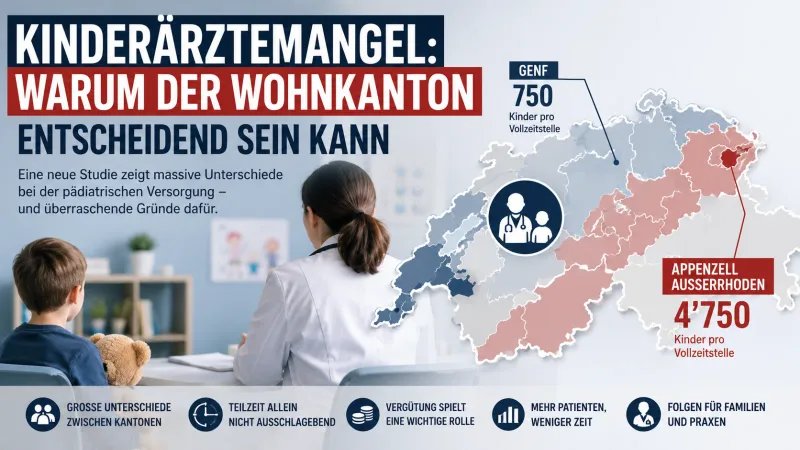
The differences become particularly clear when comparing the cantons. In Geneva, one full-time equivalent pediatrician serves around 750 children. Basel-Stadt, Vaud, and Ticino also show a comparatively high density of care.
The situation is quite different in Appenzell Ausserrhoden: there, approximately 4,750 children are served by one full-time position. In Obwalden, it is about 4,150, in Schaffhausen 3,550, and in Thurgau 3,100.
Calculated figures show that Appenzell Ausserrhoden has more than six times as many children per full-time equivalent pediatrician as Geneva.
Around two-thirds of the surveyed pediatricians also stated that there is a shortage of primary pediatric care in their region. This shortage is particularly often perceived in rural areas.
Swiss Average Exceeds US Guideline
The study authors compare the Swiss situation with a US recommendation of 1,200 to 1,400 children per pediatrician. The Swiss average of approximately 1,600 children per full-time position is higher than this.
For comparison: For adult medicine, the FMH recommends one general practitioner per 1,000 inhabitants. However, examinations of children often require more time than adult consultations.
Part-Time Work Not the Full Explanation
A frequently cited reason for the pediatrician shortage is the increasing prevalence of part-time work. Indeed, 87 percent of practicing pediatricians work less than 95 percent. The median workload is 70 percent.
However, the result of the statistical analysis is interesting: the level of average workloads does not systematically explain the differences between the cantons.
While two-thirds of respondents believe that part-time work exacerbates the shortage, the data does not show that cantons with a particularly high number of part-time positions are automatically less well-served.
Another point to consider: pediatricians worked a median of 35 hours per week. Projected to a full-time workload, this equals approximately 50 hours. Therefore, part-time does not necessarily mean a low actual workload.
Remuneration Plays a Role
The researchers found a stronger statistical correlation with remuneration. Higher cantonal tax point values in the then-applicable Tarmed tariff were associated with a higher density of pediatricians.
Statistically, this factor was associated with almost 40 percent of the cantonal differences in pediatrician density. However, this does not imply that higher tariffs automatically lead to a specific number of additional pediatricians.
The study also mentions other factors, including increasing administrative burdens, rising parental expectations, and the financial risk of owning a practice.
Doctors in Underserved Cantons Treat More Children
The differences are evident not only in statistics but also in daily practice. In cantons with less than 0.5 full-time positions per 1,000 children, pediatricians treat a median of approximately 25 patients per day. In better-served cantons, it is 17.
There is also a difference in preventative check-ups: in underserved cantons, approximately 30 minutes are allocated, while in well-served cantons, it is about 40 minutes.
The bottleneck for accepting new patients is even more pronounced. In underserved cantons, only 18 percent of practices accept all new patients. In well-served cantons, this figure is 51 percent.
What Does This Mean for Families?
For parents, a low pediatrician density can mean longer travel times, difficulties finding a practice, or resorting to other medical services.
The University of Bern points out that parents and professionals have reported difficulties for several years in finding a pediatrician or getting a quick appointment for acute problems. Many families therefore resort to emergency rooms at children's hospitals even for less severe cases.
However, direct waiting times were not examined in the study. Therefore, the figures on doctor density cannot directly indicate how long a family in a particular canton has to wait for an appointment.
The Ball is Now in Politics' Court
The study primarily provides a detailed inventory. It shows that the pediatrician shortage is not uniformly severe everywhere, and that simple explanations like part-time work are insufficient.
The researchers identify starting points in financial frameworks, the reduction of administrative burdens, and in basic and continuing education in primary pediatric care.
This poses a concrete question for politicians: How can pediatric care be strengthened in areas where families currently have particularly limited access to pediatric practices?
A follow-up study will also examine the parents' perspective. This could provide a more accurate assessment in the future of how regional differences actually affect family care.
Sources
- University of Bern: «Bern Study Shows: Pediatricians Lacking – Massively Depending on Canton», September 1, 2026
- Swiss Medical Weekly: «Shortages of Pediatric Primary Care and Contributing Factors in Switzerland», 2026
- Medinside: «Pediatric Care is a Matter of Luck», September 2, 2026