Rain Not Enough: Federal Government Calls for More Water Saving
Drought Persists: Cantons and Population Urged to Act
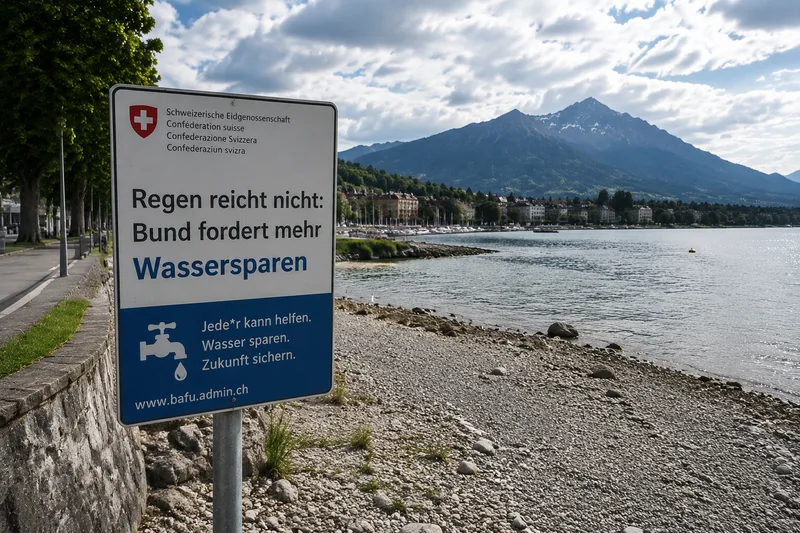
Recent rainfall has not compensated for the persistent drought in Switzerland. The Federal Council and the Federal Office for the Environment (BAFU) are therefore calling on the cantons and the public to use water sparingly. In a media release dated July 24, 2023, BAFU stated: "Recent precipitation could not offset the drought." The situation remains tense, particularly in Western Switzerland and parts of the Central Plateau. The Alps are also affected, with an unusually high snowline.
Regional Differences
Rainfall over the past few days varied significantly by region. While the Alps locally received up to 50 litres per square meter, Western Switzerland remained largely dry. According to the Federal Office of Meteorology and Climatology (MeteoSchweiz), soil moisture in affected areas is well below the seasonal average. The cantons of Vaud and Valais are particularly affected, with rivers and streams carrying less water than usual. The situation in the Jura is also tense. Some municipalities have already implemented irrigation bans for private gardens.
The Federal Government reminds that water is a shared resource that must not be wasted. Cantons are responsible for water management. They can restrict water extraction for irrigation or prescribe alternative water sources. Some cities have already announced a ban on daytime garden watering. Other cities may follow. Water-saving cultivation methods are needed in agriculture. Read more in our article on the Water Scarcity in Western Switzerland.
Consequences for Agriculture
Agriculture suffers from the persistent drought. In the Central Plateau, yields of various crops are at risk, including cereals, potatoes, and vegetables. Water supply is particularly difficult in regions with light soils. Many farmers must irrigate more frequently, which increases water demand and further strains groundwater reserves. Agricultural associations expect significant crop losses if the drought continues. Early harvesting could be a solution for some crops.
The Federal Government is therefore examining support measures for affected farmers. The Federal Office for Agriculture (BLW) is closely monitoring developments. One option is the facilitated use of emergency water for irrigation. Farmers are also urged to plan cultivation more carefully and to rely on drought-tolerant varieties. The Farmers' Association demands unbureaucratic assistance from the Federal Government. Our editorial team has summarized how agriculture is reacting to the drought in this article.
Energy and Hydropower
The drought also impacts energy production. The reservoirs of Swiss hydropower plants are low. According to the Federal Office of Energy (BFE), the filling level at the end of July 2023 was below the long-term average. Electricity production from hydropower is expected to decrease significantly in the coming weeks. This could affect supply security next winter, especially if neighboring European countries also suffer from water scarcity. Large energy consumers are urged to review their energy planning and consider using backup power in this situation.
The Federal Government recommends that the public reduce water consumption. Collecting rainwater, repairing leaky faucets, and using water-saving devices are simple but effective steps. BAFU announced it will publish detailed information materials with concrete tips in the coming days. "We ask everyone to use water responsibly," says a BAFU spokesperson. A relaxation of the situation is only expected with abundant, prolonged rainfall. Until then, every drop counts. Further recommendations can be found in this overview.