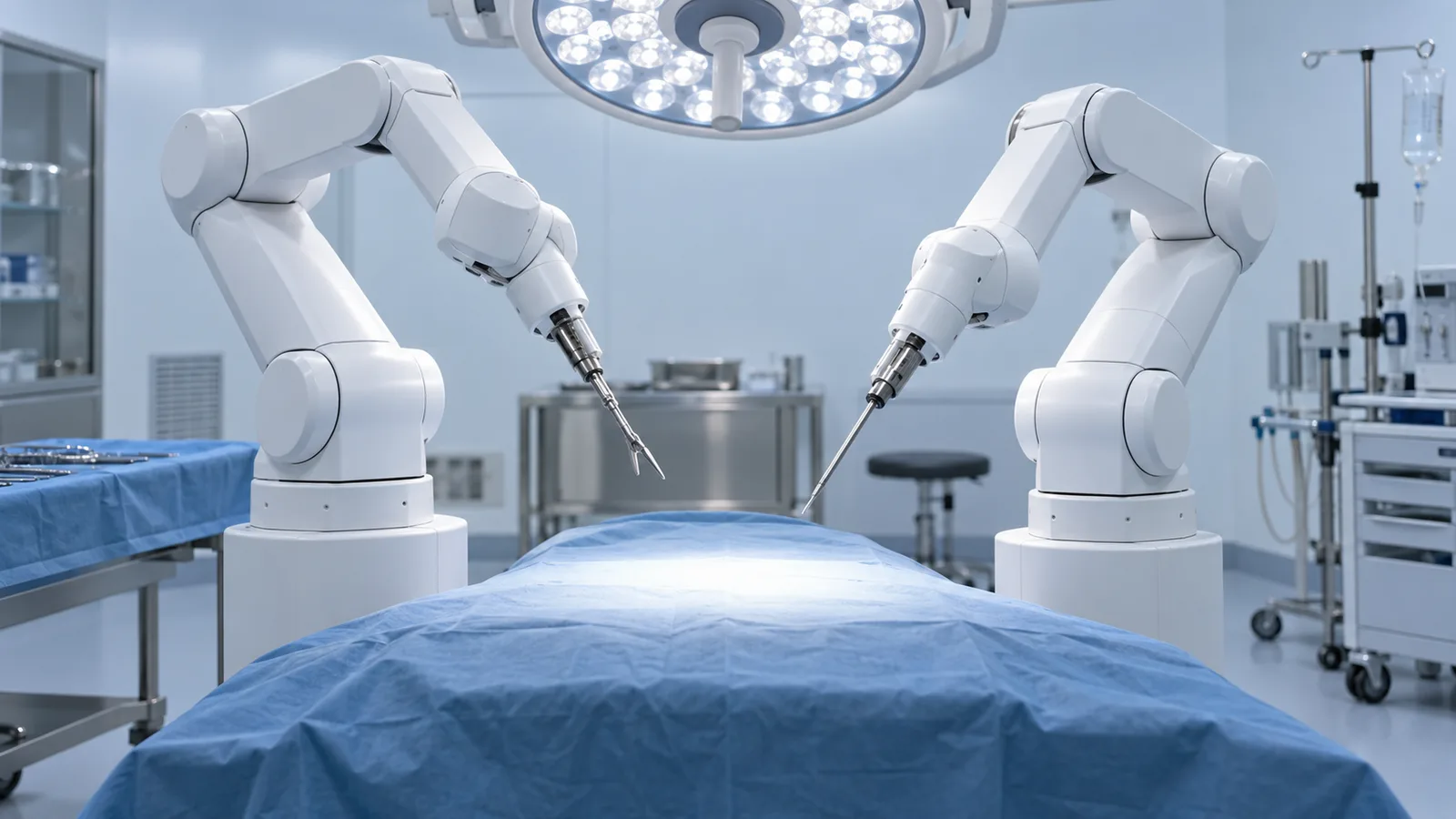
Robot Surgery Booms: Device Count Is Not the Decisive Question
Markedly more robot-assisted procedures were performed in Switzerland within a year. The trend can benefit patients – if benefit, training and costs stay transparent for each operation.

Surgical robots long ago stepped out of medicine's future narrative. They stand in more and more Swiss hospitals, accompany procedures in urology, gynaecology, visceral surgery and orthopaedics, and are increasingly marketed as a sign of modern care. According to research by Medinside, around 22,000 robot-assisted operations were performed last year – 25 percent more than in 2024.
The figure is considerable. But it does not automatically mean that a quarter more patients are now being treated better. A surgical robot does not operate on its own. It translates the movements of a surgical specialist into particularly finely controllable instruments and can improve visibility and mobility in certain procedures. Whether that produces an advantage for a specific person depends on the diagnosis, the method, the team's experience and the comparison procedure.
A tool, not an autopilot
"Robot surgery" is a seductive term because it sounds like autonomy. In the operating theatre, however, responsibility stays with people. Surgeons control the system, plan the procedure, decide on risks and can switch technique when it is medically necessary. The technology is therefore more a highly precise instrument than an actor in its own right.
Its strength often lies in minimally invasive surgery. Mobile instruments and an enlarged three-dimensional view can help in narrow anatomical spaces. In urology, robot-assisted radical prostatectomy is part of the standard offering in many centres. Procedures on the kidney, uterus or bowel are also performed with the technology.
In orthopaedics, the upswing is more recent. Medinside has reported particularly strong growth in knee prostheses since 2022. Here a system can support planning and alignment. Whether this translates into fewer complications, better long-term results or lower follow-up costs must, however, be examined in robust comparisons. Precision in the image or in the surgical record is not automatically the same as a clinically relevant advantage.
Evidence differs from procedure to procedure
The scientific literature on robot-assisted surgery is extensive, but not uniform. For some operations, studies show advantages in blood loss, length of stay or technical parameters. For others, results are comparable with well-established laparoscopic or open surgery. Differences can also be linked to a team's learning curve, case selection and the experience of a centre.
The question "robot-assisted or not?" is therefore not enough. More useful are concrete questions: for which indication? Against which comparison procedure? Which results are measured? And for how long are patients followed up? The Swiss surgical classification system CHOP does allow procedures to be recorded; for a broad quality debate, however, comparable outcome data is additionally required.
Investment, training and access
The systems are expensive, as are maintenance, instruments and training. Whether the extra costs are offset by shorter stays, fewer complications or more efficient workflows varies by specialty. For hospitals, an additional competition arises: those who offer the technology can attract specialists; at the same time, enough cases must be available for teams to develop a high level of routine.
The 25 percent growth shows a clear change in the Swiss operating theatre. But the yardstick for success must not be the number of robots or procedures. It must be: for which people does the technology demonstrably improve safety, recovery or outcome – and at what price?
Sources
- Medinside: Growth of robot surgery in Switzerland: medinside.ch/de/roboterchirurgie-25-prozent-mehr-operatione…
- Federal Statistical Office: Swiss surgical classification CHOP: https://www.mct.bfs.admin.ch/fr/chop/2025/hierarchy
- Swiss Medical Board: Publications: https://smartermedicine.ch/
- Cochrane Library: Research on robot-assisted surgery: https://www.cochranelibrary.com/


