Starlink in Vietnam: New Questions for Swiss Net Policy
Starlink in Vietnam: New Questions for Swiss Net Policy
Starlink in Vietnam: New Questions for Swiss Net Policy
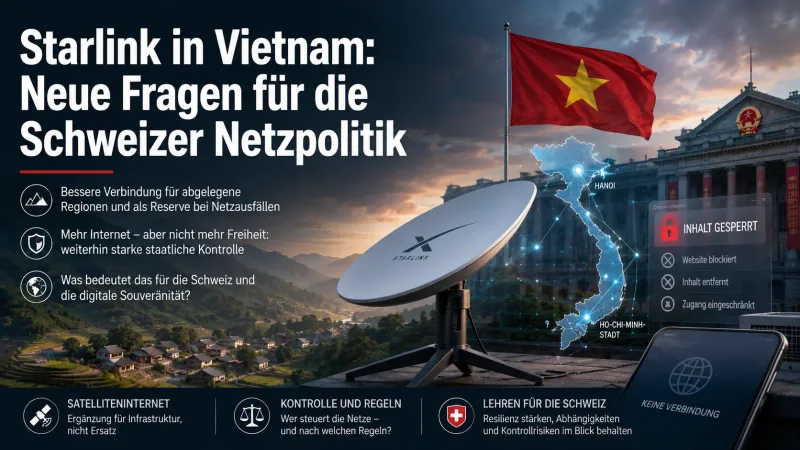
Vietnam allows Starlink to launch under state control. The satellite service aims to better serve remote regions and act as a backup during network outages. However, the case also shows: satellite internet does not automatically mean more internet freedom.
Since August 2026, customers in Vietnam can order Starlink subscriptions. SpaceX's satellite service primarily aims to reach regions where fiber optic or mobile network coverage is more challenging. At the same time, internet access in Vietnam remains heavily state-regulated.
The pilot project is limited until the end of 2030 and restricted to a maximum of 600,000 users. The cheapest rate for private customers costs approximately 1.13 million Vietnamese Dong or about 43 US dollars per month. The necessary hardware costs around 8.66 million Dong.
Vietnam Does Not Need Starlink for the Entire Country
Vietnam already has a relatively well-developed digital infrastructure. According to government figures, around 85.6 million people used the internet by the end of 2025. Approximately 85 percent of households had fiber optic connections, while there were over 110 million mobile broadband subscriptions.
Starlink is therefore intended to help primarily where traditional networks reach their limits. These include remote mountain regions and islands. Satellite internet could also play a role as a backup during typhoons, floods, or other events where terrestrial networks might fail.
However, the high price limits its spread. Especially in rural regions, a dedicated Starlink connection is unlikely to be worthwhile for many households. According to scientist Khac Giang Nguyen, shared connections for schools, clinics, or authorities might therefore become more important than individual subscriptions.
More Internet – But Not More Freedom
The political contradiction is particularly interesting: Starlink expands technical access to the internet but does not automatically change the rules under which this internet is used.
Vietnam is classified as "not free" in Freedom House's Freedom on the Net report. Authorities can block content and require platforms to remove specific posts. According to Deutsche Welle, Facebook, YouTube, and TikTok complied with more than 94 percent of such government requests in the first half of 2026.
Starlink is also not exempt from these conditions. The service is operated through the Vietnamese subsidiary Starlink Services Vietnam. Four gateway ground stations and up to 600,000 terminals were approved for the pilot operation.
This demonstrates a fundamental model in Vietnam: a state can allow foreign satellite technology while ensuring that the data traffic flowing through it remains within its legal and regulatory framework.
The Trade Policy Aspect
The approval of Starlink also has an economic policy dimension. Vietnam faced pressure due to its high trade surplus with the USA. The opening to a significant American company was therefore also interpreted as a signal to Washington.
However, the decision cannot be explained by trade policy alone. For Vietnam, Starlink also offers practical benefits: satellite internet can supplement existing infrastructure and increase the resilience of communication networks.
What Does This Mean for Switzerland?
The launch of Starlink in Vietnam does not initially have direct implications for Swiss net policy. However, the case raises a fundamental question that is also relevant for Switzerland: How much state control should be possible when private satellite networks become part of the digital infrastructure?
For Switzerland, satellite internet can be particularly interesting for supplying remote areas, supplementing existing networks, and providing communication in crisis situations. At the same time, different legal and political frameworks apply here than in Vietnam.
This raises not only the question of whether Starlink can provide fast internet. It also concerns who has access to such infrastructure in a crisis, who can control it, and what rules apply to the data traffic running through it.
Satellite Internet as Part of Digital Infrastructure
The Vietnam case therefore shows a development that goes beyond Starlink. Satellite internet is increasingly becoming a supplement to classic communication networks. Especially during natural disasters, power outages, or damaged fiber optic and mobile networks, a ground-independent connection can offer advantages.
However, this creates a new area of tension for states: they want to utilize the benefits of this technology without completely relinquishing control over critical communication infrastructures.
Vietnam shows that more internet access does not automatically mean more internet freedom. For Switzerland, a different question arises in the long term: How can the resilience of digital networks be strengthened without creating new dependencies or control possibilities?
Sources
- Deutsche Welle: Starlink in Vietnam – Internet Access Without Internet Freedom
- Reuters: Starlink starts taking orders for satellite internet service in Vietnam
- Reuters: Vietnam paves way for Starlink amid US trade pressure
- Freedom House: Vietnam – Freedom on the Net 2025
- Vietnam Ministry of Science and Technology: Mobile Internet Subscriptions