Trump Pursues Venezuela Oil: What It Means for Switzerland
A deal with great potential, but many open questions.
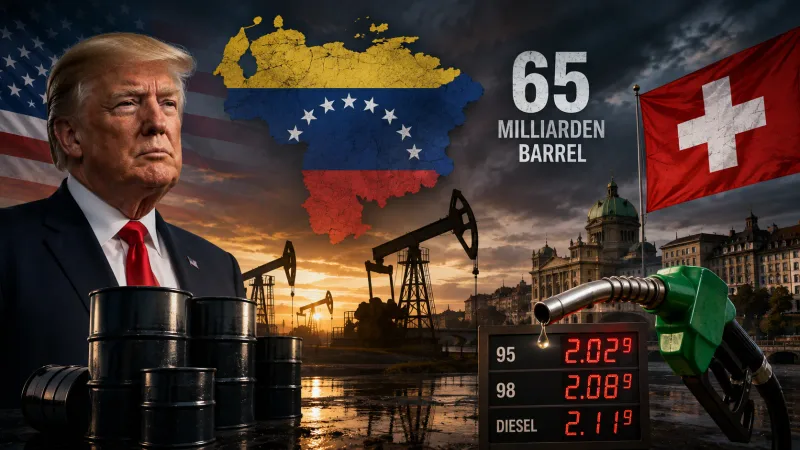
The US aims to gain access to Venezuela's vast oil reserves through a new agreement. President Donald Trump promises lower petrol prices. For Switzerland, the deal could also become interesting in the long term – in the short term, it is unlikely to change much at the pump.
US President Donald Trump speaks of the “greatest oil deal in world history”. According to him, the US has reached an agreement with Venezuela that will allow US companies a majority stake or control over the economic exploitation of oil fields with a proven potential of more than 65 billion barrels.
Venezuela possesses the world's largest proven oil reserves. The International Energy Agency and the US Energy Information Administration estimate them at more than 300 billion barrels. However, only a fraction of what is technically and economically possible is currently being extracted. Lack of investment, dilapidated infrastructure, and years of political and economic instability have severely weakened the Venezuelan oil industry.
What Exactly Was Agreed
According to Venezuela's interim government, the agreement concerns 17 oil fields with a proven potential of around 65 billion barrels. A newly created private company is to develop these fields over a long period. Venezuela expects investments of more than 100 billion dollars and tax revenues exceeding 209 billion dollars.
However, many details are still open. The full contract has not yet been published. It remains unclear, among other things, which companies are involved, who will finance the multi-billion dollar investments, and what the exact participation and off-take conditions are.
Reuters reports that the US is to receive approximately 55 percent of the effective production. This is different from saying Washington owns or controls 65 billion barrels of oil. These are proven reserves or the potential of certain fields – not oil that has already been extracted and is available.
Why Trump Is Now Betting on Venezuela
The timing of the agreement is no coincidence. The US is under pressure due to high energy prices. At the same time, the war with Iran has unsettled international energy markets.
The American government therefore wants to develop additional oil sources. Trump promises that more Venezuelan crude oil will lower petrol prices in the US in the long term.
However, years lie between a contract and additional oil at petrol stations. Venezuela's production facilities and refineries are in poor condition in many places. The necessary infrastructure must partly be rebuilt. Experts therefore assume that a significantly higher production cannot be achieved in the short term.
US Oil Reserves Are Also an Issue
In the debate, various terms are often mixed up. The US has large proven oil reserves. The country's strategic petroleum reserve, however, is a government stockpile for crisis situations.
This strategic reserve has indeed shrunk significantly. According to the US Energy Information Administration (EIA), the stock stood at approximately 293 million barrels in mid-August 2026. This puts the strategic reserve at a historically low level.
The 65 billion barrels from the Venezuela deal should therefore not be simply compared with the American emergency reserve. It is something completely different: long-term extractable or proven deposits.
What Does This Mean for Switzerland?
For Swiss citizens, the crucial question is simpler: Will petrol become cheaper?
In the short term, probably not. The Venezuelan deal does not change the global oil supply overnight. The additional extraction must first be financed, the infrastructure repaired, and production ramped up.
In the long term, however, Venezuela could become a more significant supplier on the world market again. More available oil can – other things being equal – reduce price pressure on the world market. Switzerland could also benefit from this.
The country has no oil deposits of its own and must import its entire oil requirement. Petroleum products cover about half of Switzerland's energy needs. Switzerland reacts sensitively to international price fluctuations accordingly.
Why Oil Prices Influence Swiss Inflation
The connection was already visible this year. The Swiss National Bank noted in June that inflation had risen from 0.1 percent in February to 0.6 percent in May. The main reason was higher prices for petroleum products.
The State Secretariat for Economic Affairs (SECO) also concluded that higher energy prices are burdening the Swiss economy. The federal government's June forecast for 2026 anticipated economic growth of only 0.9 percent. At the same time, an average inflation rate of 0.6 percent was expected.
Permanently lower oil prices would therefore not only relieve motorists. Transport, heating costs, and energy-intensive production processes could also become cheaper. Through these channels, part of the effect would also reach consumers.
The effect would, however, be limited. The oil price is only one of many factors determining Swiss inflation. Moreover, the Swiss consumer basket contains a comparatively small share of oil and natural gas. SECO points out that the corresponding share in the Swiss consumer basket is significantly lower than in the Eurozone.
The Petrol Pump Initially Remains Under Pressure
This year's development shows how strongly international oil prices impact Swiss petrol stations. According to TCS, unleaded 95 cost an average of 1.65 Swiss francs per liter on January 1, 2026. By August 20, it was already 2.02 francs. At the end of August, the value was around 1.98 francs.
A new major oil supplier could help absorb such price shocks in the long term. However, petrol prices do not only depend on crude oil. Refinery costs, transport, exchange rates, taxes, and other levies are also added.
A Glimmer of Hope – But No Price Promise
For Switzerland, the most important potential advantage is therefore not an immediately cheaper liter of petrol. A larger and more broadly based global oil supply would be more interesting.
The more producing countries and production capacities are available, the lower the dependence on individual crisis regions can generally be. This can stabilize global energy markets.
At the same time, the deal remains politically and legally controversial. Venezuela's interim government has difficult democratic legitimacy. Furthermore, questions arise regarding the duration of the agreement, previous expropriations of foreign companies, and the willingness of American corporations to actually invest billions.
For Switzerland, It Means: Wait and See
The oil deal between Washington and Caracas is therefore primarily a long-term project. Even if the announced investments actually flow, it will likely take years until the additional production has a noticeable impact on the world market.
For Switzerland, the development remains relevant nonetheless. The country is completely dependent on energy imports and feels international oil price shocks through fuels, transport, and other costs. A more stable oil market would therefore also be good news for the Swiss economy.
However, anyone hoping for lower petrol prices today due to the Venezuela deal is likely to be disappointed. The contract is large – its effect on the world market still needs to emerge.
Sources
- DIE ZEIT: USA Secure Control Over Venezuelan Oil Reserves
- Reuters: Trump says US is taking partial control of Venezuela's vast oil reserves
- Associated Press: What we know about Trump's deal giving US access to vast oil reserves in Venezuela
- US Energy Information Administration: Strategic Petroleum Reserve
- Federal Office for National Economic Supply: Petroleum Products
- Swiss National Bank: Monetary Policy Assessment June 2026
- SECO: Economic Forecast June 2026
- TCS: Development of Petrol Prices in Switzerland