Trump threatens EU with new trade barriers over Canada
Washington is threatening tariffs and restrictions over the EU's rapprochement with Canada. An order to exclude goods from civilian US federal procurement already exists against Canada.
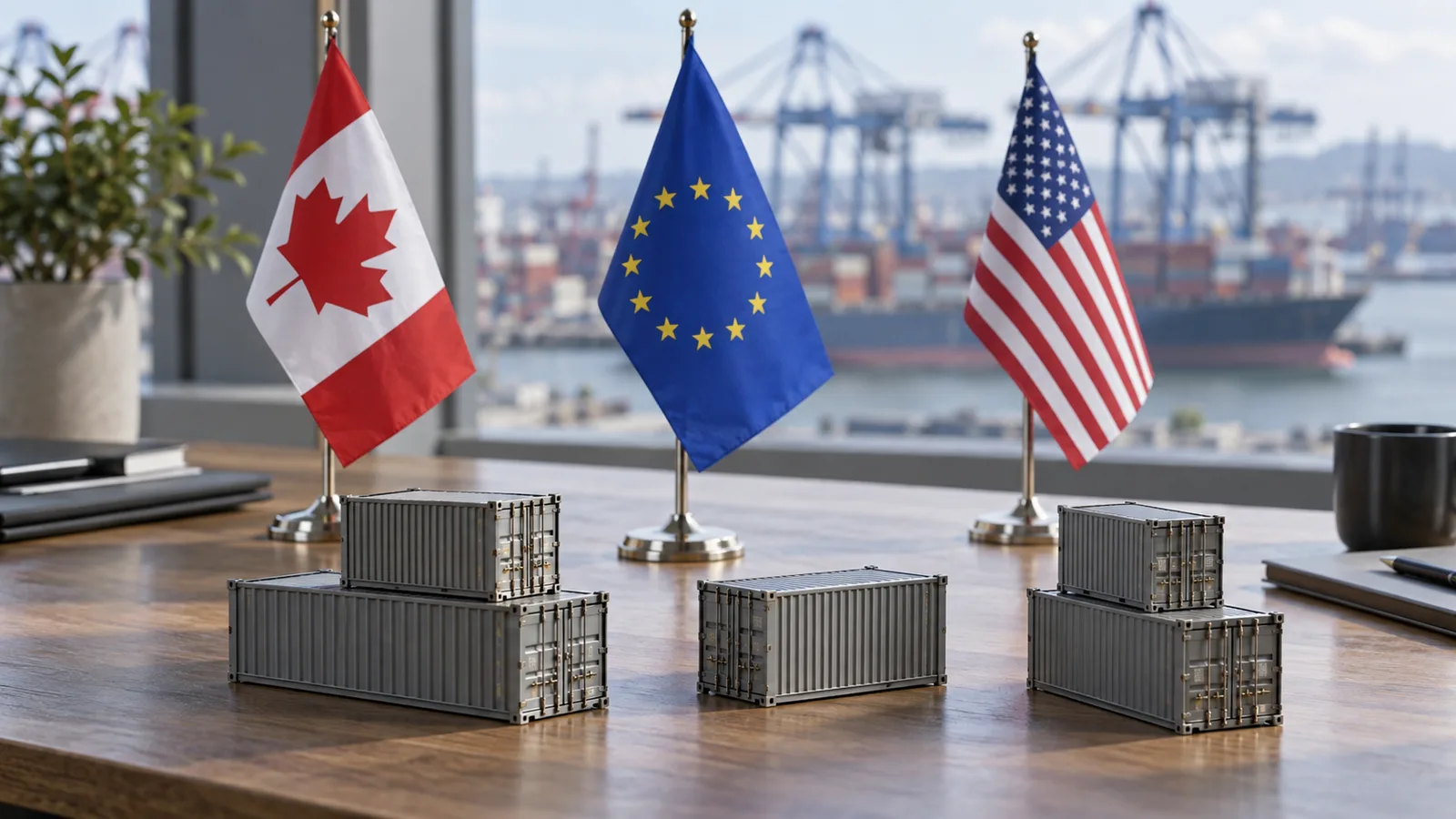
Donald Trump has turned Europe's relationship with Canada into the subject of a new trade threat. Speaking in North Carolina on 16 September, the US President held out the prospect of high tariffs or a trade halt on numerous goods if he were to regard the closer EU-Canada partnership as a hostile act. That is how Reuters documents it. He did not thereby give binding notice of a halt to all trade.
The difference matters economically: a threat can unsettle calculations. Only a decision that has been made concrete shows which companies could actually pay new duties or lose markets.
One condition, but still no list of goods
The trigger was Ursula von der Leyen's proposal to make Canada the EU's first «associate member». According to Reuters, how this status would be shaped and whether the EU states would support it remains open. Reuters reports that Trump said at the same time that the rapprochement was fine if the intentions were good. Which intentions he would accept remained open. Nor did he name a tariff rate, a list of affected goods or an entry into force in these remarks.
Canada's Prime Minister Mark Carney reaffirmed his country's right to choose its own partnerships in Strasbourg on Thursday. In a further Reuters report, he argued that closer ties with the EU could also make Canada a better partner for the US. The idea of an alliance necessarily directed against Washington is therefore contested.
A written order against Canada already exists
On the same day as his threat, Trump signed a memorandum on government procurement. It directs the responsible US agencies to identify Canadian goods that can lawfully, and where justified in each individual case, be removed from or excluded from civilian federal procurement.
That is narrower than a ban on all Canadian imports. The order concerns government purchases and contains explicit reservations in favour of the law in force. It evidences a mandate to act, not full implementation across all agencies already.
As justification, the White House cites Canada's «Buy Canadian» policy and restrictions at provincial level. That these are unfair is the position of the US government. The order does not name the EU rapprochement as a reason. Mere proximity in time therefore proves no causal link.
The figure of more than 280 billion dollars a year cited in it also requires context: it refers to the federal procurement volume covered by the US under the WTO Government Procurement Agreement. It is neither the value of Canadian deliveries nor a quantified damage figure.
Europe's concessions do not prevent new threats
The new warning meets European concessions that have already been put into practice. According to the European Commission, the EU abolished all tariffs on US industrial goods as of 1 July 2026. The basis is the joint trade statement of August 2025. The current dispute shows that an agreement on market access does not remove political conflicts over other partnerships.
Much is at stake on both sides. According to the Commission, goods trade between the EU and the US totalled 910.6 billion euros in 2025. Of that, 554.9 billion was EU exports and 355.7 billion imports from the US. Services are not included in these figures.
A broad trade halt would therefore also hit American sellers and buyers. The Commission names pharmaceutical ingredients, machinery and aviation components, among others, as important European deliveries. This interdependence argues against the idea of a cost-free punitive measure. It does not guarantee, however, that an escalation will not happen.

Canada and the EU have long been working on concrete projects
Behind the politically conspicuous term «association» lie negotiations that are already under way. Canada's foreign ministry confirmed progress on 2 September in defence cooperation, digital trade and critical raw materials. The next Canada-EU summit is scheduled for 29 and 30 October.
Tariff reduction, too, does not begin only now: CETA has been provisionally applied since 21 September 2017. A new political label therefore says little about what additional rights companies would actually gain. What counts are the negotiated rules and their implementation.
For Swiss suppliers, the entire supply chain counts
Switzerland is not an EU member. That does not, however, amount to economic shielding. In the FDFA overview published in July 2025, 51 percent of Swiss goods exports go to the EU.
One possible scenario: if a Swiss company supplies components to a European machinery manufacturer, new US barriers could weaken that manufacturer's sales and thus later orders with the supplier. That would be an indirect effect. Whether it materialises depends on the product, rules of origin, customers and the design of any future measure. No concrete loss of Swiss orders can yet be derived from Trump's statement.
For companies, the next checkpoint therefore leads away from the headline: is there a binding order, which goods does it cover, and from when does it apply? As long as these answers are missing for the EU threat, the economic risk remains open. The procurement order against Canada shows at the same time why a mere all-clear would be just as premature.
Sources
Primary sources:
- White House: Memorandum «Restoring Reciprocity in Government Procurement», 16 September 2026
- European Commission: Trade with the US, figures and implementation of the trade statement
- Global Affairs Canada: Anand–Kallas meeting and preparation of the Canada-EU summit, 2 September 2026
- European Commission: CETA and trade relations with Canada
- FDFA: Switzerland–EU in figures, published on 7 July 2025
Agency reports on the current statements:
- Reuters: Trump's conditional trade threat and reactions, 17 September 2026
- Reuters: Carney defends Canada's free choice of partners, 17 September 2026
Research status: 17 September 2026.


