Weidel: "People Are Talking Past Each Other"
AfD Leader Reaffirms Uncompromising Stance in ZDF Summer Interview
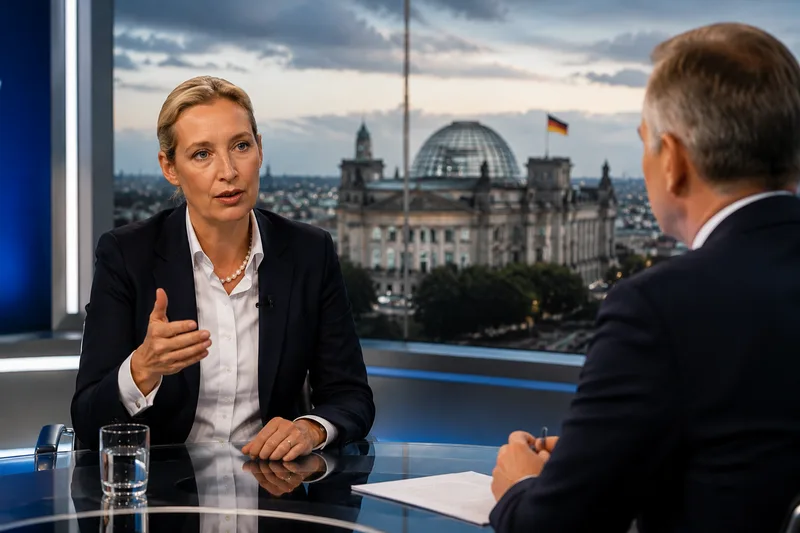
AfD leader Alice Weidel appeared confident in the ZDF summer interview on August 23, 2026. She discussed the upcoming state elections in Saxony-Anhalt and the AfD's political future. Weidel announced her party would assume governmental responsibility not only in individual federal states but also at the federal level. She also sharply criticized the CDU and other established parties.
In a conversation with ZDF presenter Wulf Schmiese, Weidel defended the AfD's key positions on migration, climate policy, internal combustion engines, the Euro, and Germany's relationship with the Schengen Area. This development is also relevant for Switzerland: Germany is Switzerland's most important trading partner in Europe, and political changes in Berlin can impact trade, cross-border traffic, and European cooperation.
Weidel Sees AfD on Path to Government
Weidel explicitly presented the AfD as a future governing party during the summer interview. Regarding the state election in Saxony-Anhalt, she expressed confidence that the party could assume political responsibility there. She also announced a similar claim for the federal level.
At the same time, Weidel criticized the so-called 'firewall' of established parties against the AfD. She called it "the most undemocratic thing there is." She particularly attacked the CDU, accusing it of failing to keep political promises.
However, Weidel did not fundamentally reject cooperation with other parties. When asked about potential political alliances, she stated she was willing to work with any party she deemed capable.
Migration Remains a Central Issue
A key focus of the interview was migration policy. Weidel reaffirmed the AfD's demand for a significantly more restrictive policy, particularly emphasizing public safety in her arguments.
When asked how potential deportations to Syria or Afghanistan could be practically organized and whether corresponding readmission agreements exist, Weidel provided no concrete answer. Instead, she pointed to stronger securing of German borders and announced that Germany could withdraw from the Schengen Agreement.
Such a development would be of particular interest to Switzerland. Although Switzerland is not a member of the European Union, it belongs to the Schengen Area. Changes at the German borders could therefore impact cross-border personal traffic between Germany and Switzerland.
Germany and Switzerland maintain close economic and social ties. People commute across the border daily, while businesses rely on smooth flows of goods and people. A fundamental change in German Schengen policy would therefore be closely monitored in Switzerland.
Dispute Over German Automotive Industry
The future of the German automotive industry was also discussed. Weidel defended the AfD's position against government mandates for specific propulsion technologies, advocating for "technological openness."
The German automotive industry is also relevant for Switzerland. Germany is one of Switzerland's most important trading partners, and numerous Swiss companies are integrated into German and European supply chains.
A change in German industrial policy could therefore indirectly affect Swiss suppliers and companies. This is particularly true if the German automotive industry focuses more on specific technologies or realigns its supply chains.
Weidel Questions Climate Policy
On the topic of climate change, Weidel questioned the necessity of far-reaching political measures. She pointed out that climate changes have occurred in the past and rejected policies that she believes interfere too much with the economy and daily life.
This position contrasts with the climate policies of the German federal government and the European Union. The development is relevant for Switzerland because the Swiss economy is closely linked to the European single market, and many companies are affected by European environmental, energy, and industrial policies.
Criticism of the Euro and Potential Consequences for Switzerland
European monetary policy was also a topic of the interview. Weidel defended the AfD's position, which still considers Germany's exit from the Euro as a political option. She called the Euro an unstable currency and highlighted Germany's positive economic development before the introduction of the common currency.
A fundamental change in German or European monetary policy would be of significant importance for Switzerland. Germany is the Eurozone's largest economy and a key trading partner for Switzerland.
A serious political conflict over the future of the Euro could lead to significant movements in financial markets. In such a scenario, the Swiss franc could also come under stronger upward pressure. This would be relevant for Swiss exporters, as a stronger franc makes their products more expensive abroad.
Whether such a scenario could actually materialize depends on numerous factors. Weidel's statements in the summer interview do not constitute a concrete announcement of a German Euro exit.
Schengen: An Issue with Direct Swiss Relevance
Weidel's demand for a potential German withdrawal from the Schengen Area is particularly interesting for Switzerland. Switzerland has been part of the Schengen Area since 2008, largely abolishing systematic personal checks at borders with other Schengen states.
Germany is particularly important for Switzerland in this context. The shared border is approximately 360 kilometers long, connecting numerous regions with close economic and social exchange.
A German withdrawal from Schengen would not automatically mean Switzerland ends its own Schengen membership. However, it could lead to additional border controls and new administrative requirements for traffic between Germany and its neighboring states.
Therefore, potential impacts would be of great interest to cross-border commuters, tourism, and businesses. The extent of these impacts would depend on the specific arrangements Germany would agree upon with its European neighbors in the event of a withdrawal.
The AfD and Switzerland
Political developments in Germany are traditionally closely monitored in Switzerland. Germany is Switzerland's most important trading partner and plays a central role in European economic policy.
A stronger AfD influence on German politics could therefore become relevant for Bern and the Swiss economy, particularly concerning issues such as migration, freedom of movement, energy policy, trade, and relations between Switzerland and the European Union.
At the same time, a distinction should be made between political positions and concrete political decisions. The AfD is currently in opposition. Which of its demands could actually be implemented depends on election results, potential coalitions, and political majorities.
Saxony-Anhalt as an Important Test
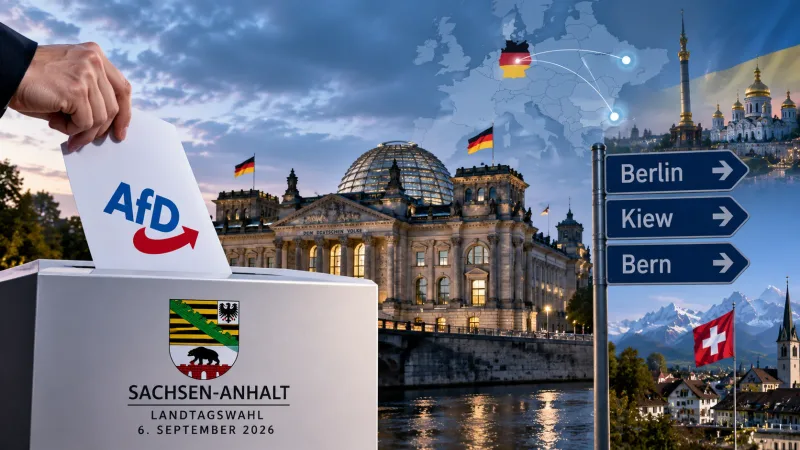
The timing of the summer interview is particularly politically relevant. On September 6, 2026, the state election in Saxony-Anhalt will take place. The AfD is significantly ahead in polls there, and a very strong result could underscore its claim to governmental responsibility.
For the AfD, the election thus symbolizes an attempt to evolve from an opposition party into a potential governing party. A strong result could further intensify the debate among established parties regarding how to deal with the AfD.
What Becomes Important for Switzerland Now
For Switzerland, three developments are particularly relevant: the AfD's strength in German elections, a potential shift in German European policy, and concrete changes in migration and border controls.
As long as the AfD does not hold governmental responsibility at the federal level, many of its demands remain political positions. However, should its political power significantly increase, issues such as Schengen, the Euro, migration, and German industrial policy could also gain importance for Switzerland.
The ZDF summer interview was therefore not just a look at the German election campaign. It also highlighted political positions whose potential impacts extend beyond Germany. For Switzerland, the crucial question will likely be whether the AfD's current demands become concrete government policy in the future.