13th AHV Pension Arrives in December – Switzerland Votes on Funding
13th AHV Pension Arrives in December – But Funding Remains Controversial
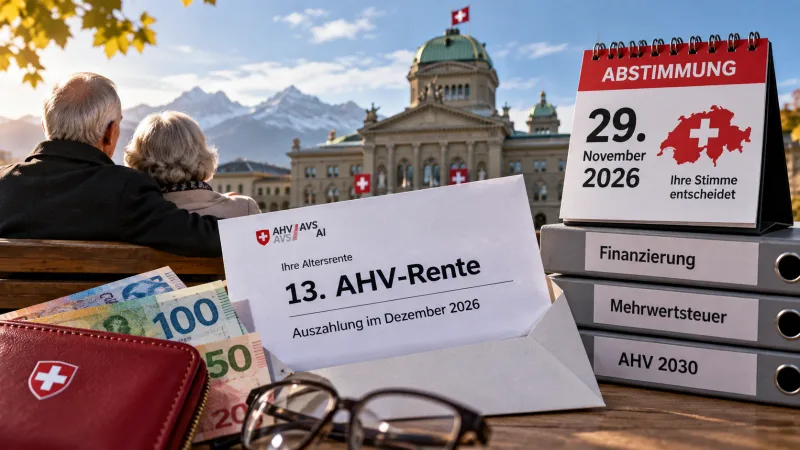
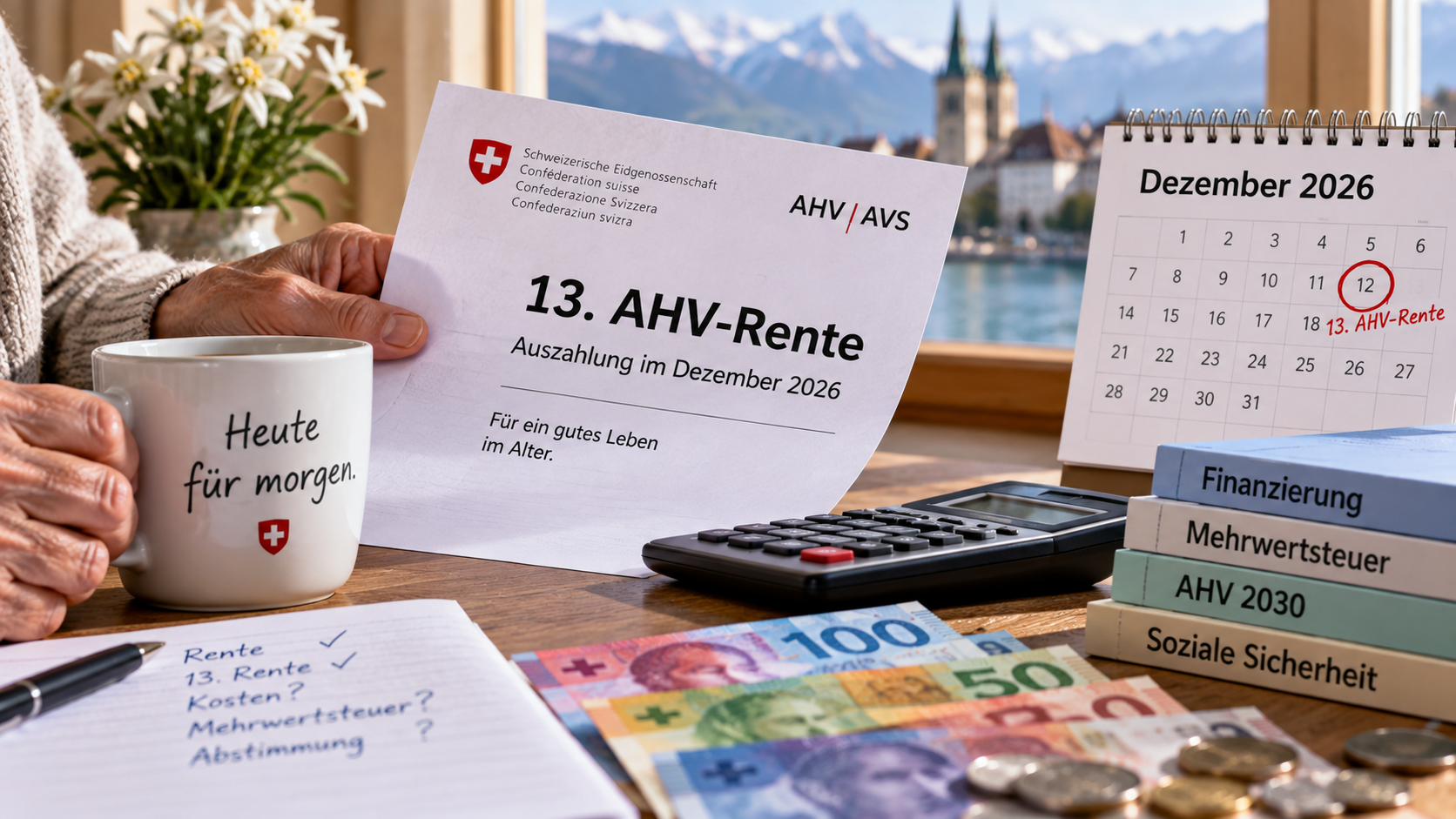
The 13th AHV pension will be paid for the first time in December 2026. For pensioners, the most important question is answered: the additional old-age pension will arrive automatically with the December pension. The long-term funding, however, remains open. Parliament relies on a higher value-added tax – but this solution still requires approval from the people and the cantons.
The First 13th AHV Pension Arrives in December
The introduction of the 13th AHV pension dates back to the popular vote on March 3, 2024. At that time, the Swiss electorate accepted the initiative «For a Better Life in Old Age».
Its implementation is now legally regulated. The first additional old-age pension will be paid in December 2026. Thereafter, payment will occur once a year in December as a supplement to the normal December pension.
Essentially, all persons receiving an AHV old-age pension in December are entitled. Payment is automatic. An application is not required.
Key Facts at a Glance
- First Payment: December 2026
- Payment: together with the December pension
- Entitlement: Persons entitled to an AHV old-age pension in December
- Calculation: one-twelfth of the old-age pensions paid out in the respective year
- Application: not necessary
- Vote on Funding: November 29, 2026
How Much Additional Money Will There Be?
The 13th AHV pension corresponds to one-twelfth of the total old-age pensions paid out during the year. Therefore, it is not simply the last monthly pension paid.
Certain additional benefits are not considered in the calculation. These include, for example, children's pensions and supplementary pensions, as well as the pension supplement for women of the transitional generation after AHV 21.
The exact amount of the 13th pension can therefore only be finally calculated in December. The responsible compensation fund considers the old-age pensions actually paid out during the year.
A Simple Example
Someone who receives an unchanged old-age pension of 2,500 francs every month for an entire year reaches an annual total of 30,000 francs.
One-twelfth of that is 2,500 francs. In this simplified example, the 13th AHV pension would thus also amount to 2,500 francs.
This example is for illustration only. The actual calculation is based on the old-age pensions paid out in the respective year.
Who Will Receive the Additional Payment?
The 13th payment applies to AHV old-age pensions. Survivors' pensions for widows, widowers, and orphans, as well as disability pensions, continue to be paid twelve times a year.
Children's pensions also do not become a 13th payment. However, anyone receiving a disability pension who later reaches the AHV reference age will receive an old-age pension from that point and thus, in principle, also the 13th AHV pension.
Furthermore, the additional old-age pension must not lead to supplementary benefits being cut or cancelled. It is explicitly not taken into account when calculating the reckonable income for supplementary benefits.
The Big Unanswered Question: Who Pays for the 13th Pension?
The introduction of the 13th AHV pension incurs significant additional expenses. Approximately 4.2 billion francs are needed for the first year. According to calculations by the Federal Social Insurance Office, costs are expected to rise to around 4.5 billion francs by 2030 and around 5.4 billion francs by 2040.
This is precisely where the political conflict lies. The popular initiative itself contained no specific funding source. Parliament therefore had to decide how the additional AHV expenditures should be covered.
After long deliberations, the National Council and the Council of States decided on a solution in June 2026: the value-added tax is to be increased from 2028.
Value-Added Tax to Rise to 8.5 Percent
According to the parliamentary decision, the standard VAT rate is to increase from the current 8.1 to 8.5 percent. The special rate for accommodation services is to be raised from 3.8 to 4.0 percent.
The reduced VAT rate of 2.6 percent for daily necessities, however, remains unchanged. This includes foodstuffs and certain medicines.
Planned VAT Increase
- Standard Rate: 8.1 % → 8.5 %
- Accommodation: 3.8 % → 4.0 %
- Reduced Rate: 2.6 % → unchanged
- Planned Start: 2028
However, the increase is not sufficient to cover the entire additional costs of the 13th AHV pension. According to parliamentary calculations, no additional revenue from this funding would flow in 2026 and 2027. From 2028, the AHV would receive additional funds from the value-added tax.
The People Have the Final Say
Thus, the funding has not yet been finally decided. Because the VAT increase requires an amendment to the Federal Constitution, it needs the approval of the people and the cantons.
The vote is scheduled for November 29, 2026. Only after that will it be clear whether the VAT funding decided by Parliament can actually be implemented.
However, this does not mean an uncertain outcome for the payment of the 13th AHV pension in December 2026. The first additional old-age pension is planned regardless.
The Crucial Difference: The 13th AHV pension itself will arrive in December 2026. The funding of the additional expenses from 2028 is controversial and not yet finally decided.
In 2026 and 2027, the Pension Will Initially Be Paid Without New Funding
The transition period is therefore particularly relevant. The 13th AHV pension will already be paid in 2026 and 2027, although the planned additional funding via value-added tax is only expected to take effect from 2028.
This initially creates a funding gap. At the same time, the AHV already faces a long-term financial challenge. The Federal Social Insurance Office points out that, without additional funds, expenditures will rise more sharply than revenues from 2026.
The 13th AHV pension is therefore not the only problem for old-age provision. It increases financial pressure on a system already facing additional challenges due to demographic developments.
Why Funding is Politically Contested
Different funding models were discussed in Parliament. At times, the debate concerned not only a higher value-added tax but also higher AHV wage contributions.
In the final vote, a pure value-added tax solution ultimately prevailed. An additional increase in wage contributions was waived.
Proponents see value-added tax as a way to distribute the additional costs more broadly across the population. Critics warn, among other things, of higher consumer costs and complain that it would not solve the structural problems of the AHV.
This is precisely why the funding of the 13th AHV pension is closely linked to the next major AHV reform. Under the title «AHV 2030,» further measures are being discussed to stabilize the long-term funding of old-age provision.
What Pensioners Need to Know Now
- The first 13th AHV pension will be paid in December 2026.
- It comes automatically with the December pension.
- An application is not required.
- The amount generally corresponds to one-twelfth of the old-age pensions paid out during the year.
- The exact amount will only be definitively calculated in December.
- The 13th pension is not considered as reckonable income for supplementary benefits.
- Funding via a higher value-added tax has not yet been finally decided.
- On November 29, 2026, the electorate will decide on the planned funding.
What is Already Decided – And What Remains Open
TopicStatusIntroduction of the 13th AHV pensionDecidedFirst paymentDecember 2026Automatic paymentYesAmount1/12 of the annual old-age pensionFunding 2026/2027No new specific additional fundingPlanned funding from 2028Value-added tax +0.4 percentage pointsFinal approval for VAT increaseStill openPopular voteNovember 29, 2026
Conclusion: Payment is Clear – The Bill is Not Yet Fully Settled
The discussion surrounding the 13th AHV pension changed in summer 2026. It is no longer about whether and how the additional old-age pension will fundamentally be implemented. These questions are largely settled.
In December 2026, eligible persons will receive a 13th old-age pension for the first time. Payment is automatic and follows a clearly defined calculation.
The crucial political question has now shifted: How should the additional burden on the AHV be financed permanently?
Parliament has decided on a value-added tax increase for this purpose. But before it can take effect, the people and the cantons must approve it. At the same time, further measures to stabilize the long-term financing of old-age provision are already being discussed under the «AHV 2030» reform.
The 13th AHV pension is thus a reality – but its long-term funding remains part of a larger political debate about the future of Swiss old-age provision.
Sources
- Federal Social Insurance Office (BSV): Implementation of the 13th AHV Pension
- Swiss Compensation Fund (EAK): Information on the 13th AHV Pension
- Swiss Parliament: Decision on the Funding of the 13th AHV Pension
- Swiss Parliament: Questions and Answers on Funding