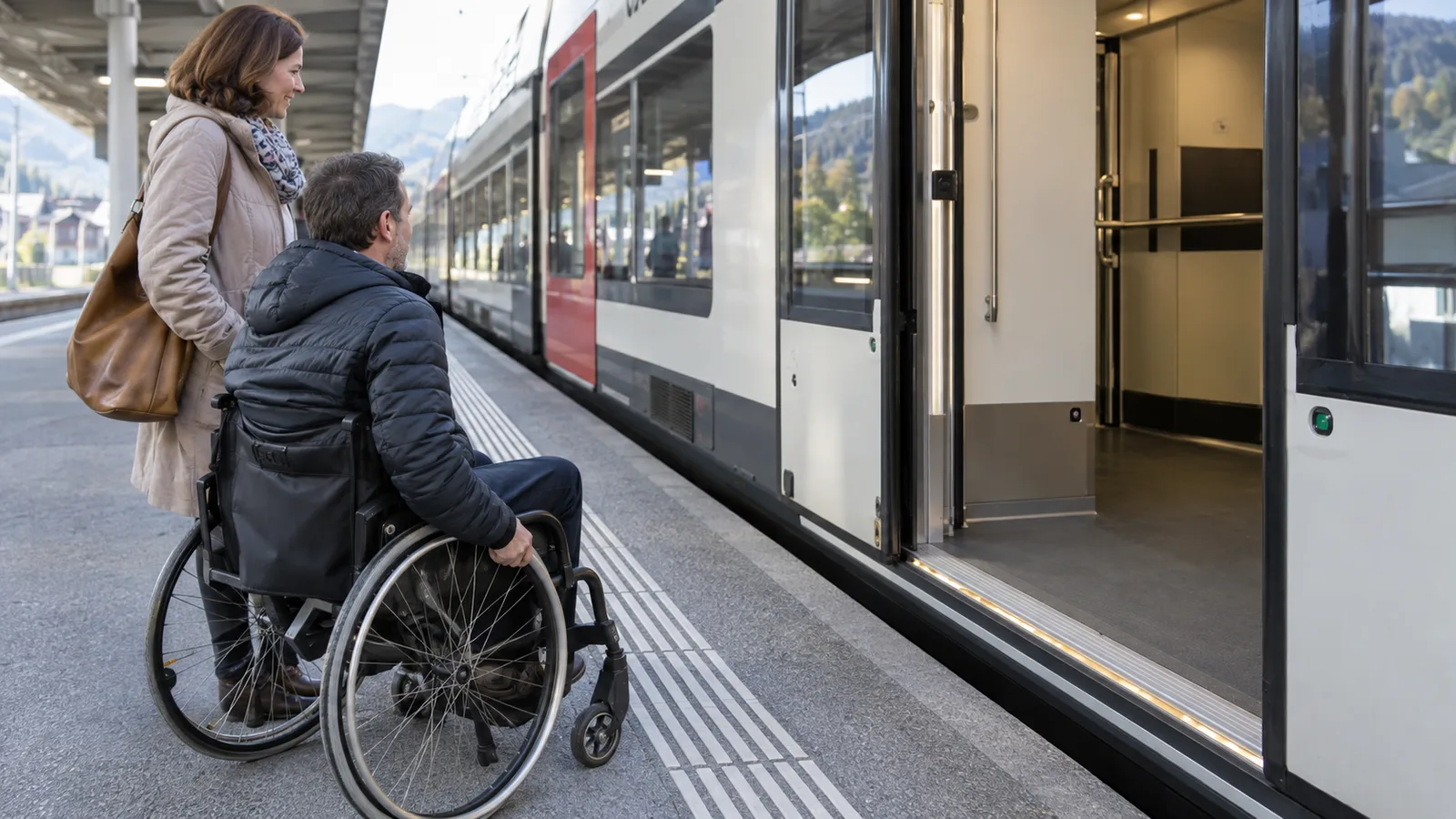
Accessible travel: a rebuilt station is not a whole journey
For Mobility Week it is worth looking at the entire route. Good national rates say little about whether a specific Saturday trip actually works.
The train is reachable, the destination station modernised – and even so a trip can fail at a single step. Anyone travelling with a wheelchair, a walking aid or another impairment does not need an average good connection. What is needed is a route whose individual parts actually fit together: from the front door to the destination.
European Mobility Week, from 16 to 22 September 2026, once again takes up the theme of mobility for all. This year the campaign emphasises fairness between generations. For Switzerland that provides an occasion to read progress in public transport more closely. A high rate of accessible stations and a weekend trip that can be undertaken independently are related statements, but they are not identical.
82 percent – of whom?
In July 2025 the Federal Office of Transport (FOT) reported that at the end of 2024 a total of 1132 of roughly 1800 railway stations could be used autonomously. Because large stations were adapted first, 82 percent of travellers benefited from this. The two figures do not contradict each other: one counts stations, the other weights them by how much they are used.
Anyone who turns the 82 percent into a share of all stations is misreading the statistic. Nor is the figure a current measurement for September 2026. It explicitly describes the situation at that time. For a single location, a national average also cannot answer whether boarding is possible today or what assistance is needed.
The legal deadline for adaptation essentially ended at the end of 2023, insofar as conversions were proportionate. The FOT noted that it was not met everywhere. Its report cites staff shortages and missing time windows for construction work, among other things, as the explanations given by the railways. These reasons explain the delays from the operators' point of view; they do not remove the restrictions for travellers.
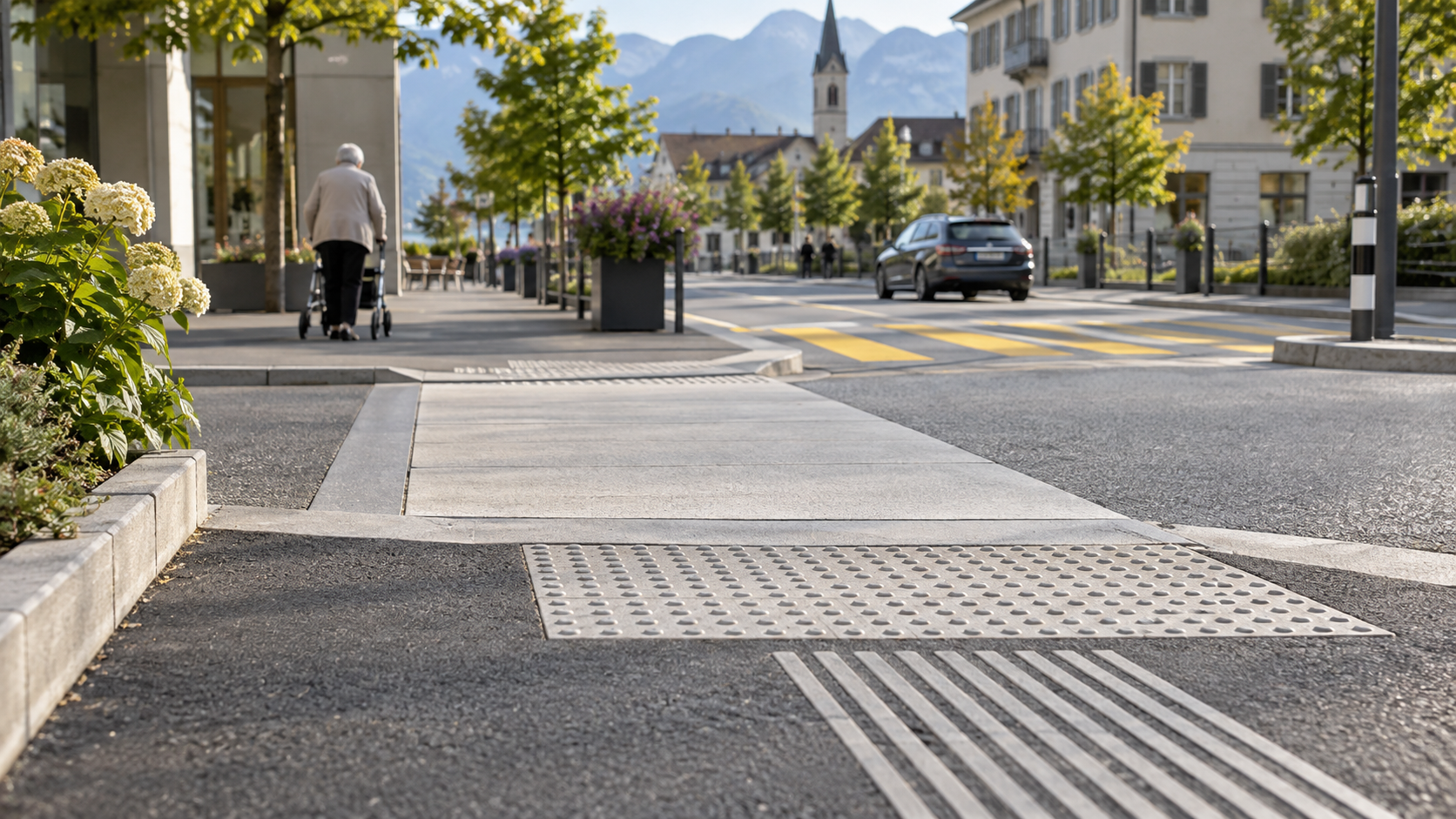
The gap can lie before the station
On an everyday or leisure trip, responsibilities change hands. As the FOT explains, the cantons and municipalities are responsible for adapting bus stops, since they own the roads. A well-developed rail section therefore says nothing about the bus to the station. From the traveller's perspective, the footpath to the destination is also part of the connection.
One practical conclusion follows from this: the quality of a journey is limited by its weakest necessary point. A single barrier cannot be offset against many well-accessible platforms elsewhere. This very difference gets lost when progress is communicated exclusively through national percentages.
That is not an argument against prioritising heavily used stations. Such work reaches many people. It is an argument for also looking at complete routes and concrete connections. Only then does it become visible where the next upgrade would actually make a previously impossible trip possible.
Assistance must match the connection
SBB offers information and free boarding and alighting assistance through the Contact Center Handicap. The number 0800 007 102 is reachable daily from 5 a.m. to midnight. Assistance can also be reserved through the AMO registration and information system. These services make travel easier, but they are not the same as infrastructure that can be used independently at any time without prior notice.
For journeys within Switzerland, SBB generally states one hour of notice; in exceptional cases and for shuttle services, two hours. Special registration times apply to early connections before 6 a.m. and to the night network. The specific journey should therefore be clarified well in advance rather than relying on the shortest deadline stated.
Caution with standard values is also needed for transfers. According to SBB, the minimum times stored in the ordinary online timetable are not sufficient in every case for travellers with reduced mobility. A connection that is mathematically reachable can be too tight in the actual course of a personal journey. Advice should therefore take in the complete connection, including the return journey.
Spontaneity is part of participation
For Saturday, that means not only choosing the destination, but also planning entrances, connections and, if necessary, assistance. This additional work is itself an indication of what full accessibility would have to deliver. It would not merely make transport possible, but leave more freedom to set off at short notice or to extend a stay.
The success of the upgrades therefore ultimately shows in a simple question: can a person actually make the journey they want? A percentage figure provides important background for that. The answer lies along the whole route.
Sources
European Mobility Week 2026 · FOT: accessible railway stations, as at the end of 2024 · FOT: accessibility in public transport · SBB: Contact Center Handicap and registration deadlines


