Are immigrant background voters becoming alienated in Switzerland too?
Germany shows a shift. But what about voters with a migration background in Switzerland?
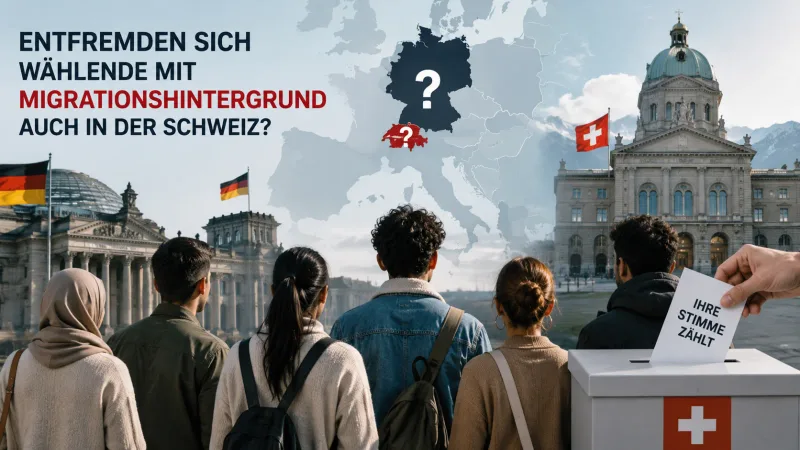
How do people with an immigration history vote? A new study from Germany raises this question again. The German Centre for Integration and Migration Research (DeZIM) investigated which parties eligible voters with and without a migration background generally consider electable – and how this assessment changed within one year.
The results show increasing detachment from several parties. This is particularly pronounced among eligible voters with ties to Turkey, the Middle East, and North Africa. This raises an obvious question for Switzerland: Is there a similar development here?
More Than Seven Million Eligible Voters
The political importance of the group is growing. According to Deutsche Welle, in 2023, approximately twelve percent of eligible voters in Germany had an immigration history. This corresponds to more than seven million people.
This electorate has long been an important factor for parties. At the same time, the DeZIM study shows that their attachment to the existing party system is changing.
An important caveat must be noted: The study does not ask which party someone would vote for in a specific election. Rather, it measured voting inclination – meaning whether a person could fundamentally imagine voting for a particular party at some point. A person can consider several parties electable.
SPD Remains Ahead – But Loses Support
The SPD continues to have the largest voter potential among people with a migration background. Approximately two-thirds of respondents generally consider the Social Democrats electable. CDU and CSU follow with a relatively small gap.
At the same time, a change is evident. Especially among people with ties to the MENA region and Turkey, the electability of several parties declined within one year. For CDU and CSU, according to the analysed data, it fell from approximately two-thirds to about half. For the SPD, it decreased in this group from 71 to 60 percent.
However, the study provides no conclusive explanation for this decline. The authors point out that various factors may play a role. Migration background alone does not explain voting behaviour.
Rejection of the AfD Is Particularly Strong
The AfD is a clear exception. It experiences the strongest categorical rejection overall among the groups studied. Approximately 65 percent of respondents state that they would never vote for the party. Among people with ties to the MENA region and Turkey, this proportion is even about 80 percent.
At the same time, the AfD is not equally weak across all groups. Among people with roots in Russia or other former Soviet Union states, their voting inclination is comparatively higher.
Deutsche Welle also notes that the AfD attempts to specifically target people with an immigration history – including through communication in their native languages. Representatives of the Turkish Community in Germany simultaneously criticise that other parties do not address issues such as security and discrimination sufficiently from the perspective of migrant voters.
Younger Generations Detach More from the SPD
The intergenerational development is particularly interesting. Friederike Römer, co-author of the DeZIM study, points out that older respondents with a migration background still lean more towards the SPD. However, the traditionally relatively close connection between the SPD and migrant voters appears to be dissolving among younger generations.
Thus, it is not simply a question of whether people with an immigration history vote “left” or “right.” Rather, the study indicates that political affiliations are changing, and traditional party ties may weaken.
What Is Known About This in Switzerland?
The German results cannot be directly transferred to Switzerland. However, it would be equally wrong to say that there are no data available here at all.
The Swiss electoral study Selects has been investigating electoral participation and voting behaviour in federal elections since 1995. Migration background was also considered in the analysis. The Selects analysis of the 2023 National Council elections, for example, shows that the SP was the strongest party among people with a migration background, just ahead of the SVP. The FDP also performed above average in this group.
However, the available Swiss data answer a different question than the current DeZIM study. They show differences in voting behaviour but do not provide an directly comparable current time series on whether the attachment of people with a migration background to Swiss parties is currently changing similarly to Germany.
Comparison Is Also Difficult Due to Definition
Even the question of who is considered a person with a migration background is not trivial. In Switzerland, electoral research uses corresponding definitions based, among other things, on country of birth, nationality at birth, and the parents' country of birth.
Additionally, there is the political system. At the federal level, Swiss citizens are generally eligible to vote. For cantonal and communal elections, different rules sometimes apply because individual cantons and municipalities have introduced voting rights for foreigners.
Therefore, anyone wishing to compare the political behaviour of people with a migration background must first clarify which group is being discussed: the entire population with an immigration history, naturalised Swiss citizens, or all individuals who are actually eligible to vote.
Switzerland Has Data – But a Different Data Situation
This is precisely the crucial difference from the German study. Switzerland is by no means a data-free zone. With Selects, there is established electoral research that examines differences based on migration background.
What is currently missing is a study directly comparable to the current DeZIM analysis, which could show over several survey periods whether the voting inclination and party affiliation of people with a migration background are changing in Switzerland.
Therefore, it would be premature to draw conclusions for Switzerland from the German development. Neither can it be stated that Swiss voters with a migration background are detaching from established parties in the same way, nor can the opposite be proven.
Why the Question Is Still Relevant
The development in Germany shows the political importance this electorate can achieve. If traditional party affiliations weaken, parties must strive even harder to appeal to different social groups.
This also applies to Switzerland. Migration, naturalisation, and the political integration of people with an immigration history are no longer fringe issues. At the same time, political participation can look very different depending on residency status, naturalisation, and cantonal voting rights.
Therefore, the crucial question is not whether people with a migration background, as a group, vote “left” or “right.” More interesting is, whether their political affiliations are changing – and what issues play a role in this.
The Swiss Answer Is Still Pending
The new DeZIM study provides an important insight for the political debate in Germany: people with an immigration history do not form an electorate permanently tied to a specific party. Their political preferences can change.
However, no corresponding development can yet be derived for Switzerland. While there are data on voting behaviour, there is no directly comparable current study on the question of political alienation.
The title question therefore remains open: Are voters with a migration background becoming alienated in Switzerland too? The available Swiss data provide initial indications of differences in voting behaviour. However, whether a similar change to Germany's develops from this would require a targeted study.
Sources
- DeZIM-Institut – Study "Stability and Change: Which parties can voters with and without a migration background imagine voting for?" (August 31, 2026)
- Deutsche Welle – "Why Parties Are Losing Voters with a Migration Background" (September 2, 2026)
- FORS – Swiss Electoral Study Selects, "Federal Elections 2023: Electoral Participation and Voting Decision" (2024)
- FORS – Information on the Swiss Electoral Study Selects and current panel data