Autonomous Driving: Where Switzerland Lags Behind Tesla – and Where It Doesn't
Tesla is already operating driverless in the US. Switzerland relies on controlled pilot projects and is slowly catching up.
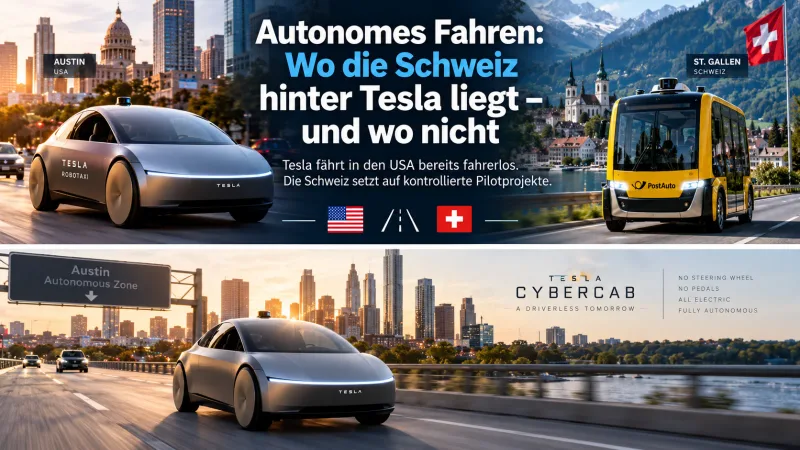
Two different speeds are currently emerging in autonomous driving. In the US, Tesla is launching its robotaxis on the roads. In Europe, the approval of driving assistance systems is still being debated. In Switzerland, concrete pilot projects are already underway. The question is therefore not simply whether Switzerland is lagging. What is crucial is which form of autonomous driving one considers.
Tesla is already driving driverless in the US
In early September 2026, Tesla launched its first Cybercab rides in Austin, Texas. The vehicle is specifically designed for robotaxi operation and operates without a steering wheel or pedals. Its use is initially restricted to specific areas.
This means Tesla is going a step further than with its well-known "Full Self-Driving" system. The name should not lead to confusion: FSD Supervised is not fully autonomous driving. The driver must supervise the system and be able to intervene at any time.
Cybercab, on the other hand, involves truly driverless operation. This exact difference is crucial for international comparison.
The US is moving faster – but not without debate
However, the technological lead of the US does not mean that all issues have been resolved there. The US National Highway Traffic Safety Administration (NHTSA) has launched an investigation related to the certification of around 1000 Cybercabs.
Among other things, the investigation concerns whether the vehicles meet the applicable safety requirements. At the same time, the US government is working to adapt certain regulations for autonomous vehicles. Tesla is therefore operating at the intersection of technological progress and regulatory requirements.
The Netherlands are further ahead than Switzerland with Tesla
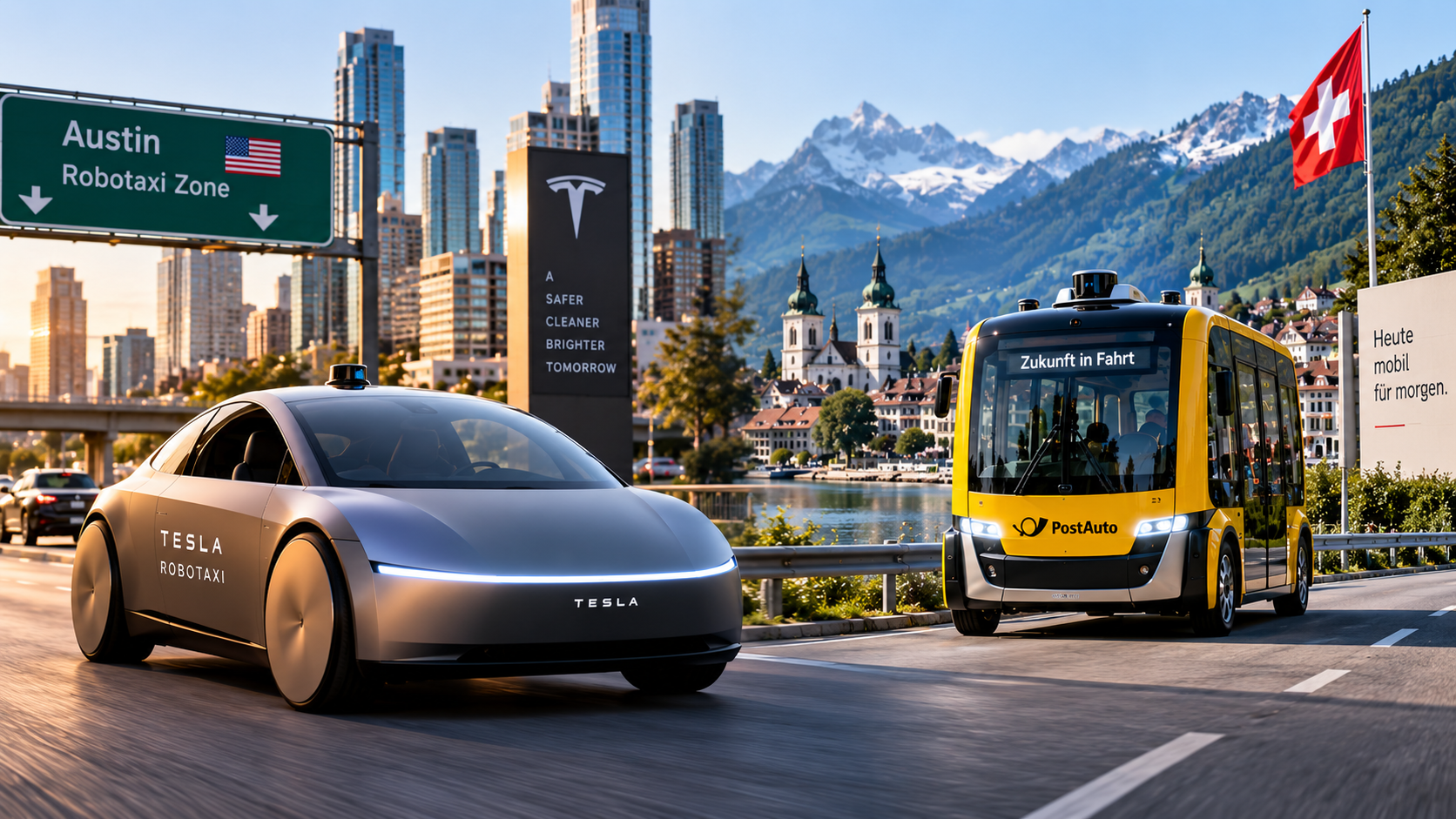
In Europe, the Netherlands, in particular, has positioned itself as a pioneer in Tesla FSD. The Dutch approval authority RDW type-approved Tesla's FSD Supervised in 2026. Other European countries have joined this development.
France also started tests with Tesla FSD in early September. This shows that momentum is building in the European approval of the Tesla system.
Switzerland is not currently part of this. Tesla FSD Supervised is not yet available on Swiss roads.
Switzerland has nevertheless made an important step
In terms of the legal framework, however, Switzerland is further ahead than a glance at Tesla might suggest. Since March 1, 2025, new rules for automated driving have been in effect.
The Swiss legal framework permits three applications: a highway pilot for appropriately approved vehicles, driverless vehicles on officially authorized routes, and automated parking in designated areas.
This does not mean that every autonomous vehicle is automatically approved. Manufacturers and operators must meet the respective safety requirements. For driverless vehicles, official approval for the specific route is also required.
AmiGo shows what is already possible
Switzerland is particularly advanced with the AmiGo project by PostAuto and Baidu Apollo Go. Since 2026, automated vehicles have been deployed on public roads in Eastern Switzerland.
The pilot area covers approximately 80 square kilometers in St. Gallen, Appenzell Ausserrhoden, and Appenzell Innerrhoden. In the current phase, a safety driver is still on board. However, the vehicle already performs essential driving tasks autonomously.
The next step is intended to be driverless operation. For this, initial rides with a closed user group are planned. If the necessary safety requirements are met, the project is to be further expanded.
Regular operation with up to 25 vehicles is planned for 2027.
Tests are also underway in the Canton of Zurich
AmiGo is not the only Swiss project. In the Furttal valley in the Canton of Zurich, automated vehicles are also operating in public road traffic. The project aims to gather experience with a larger operating area. In the future, monitoring from a central control room is planned.
Further projects exist in Bern and Arbon, among others. These involve various applications such as delivery vehicles, shuttles, and public transport.
Why Switzerland still lags behind with Tesla
The main difference between Tesla and the Swiss projects lies primarily in their approach. Tesla aims to bring a technically universal system to the road. Switzerland proceeds step-by-step: defined routes, clearly delimited operating areas, and official permits.
For a Swiss Tesla driver, the outcome is nevertheless clear: while FSD Supervised is already approved in the Netherlands, the function cannot currently be used in Switzerland.
Switzerland therefore lags behind some European countries in this specific application.
The situation is different for autonomous public transport
The situation is different when looking not at Tesla, but at actual autonomous operation. With AmiGo, Switzerland already has an approved pilot project on public roads. Further projects are being prepared or tested.
This is not yet driverless mass transit. However, Switzerland has created the legal prerequisites and is already gaining experience under real traffic conditions.
What Comes Next?
The crucial step will be the transition from test operation to everyday use. If the Swiss pilot projects are successful, autonomous vehicles could initially be deployed on clearly defined routes – for example, as shuttles in peripheral regions or as an addition to public transport.
For private vehicles, development is likely to be slower. Here, manufacturers must have their systems approved for the respective jurisdiction. Whether and when Tesla FSD will also be available in Switzerland therefore depends not only on technical development but also on the approval process.
Conclusion: Switzerland is not left behind
Those who only look at Tesla arrive at a clear conclusion: Switzerland is lagging. Driverless Cybercabs are already operating in the US, and the Netherlands are also further ahead with Tesla FSD.
However, the overall picture for autonomous driving is more nuanced. Since 2025, Switzerland has had a legal framework, facilitates concrete pilot projects, and is already working on the transition to driverless vehicles.
Switzerland is therefore neither a pioneer nor a laggard. It is pursuing a more cautious path – and the crucial question will be whether these pilot projects genuinely lead to driverless everyday life.
Sources
Federal Roads Office (ASTRA): Automated Driving PostAuto: Project AmiGo Canton of Zurich: Automated Driving in Furttal RDW Netherlands: Tesla FSD Supervised Reuters: Tesla Cybercab, NHTSA and Tesla FSD in Europe