Bilateral III: Council of States Committee Says Yes – What Awaits Switzerland
The Council of States' Foreign Affairs Committee (APK-S) supports the Switzerland-EU package. Wage protection, immigration, and the referendum are now central to the debate.
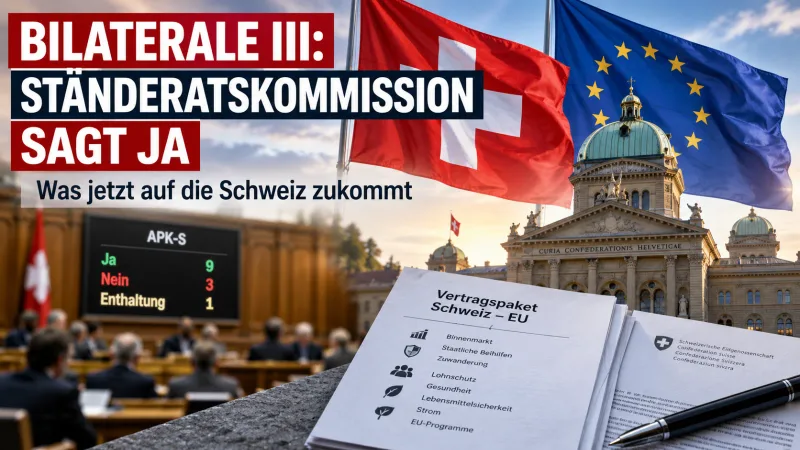
Bern – The Bilateral III package reaches its next crucial stage. The Council of States' Foreign Affairs Committee (APK-S) supports the Switzerland-EU agreement package. On September 4, 2026, it voted 9 to 3 with one abstention in favor of the proposal.
In its overall assessment, a clear majority of the committee supported the stabilization of relations between Switzerland and the European Union, the parliamentary services announced.
However, the political debate is far from over. The Council of States will next address the package. Wage protection, the adoption of EU law, immigration, and the question of a possible referendum are likely to be key discussion points.
What Does Bilateral III Entail?
The agreement package aims to stabilize and develop relations between Switzerland and the EU in the long term. It includes adjustments to existing internal market agreements and new arrangements in various areas.
These include rules on state aid, Switzerland's participation in EU programs, and the Swiss cohesion contribution. New agreements are also being added in areas such as electricity, food safety, and health.
The Federal Council's message comprises a total of 94 relevant EU legal acts. According to the Federal Council, their implementation would require 36 federal laws to be amended and three new federal laws to be created.
Thus, it is not a single new treaty but a comprehensive package of various agreements and legal adjustments.
Health and Food Safety Affect Daily Life
Part of the agreements could become directly noticeable for the population. The topic of food safety involves closer cooperation with the EU on controls and standards.
The health agreement aims to improve cooperation on medicines and cross-border health risks, among other things. Exchange with European partners is to be facilitated, especially during crises or supply problems.
The electricity agreement is different. It is not yet ready for parliamentary debate. Therefore, specific impacts on the Swiss electricity market are not currently part of the parliamentary discussions.
Dynamic Adoption of Law Remains Controversial
A central point of contention is the so-called dynamic adoption of law. In the internal market areas affected by the package, Switzerland would generally adopt new relevant EU rules, provided the corresponding conditions are met.
Proponents see this as a necessary prerequisite for permanent access to the European single market. Critics, however, fear that it will limit Switzerland's political room for maneuver.
The debate therefore revolves around a fundamental question: How closely should Switzerland bind itself to the development of EU law if it simultaneously wants to remain outside the European Union?
Wage Protection Creates Potential for Conflict
In addition to the adoption of law, the protection of Swiss wages and working conditions is one of the most sensitive points.
The APK-S supports the overall package, but there are differing positions within parliament on individual accompanying measures. The Council of States' Committee for Economic Affairs and Taxation (WAK-S) has also taken different stances on specific issues.
Discussions include dismissal protection for employee representatives, sureties, and subcontractor liability. For trade unions, these points are crucial.
They have announced their rejection of the agreement package if, in their view, the agreed accompanying measures for wage protection are not sufficiently secured.
Immigration Remains a Political Sticking Point
The question of immigration is also likely to accompany the parliamentary debate. The demand for a possible safeguard clause, should immigration reach a certain level from Switzerland's perspective, is particularly controversial.
How such a clause would be specifically designed is not yet conclusively clarified in all aspects. Precisely these open questions make the domestic political evaluation of the agreement package difficult.
The Swiss Farmers' Union has therefore pointed out that the consequences of the proposal are difficult to assess as long as various points still need to be specified during domestic implementation.
Who Decides in the End?
One of the most important political questions concerns the referendum. The Federal Council intends to subject the package to an optional referendum. This would allow the people to vote on it if the necessary conditions for a referendum are met.
The Federal Council justifies its position, among other things, with the previous practice for Bilateral I and II agreements. It rejects a parliamentary initiative that would demand a mandatory referendum with a majority of cantons for the agreement package.
Thus, it is not only about whether the people can vote, but also about the threshold for approval.
In a mandatory referendum, the people and the cantons would have to approve. In an optional referendum, the popular majority generally decides, provided the referendum is called.
Now It's the Council of States' Turn
Following the decision of the Council of States' Foreign Affairs Committee (APK-S), the ball is now in the Council of States' court. In the autumn session, the stabilization part will first be discussed. This will be followed by the agreements on food safety and health.
The electricity agreement is not yet ready for consideration. Even after that, the process is not yet complete: the National Council must also deal with the proposal. Depending on the course of events, differences between the two councils may also arise.
A final parliamentary decision is therefore not expected until 2027 at the earliest.
Why This Decision is Important for Switzerland
The Bilateral III package goes far beyond individual technical adjustments. It concerns how Switzerland intends to deal with its most important economic and political partner in the future.
For proponents, the package offers more legal certainty, more stable access to the EU internal market, and closer cooperation in areas such as electricity, health, and food safety.
Opponents, however, warn against a loss of political room for maneuver, a stronger alignment with EU law, and potential consequences for wages, immigration, and Swiss autonomy.
The approval by the Council of States' Foreign Affairs Committee (APK-S) is therefore an important step – but not yet a decision on Bilateral III. The decisive political confrontations are still ahead.
Conclusion
With the Council of States committee's approval, the Bilateral III package has cleared an important parliamentary hurdle. The package will now be discussed in the Council of States.
Whether it ultimately finds a majority, however, depends on several controversial points. Wage protection, dynamic adoption of law, immigration, and the referendum mode are likely to shape the debate.
One thing is already clear: with Bilateral III, Switzerland is not only deciding on individual agreements with the EU but also on the long-term shaping of its relationship with Europe.
Sources
- Parliamentary Services – Council of States' Foreign Affairs Committee
- Parliament – Council of States' Committee for Economic Affairs and Taxation
- Federal Council / FDFA – Message on the Switzerland-EU Package (Bilateral III)
- Federal Council – Position on the Referendum on the Agreement Package
- SRF – Report on the Approval by the Council of States' Committee