CHF 24.6 Million for Politics: How Transparent is Switzerland?
New disclosure rules shed light on federal party funding, yet reveal significant system gaps.
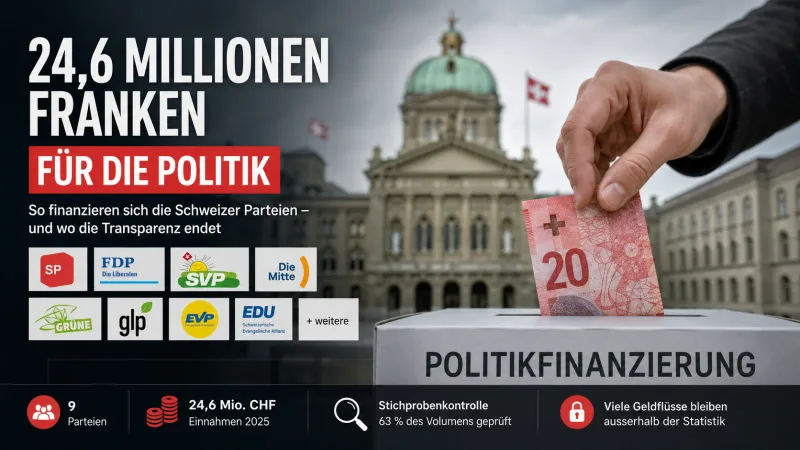
CHF 24.6 million. This is the amount of revenue nine parties represented in the Federal Assembly reported for 2025. The figure sounds considerable, yet it only represents a fraction of what finances Swiss politics. Not all political financial flows are recorded.
The Federal Audit Office (FAO) published the figures on August 31, 2026. In the previous year, CHF 25.6 million had been reported. Party revenues thus decreased by approximately one million Swiss francs.
New transparency rules have been in effect at the federal level since 2022. Since then, political actors must disclose their funding according to clearly defined requirements. For parties, this concerns the national organizations of parties represented in the Federal Assembly.
Social Democratic Party Leads FDP.The Liberals and Swiss People's Party
The Social Democratic Party of Switzerland (SP) reported the largest revenues in 2025, reaching CHF 7.9 million. FDP.The Liberals (FDP) followed with CHF 4.8 million, the Swiss People's Party (SVP) with CHF 3.8 million, and The Centre Party (Mitte) with CHF 2.7 million.
The Green Party (Greens) and the Green Liberal Party (GLP) also exceeded the one-million-franc mark. The Greens reported CHF 1.8 million, the GLP CHF 1.2 million. Further revenues were disclosed by the Federal Democratic Union (EDU), the Evangelical People's Party (EVP), and the Mouvement Citoyens Genevois.
A notable gap remains: The Lega dei Ticinesi, which is represented in the National Council, had not yet disclosed its funding at the time of publication.
Revenues come from various sources. These include membership and mandate contributions, donations, events, and the sale of goods and services. The SP alone took in over CHF 2.19 million in membership fees in 2025. It also led in mandate contributions with approximately CHF 484,000.
What a Donation Means – And What it Doesn't
Large contributions from companies or private individuals are observed with particular attention. Above a certain amount, the origin must be disclosed. For contributions exceeding CHF 15,000, the identity of the donors is generally public.
This provides insight into an area that had long remained largely obscure in Switzerland. At the same time, a published donation should not automatically be interpreted as proof of political influence. A company financially supporting a party does not mean that the party, in turn, makes specific political decisions.
Transparency initially only shows a flow of money. Whether this actually leads to influence cannot be deduced from the financial report alone.
Control is Not Complete
The figures are generally based on the information provided by the political actors. The FAO does not extensively audit the reports but conducts random checks.
For the 2025 financial year, it audited four parties with a total revenue volume of CHF 15.5 million. This represents 63 percent of the total reported revenues. For the SP, FDP, and the Greens, the FAO found no issues during the audit. For the EDU, however, nine foreign contributions totaling CHF 505 were identified, among other findings. Additionally, online donations of CHF 62,324 had to be subsequently reported.
This process highlights both the strength and weakness of the system: There is now a state control body and binding disclosure obligations. Simultaneously, the primary responsibility remains with the parties themselves.
The CHF 24.6 Million is Not “All the Money in Swiss Politics”
Here lies one of the most important limitations of the new figures. The CHF 24.6 million does not represent the entire funding of Swiss politics.
For example, parliamentary group contributions are not recorded. Likewise, cantonal and municipal party sections are not subject to the same disclosure obligations as national parties. If membership fees flow directly to a cantonal section, these revenues do not necessarily appear in the national register.
A party's assets are also not captured by the annual report. The FAO itself points out that a calendar year's party funding does not provide a complete picture of overall political financing or party assets.
For party-affiliated organizations, the situation is more nuanced than it first appears. A contribution must be attributed to the national party and disclosed if it is evident that the original donor intended to support that specific party. If this connection is not discernible, there is no corresponding legal obligation to disclose the original source.
Referendum Campaigns Involve Significantly Larger Sums
Referendum campaigns show how much money political disputes can actually move. For federal referendums, campaigns must disclose their funding if they spend more than CHF 50,000.
For the referendum on June 14, 2026, a total of CHF 16.78 million in definitive revenues was reported. Of this, CHF 16.27 million went to the campaign for the Sustainability Initiative. For the amendment of the Civil Service Act, CHF 508,729 was disclosed.
The FAO audited four of the 23 reported campaigns. In terms of value, these audits covered 46 percent of the total revenues.
Significant financial expenditure is also emerging for the next federal referendum. For the vote on September 27, 2026, a total of CHF 7.86 million in budgeted revenues had been disclosed by August 28: CHF 5.51 million for the Neutrality Initiative and CHF 2.35 million for the Nutrition Initiative.
However, caution is advised with these figures: The total volume reported by the FAO may contain double counting if funds are transferred between different campaigns.
More Transparency – But No Complete Answer
Switzerland now knows significantly more about who finances political parties and campaigns than a few years ago. This is progress. Citizens can trace large financial flows and gain a more accurate picture of the financial forces behind a campaign before referendums.
But transparency is not the same as control. And it does not automatically answer the question of money's influence.
This is precisely what makes the debate difficult. Full disclosure could strengthen democratic control. At the same time, not every donation should be viewed with general suspicion. Parties need money to employ staff, run campaigns, conduct political education, and contest elections.
The crucial question is therefore not whether political funding is legitimate. It is: How much influence through money is acceptable in a direct democracy – and when is additional transparency needed?
The Next Question Already Awaits
The new figures are an important step. They make visible what was previously largely unseen. At the same time, they show the limits of the system: national parties are recorded, but other levels of politics only partially. Campaigns are transparent, but only above a certain threshold. Information is audited, but not completely.
This leaves a central question unanswered: How much money truly moves Swiss politics?
The answer cannot be deduced from the CHF 24.6 million. One thing is certain: Switzerland has started to look more closely. Whether the existing rules are sufficient will ultimately depend on whether transparency not only produces data but actually enables citizens to better understand political influence.