Forced Contraception in Greenland: Lessons for Switzerland?
Danish Parliament Compensates Greenlandic Women with 40,000 Euros. The processing raises questions for dealing with historical injustice in Switzerland.
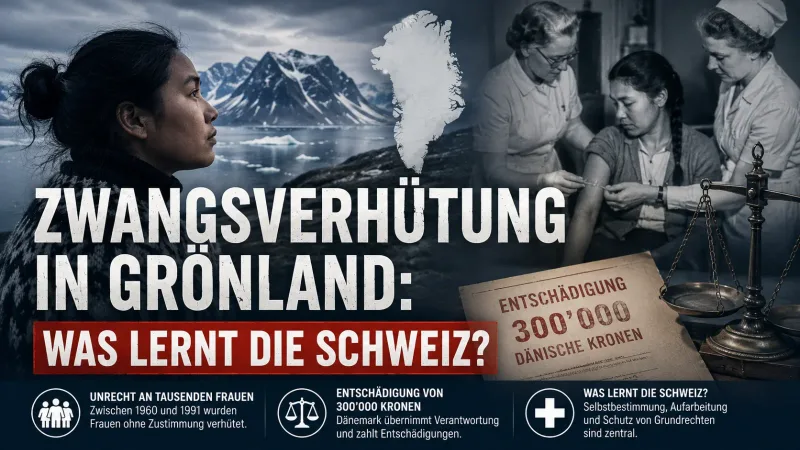
Denmark is paying affected Greenlandic women compensation of 300,000 Danish kroner. Parliament adopted a corresponding regulation on August 27, 2026. It concerns women who received contraception without their consent between 1960 and 1991, while Denmark was responsible for healthcare in Greenland.
The payment is equivalent to approximately 40,000 Euros. The regulation is linked to the so-called IUD case, where thousands of Greenlandic women and girls had IUDs inserted, particularly in the 1960s and 1970s. However, the newly adopted regulation extends beyond the actual IUD case and also covers other forms of contraception without consent.
300,000 Kroner for Affected Women
The new regulation targets Greenlandic women who received contraception without their consent between 1960 and 1991. A prerequisite is, among other things, that those affected declare to the best of their knowledge that they received such contraception in Greenland or Denmark and that the procedure can be made credible.
The compensation amounts to a lump sum of 300,000 Danish kroner per eligible woman. It is therefore not an individually assessed compensation payment, where every single health or biographical consequence must be proven. Rather, it is a politically decided recognition of the injustice suffered.
The regulation comes into force on September 1, 2026. Applications can generally be submitted until September 1, 2028. The Danish Patienterstatningen is responsible for processing.
The IUD Case Affects Thousands of Women
The case became known primarily through the practice of inserting IUDs into Greenlandic women and girls without sufficient information or consent. The measures were also related to the effort at the time to limit population growth in Greenland.
According to previous information from Danish authorities, more than 4,000 women and girls received an IUD in the 1960s and 1970s. However, this number does not automatically refer to the number of women actually eligible under the new compensation regulation.
The regulation adopted today is also broader: it concerns not only IUDs, but generally contraception without consent in the period from 1960 to 1991. Women who temporarily resided in Denmark may also be covered under certain conditions.
Independent Investigation Documents Lack of Consent
An independent investigation into contraceptive practices in Greenland and at Danish boarding schools with Greenlandic students examined the period from 1960 to 1991. More than 350 women and girls described their experiences to researchers. This involved not only IUDs but also other forms of contraception.
The investigation clarifies why the term "IUD case" only describes a part of the events. The focus is not solely on a specific medical method, but on the question of whether the affected women and girls were sufficiently informed and had actually consented to contraception.
The missing or insufficient consent is of central importance. Medical treatment generally requires that those affected are informed about the treatment and can effectively consent to it.
A Case with Colonial Background
Greenland belongs to the Kingdom of Denmark and today has extensive self-government. Until 1992, however, responsibility for healthcare in Greenland lay with Denmark. The contraceptive practice thus falls within a period when important decisions concerning the indigenous population of Greenland were largely shaped by Danish authorities.
The case is therefore also related to Greenland's colonial history and the relationship between Copenhagen and Nuuk. The question of how far state agencies intervened in the lives of the Greenlandic population and what significance demographic considerations had in this context remains part of the political and historical processing today.
Denmark Has Apologized
In 2025, Denmark officially apologized to the affected women and girls. The apology was another step in the processing of the contraceptive practice at the time.
With the now adopted compensation regulation, the Danish state also assumes financial responsibility. However, the new payment cannot undo the interventions of that time. Nor does it automatically answer all questions about individual responsibility, health consequences, or further legal claims.
Why the Term "Genocide" is Legally Delicate
In the political and public debate, the question has repeatedly been raised as to whether the practice at the time could potentially be classified as genocide. However, this is not yet a legal finding.
Genocide is a narrowly defined offense under international law. Its legal classification depends, among other things, on the specific actions and the underlying intent. The now adopted compensation regulation is therefore not a criminal or international law decision on whether the offense of genocide has been committed.
The political recognition of the injustice suffered and the legal assessment of a possible genocide are to be distinguished. Especially in such a historically and politically sensitive case, this distinction is crucial.
A Late Step in Processing
Several decades lie between the interventions of that time and today's compensation regulation. Only the reports of affected women, the independent investigation, and increasing political pressure led to a comprehensive processing of the contraceptive practice.
The now adopted payment of 300,000 kroner is therefore an important step, but it does not necessarily end the debate on the case. Open questions regarding individual responsibility, long-term health consequences, and possible further legal claims can remain independently of the lump-sum compensation.
The case also shows what consequences state interventions in personal self-determination can have over decades. For the affected women, the compensation regulation primarily means a late state recognition of what happened to them.
Sources
- Danish Ministry of Health and Ecclesiastical Affairs: Adoption of the Compensation Law, August 27, 2026
- Danish Legislative Project on Compensation Regulation
- University of Greenland: Independent Investigation into the IUD Case
- Associated Press: Report on the Results of the Independent Investigation
- Deutsche Welle: Report on the Parliament's Decision