Frequency Auction Nears Billion Mark: What Swiss Mobile Network Dispute Means
Swisscom, Sunrise, and Salt oppose the planned frequency auction. This could impact network expansion, competition, and mobile customers.
An invisible asset determines whether we can make calls, send messages, stream videos, or work on the go with our smartphones: mobile frequencies. A significant portion of this scarce public resource in Switzerland is now being reallocated. The three established network operators are not pleased about this.
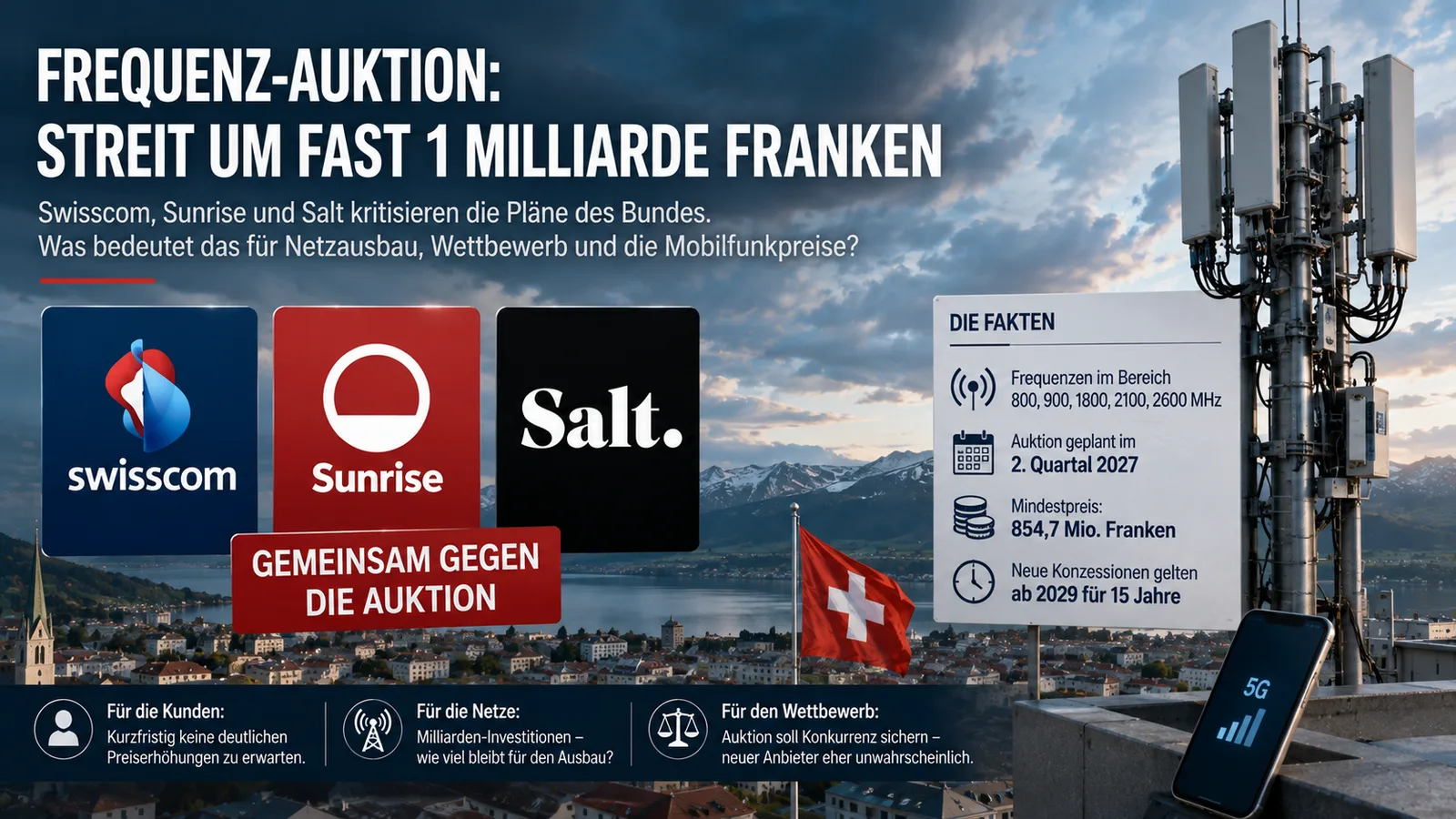
Swisscom, Sunrise, and Salt must prepare for a new allocation process. The Federal Communications Commission (ComCom) launched the tender for a substantial part of the mobile frequencies currently in use on September 1, 2026. The auction is expected to take place in the second quarter of 2027.
The auction involves frequencies from the 800, 900, 1800, 2100, and 2600 megahertz bands. These are crucial for current mobile networks. The corresponding concessions expire at the end of 2028. The new concessions will be valid for 15 years starting January 1, 2029.
At Least CHF 854.7 Million Is at Stake
The dimensions are considerable. ComCom has set a minimum price of approximately CHF 854.7 million for the auction. The actual amount paid will depend on the auction's outcome.
For comparison: During the last major allocation in 2019, the government collected approximately CHF 379 million. At that time, frequencies for the development of 5G technology were among those allocated.
However, the frequencies now subject to allocation are not simply «5G frequencies». Concessions are awarded technology-neutral. Operators can use the spectrum for various mobile communication technologies, depending on technical developments.
Why the Government Is Auctioning at All
The frequencies do not belong to the telecom companies. They are a scarce public resource that the state makes available for limited use.
ComCom justifies the reallocation with two central goals: Switzerland should continue to have three powerful mobile networks, and competition should be maintained and promoted as much as possible.
Therefore, the process is not only open to Swisscom, Sunrise, and Salt. Other companies can also apply, provided they meet the requirements. ComCom has also implemented bidding restrictions to prevent any single provider from acquiring an excessively large portion of the spectrum.
The process is more than just a monetary auction. It also concerns the question of who will be allowed to use the scarce frequencies in Switzerland in the future, and under what conditions.
The Three Major Providers Would Prefer an Extension
This is precisely where the criticism from Swisscom, Sunrise, and Salt lies. The companies state they would have preferred an extension of existing concessions rather than having the frequencies auctioned again.
Their argument: Operators have invested billions in their networks in recent years. An auction, however, creates uncertainty about which frequencies a company can actually use in the future and at what price.
Furthermore, there is the matter of the minimum prices. Sunrise, for example, criticizes that the high starting prices tie up capital that could otherwise be available for network expansion, innovations, and new products.
ComCom rejects this accusation. It states its explicit goal is not to maximize revenue for the federal government. It justifies the higher minimum prices by the high demand for certain, particularly attractive frequencies.
Why These Frequencies Are Important to Us
For smartphone users, the debate initially sounds abstract. Frequencies are invisible and intangible, yet our daily connections depend on them.
When a smartphone communicates with a mobile antenna, data is transmitted via radio frequencies. The frequency ranges available to an operator influence, among other things, how they build their network and what capacities they can provide at specific locations.
Lower frequencies, such as 800 or 900 megahertz, can cover large areas and are therefore important for service outside densely populated regions. Higher frequency ranges, in turn, can carry large amounts of data but have different propagation characteristics.
The frequency allocation is therefore a piece of digital infrastructure policy.
Will Mobile Subscriptions Become More Expensive Now?
This is likely the most important question for most people.
The current answer is: probably not – at least not directly due to the auction.
According to SRF, the consequences for customers are likely to remain manageable. A new mobile provider is unlikely to enter the Swiss market given the enormous costs for frequencies and building a proprietary network. No direct impact on prices is currently expected from the auction.
It is also noteworthy: According to SRF, previous frequency auctions did not lead to general increases in mobile subscription prices.
However, this does not mean that providers could never pass on costs to their customers. Swisscom, Sunrise, and Salt are in competition and must finance their investments. Whether higher frequency costs ultimately impact prices therefore depends on the intensity of competition and the margins companies can achieve.
The Greater Risk May Lie in Network Expansion
Therefore, a more interesting question than the next mobile subscription might be: What happens to the money telecom companies must spend on frequencies?
Every franc paid for a concession cannot simultaneously be used for another purpose. Providers therefore argue that high auction costs could hinder investments in networks, innovations, and additional capacities.
This is particularly relevant in Switzerland. Network expansion is complex due to the topography. Very different conditions exist between cities, agglomerations, mountainous regions, and remote valleys.
The industry therefore demands that the frequency allocation consider not only the auction proceeds but also the long-term benefit for the population and the economy.
The Federal Government Pursues a Different Logic
From ComCom's perspective, the long-term benefit is also at stake. The authority wants to ensure that frequencies are used efficiently and that competition among existing providers is maintained.
A central point is therefore that no single company can acquire the majority of the spectrum. The planned bidding restrictions are intended to prevent the market structure from changing at the expense of competition due to the auction.
Thus, two interests confront each other: Companies want planning certainty and the lowest possible costs. The state wants a fair and competition-oriented allocation of a scarce resource.
It's Not Just About Swisscom, Sunrise, and Salt
The tender could theoretically open the door for a new provider. In practice, however, the hurdles are high.
Anyone wishing to operate their own mobile network in Switzerland needs more than just frequencies. Antenna sites, fiber optic and other transport networks, data centers, technology, personnel, and a customer base are also necessary.
The costs for a complete market entry would therefore be enormous. Consequently, a new fourth network operator is currently considered unlikely.
This is important information for consumers: The auction does not automatically mean more competition. It aims to secure competition – but whether a new provider actually emerges is a different question entirely.
Why the Outcome Is Still Important for Switzerland
The discussion shows how fundamental mobile communication has become for Swiss society. The smartphone is no longer just a device for making calls. Payments, work, navigation, media consumption, emergency communication, and numerous services depend on functioning mobile networks.
The frequency allocation therefore indirectly determines how powerful this infrastructure can be over the next 15 years.
For the population, little is likely to change immediately. No one needs to switch phones or expect a worse network because of the auction. A sudden increase in subscription prices is also not currently foreseen.
In the long term, however, the question is more important: How will Switzerland balance affordable and high-performance mobile networks, corporate investments, and fair competition?
A Billion-Franc Dispute Over Something No One Sees
At first glance, the frequency auction appears to be a dispute between the federal government and three major telecom groups. However, behind it lies a question that affects everyone.
Switzerland is deciding who may use a part of the invisible infrastructure upon which much of our digital daily life depends.
Companies want to pay as little as possible and have long-term planning certainty. The federal government wants a transparent allocation, competition, and appropriate proceeds for the scarce resource.
For the average Swiss citizen, the auction is therefore unlikely to be felt through an immediate increase in mobile phone bills. More crucial will be what happens to the networks afterwards: How quickly will they be expanded, how powerful will connections remain – and how much competition will endure in the Swiss mobile market?
The answer to this will not be decided with the award in 2027. It will only become apparent in the years that follow.
Sources
- Federal Office of Communications (OFCOM) / Federal Communications Commission (ComCom): Allocation of mobile frequencies available from 2029
- ComCom: Tender for mobile frequencies becoming available in 2029, dated September 1, 2026
- OFCOM: Mobile frequencies for 5G allocated in Switzerland, 2019
- SRF: "Billion-Franc Auction – Swisscom, Sunrise, and Salt Against the Federal Government," September 1, 2026