From Oil Prices to Inflation: The Iran War's Impact on Switzerland
How significantly the war impacts Switzerland.
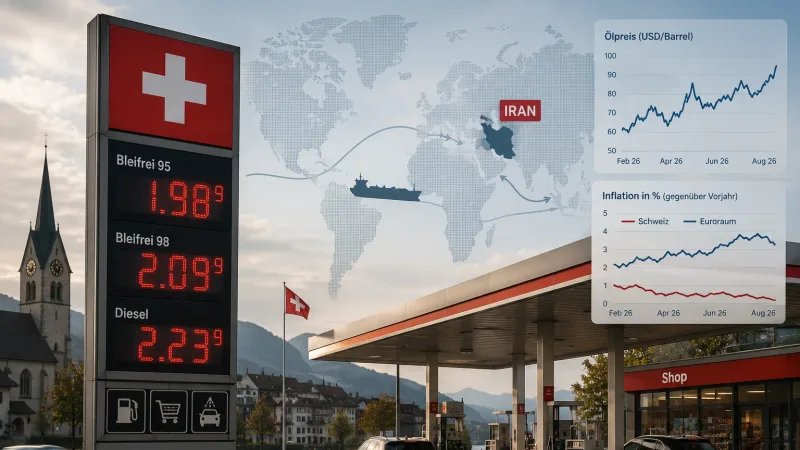
For six months, war in Iran has had noticeable consequences in Switzerland. Gasoline and diesel prices rose significantly, heating oil prices sometimes increased massively, and the Swiss economy lost momentum. Nevertheless, overall inflation remained remarkably low. While other European countries recorded significantly stronger price increases, Switzerland has so far weathered the crisis relatively well.
The War Became Visible at the Gas Station
For many Swiss, the war was first felt not through news from the Middle East, but at the gas pump. In early 2026, a liter of unleaded 95 cost an average of around 1.65 Swiss francs. After the war began in late February, prices rose sharply. In May, the average temporarily exceeded 1.90 Swiss francs.
The situation has since eased somewhat. According to current TCS surveys, unleaded 95 costs approximately 1.98 Swiss francs per liter on average in Switzerland, unleaded 98 costs around 2.09 Swiss francs, and diesel costs about 2.23 Swiss francs. These prices remain significantly above pre-war levels. Since late February, gasoline and diesel prices have increased by approximately 14 to 18 percent, depending on the product.
Why the Price Shock Was Not Greater
The decisive factor is the international energy supply. The war and restrictions around the Strait of Hormuz caused oil prices to rise sharply. Switzerland does not produce crude oil itself and must import all petroleum products.
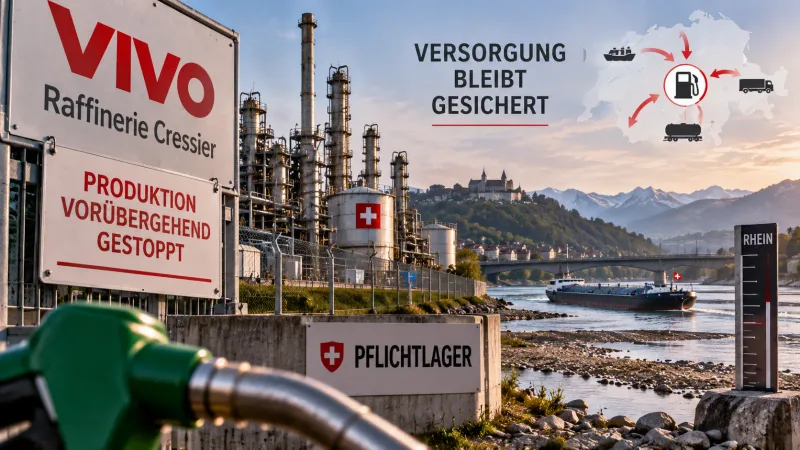
At the same time, Switzerland maintains mandatory stockpiles. For motor gasoline, diesel, and heating oil, these reserves generally cover an average demand of approximately four and a half months. These reserves are not intended to offset normal price fluctuations. Rather, they serve to gain time in the event of a severe supply disruption.
So far, Switzerland has not had to activate this final stage. The Bundesamt für wirtschaftliche Landesversorgung continues to assess the supply as secured. However, the situation remains tense because, in addition to the geopolitical situation, low water levels in the Rhine also complicate the transport of fuels.
The Surprise: Little Inflation
Even more remarkable is the development of overall inflation. In July 2026, consumer prices in Switzerland rose by only 0.4 percent compared to the same month last year. In June, the increase was 0.5 percent.
This clearly differentiates Switzerland from many European countries. In the Eurozone, annual inflation in July was 2.9 percent. In Germany, it was 2.8 percent. Higher energy prices had a particularly strong impact there: fuel prices in Germany increased by 23 percent year-on-year in July.
Why does Switzerland remain so stable despite higher oil prices? A significant factor is the strong Swiss franc. Crude oil is primarily traded in US dollars on the world market. A stronger franc can therefore cushion some of the price increase. At the same time, the Swiss economy is less dependent on fossil fuels than some European economies.
Heating Oil Impacts Households More Severely
However, the crisis is not without consequences. Heating oil prices saw particularly significant fluctuations. At the beginning of the year, 100 liters of heating oil in Switzerland cost slightly more than 90 Swiss francs. After the war began, the price temporarily rose to over 160 Swiss francs.
The market has since calmed down again. The price recently stood at approximately 110 Swiss francs per 100 liters. For households, this means the worst of the price shock is over for now – but a return to prices seen at the beginning of the year is not expected.
The Economy Also Feels the War
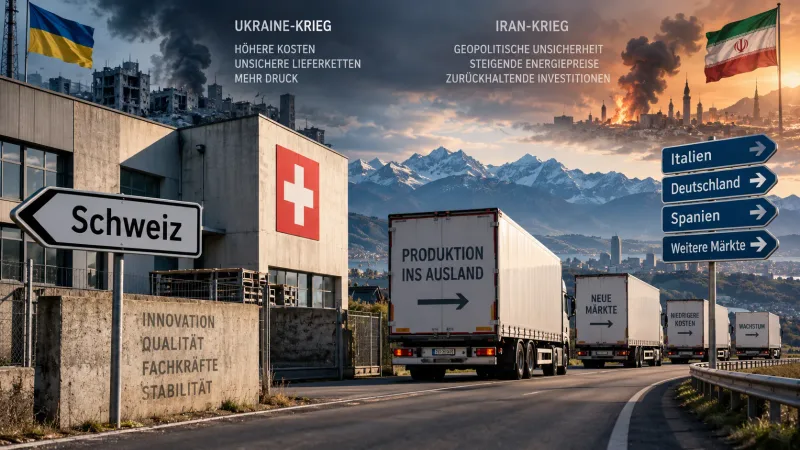
Energy prices affect not only motorists and homeowners. They increase the cost of transport, travel, and energy-intensive production processes. The federal government has therefore lowered its growth expectations for the Swiss economy. For 2026, the federal expert group anticipates growth of 0.9 percent.
The KOF at ETH Zürich is slightly more pessimistic with 0.8 percent. At the same time, economists assume that the impact on inflation in Switzerland will remain limited. The strong franc and weak domestic demand act as counterweights.
Switzerland Has Learned from Past Crises
Therefore, it is no coincidence that Switzerland has so far navigated the crisis without fuel shortages. Mandatory stockpiles, diversified transport routes, and robust crisis management have been part of Swiss supply policy for decades.
Experiences from the 1970s oil crisis and the energy price shock following the Russian attack on Ukraine have also shown that supply security cannot be organized only when supply chains are already collapsing.
In an emergency, the federal government can release mandatory stockpiles and reduce consumption. This step is not yet necessary. However, authorities continuously monitor the situation.
Switzerland Stands Strong in European Comparison
A comparison with neighboring countries highlights Switzerland's unique position. While the energy crisis has significantly impacted consumer prices in Germany and other EU states, Switzerland's overall inflation remains low.
However, this does not mean Switzerland is immune to another energy shock. Should the Strait of Hormuz remain permanently blocked, or if other critical production and transport infrastructures fail, prices could rise sharply again.
The current balance sheet is therefore twofold: The war has reached Swiss gas pumps, but not yet Swiss wallets to the extent initially feared by international energy markets.
For Switzerland, this is good news – but not an all-clear. Supply is functioning, inflation remains low, and mandatory stockpiles provide additional security. At the same time, higher fuel and heating oil prices show how dependent Switzerland also remains on global energy and transport routes.
Sources
- Bundesamt für wirtschaftliche Landesversorgung: Current Supply Situation
- Bundesamt für wirtschaftliche Landesversorgung: Mandatory Stockpiles
- SRF: Development of Gasoline and Heating Oil Prices
- Bundesamt für Statistik: Consumer Prices
- Eurostat: Inflation in Europe
- SECO: Swiss Economic Forecast
- KOF ETH Zürich: Economic Forecast