FSO wage comparison: marriage and children explain little
The newer FSO analysis for 2024 shows clear differences between groups. But it measures neither a personal «marriage bonus» nor the causal effect of a birth on pay.
In the Swiss wage statistics, married fathers show different values from unmarried men without children. The groups also differ markedly between women and men. But it does not follow that marrying or becoming a parent changes pay by the amount shown. The comparison shows existing differences at the same time; it does not follow the life course of the same people.
The data vintage also matters for the current reading. The older version of the FSO chart covers 2022 and was published in November 2025. The authority now points to a newer version for 2024, published on 30 January 2026. So this is not a new wage survey from October 2026.
What is actually being compared
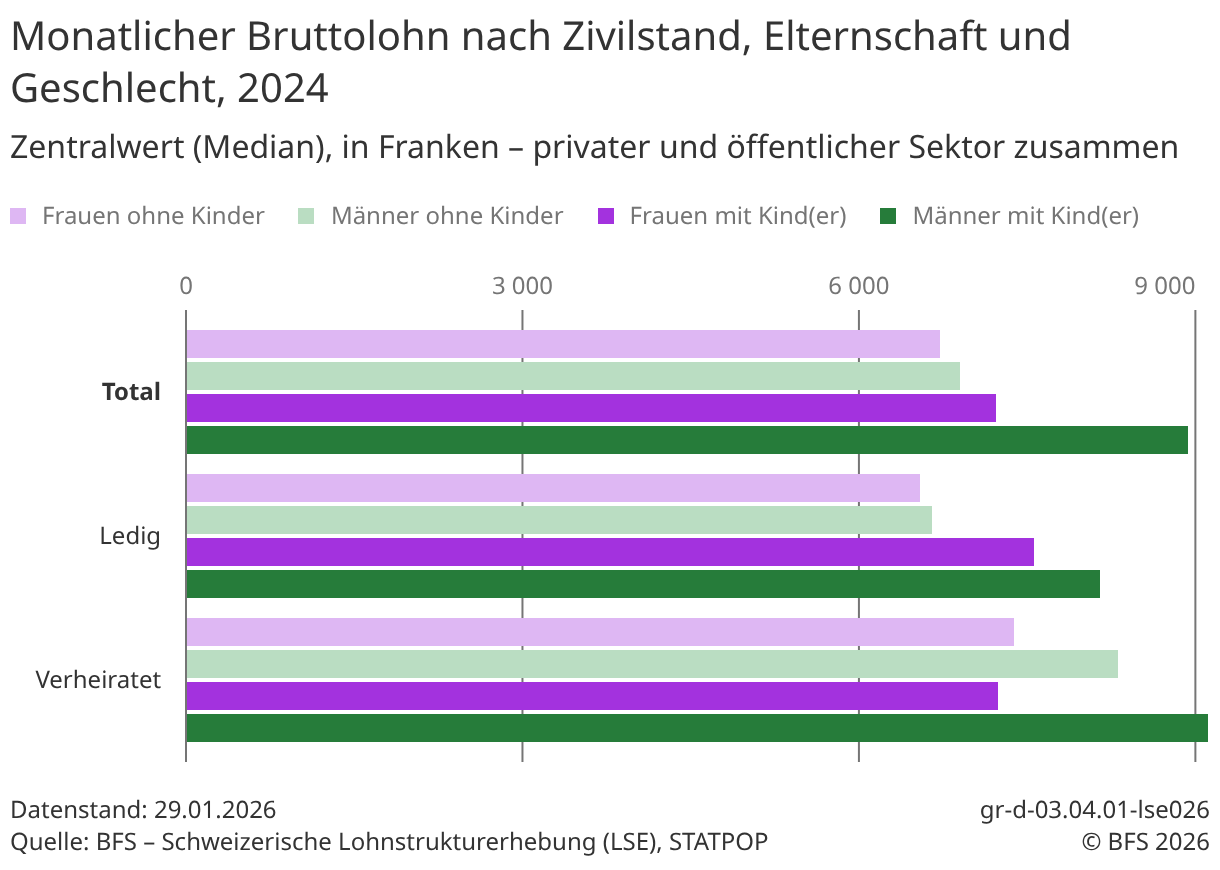
For married employees with children, the newer chart reports a median gross monthly wage of 7,249 francs for women and 9,120 francs for men. The gap is 1,871 francs; relative to the men's figure, that is around 20.5 percent. For unmarried people without children, the values are 6,559 and 6,664 francs. There the difference is much smaller.
The median divides jobs, ranked by pay level, into two equal halves. It is not the arithmetic mean. The groups cover the private and public sectors together; the FSO names the Swiss Earnings Structure Survey and the STATPOP population statistics as sources. The chart alone does not adjust for occupation, age, education or management responsibility between the groups.
A full-time wage is not the actual monthly bill
The Swiss Earnings Structure Survey (LSE) converts monthly wages to a uniform full-time basis: 4⅓ weeks at 40 hours. Among other things, it includes regular wage components as well as the 13th monthly salary and annual special payments on a pro-rata basis. Family and child allowances are not included. The standardised figure is therefore neither the net wage nor necessarily the monthly amount that actually arrives in the account.
This conversion makes it easier to compare jobs with different occupancy levels. But it does not answer how much income a household loses through part-time work or a career break. Anyone planning family finances also needs the actual workload, deductions and other income. A higher standardised median for one group is not yet a higher available household income.
The chart also shows a higher median for women with children overall than for women without children: 7,221 versus 6,738 francs. That, too, is no proof of a personal wage gain from motherhood. What is compared are differently composed groups of employees. People without such a job do not appear in this wage distribution with a fictitious zero wage.
Correlation is not causation
The decisive methodological limit lies in the group comparison. On average, people with children may be older, work in other occupations or more often hold management positions than people without children. Such characteristics can be linked to family status and pay at the same time. The observed difference therefore must not be attributed entirely to a single characteristic.
To determine a causal effect of a marriage or a birth, a study would have to take changes over time and suitable comparison groups more properly into account. The bar chart does not do that. Nor does it show whether a particular woman earns less after a birth than before. Equally, it does not prove that fathers are paid more favourably solely because of their fatherhood.
Adjusted differences are a different indicator
In its in-depth analysis of 31 August 2026, the FSO reports an average pay difference of 15.7 percent between women and men for 2024. The basis is the arithmetic mean. After accounting for structural characteristics, an unexplained difference of 6.5 percent remains according to this analysis. Both figures must be distinguished from the unadjusted median gaps of individual family groups.
«Unexplained» means that the characteristics taken into account do not explain the difference in the model used. That is not an automatic legal finding for every employment relationship. Conversely, a statistically explaining correlation must not be misunderstood as a justification for gender-specific disadvantage. The FSO explicitly points this out.
For employers, the federal government offers tools for in-company checks with Logib. The Federal Office for Gender Equality stresses that their results are not directly comparable with the national wage statistics because different models are used. For employees, the precise question therefore remains decisive: is equivalent work paid equally at one's own employer? The national chart makes the need for checks visible – it does not replace the check.
Sources
- FSO: Wage comparison by marital status, parenthood and gender, 2024
- FSO: Original chart with data for 2022
- FSO: Definitions of standard wage and median, LSE database
- FSO: In-depth analysis of wage differences 2024, 31 August 2026
- EBG: FAQ on pay equity analysis with Logib
- FSO: OPEN-BY terms of use for the article chart
- Lead image: Hadi, Wikimedia Commons
- Lead image licence: CC0 1.0