Helvetia Baloise expects up to 140 million francs in hail damage
The August storm will hit the insurer's books only in the second half of the year. Industry figures show why motor vehicles in particular carry weight – and why the total alone does not prove a risk failure.
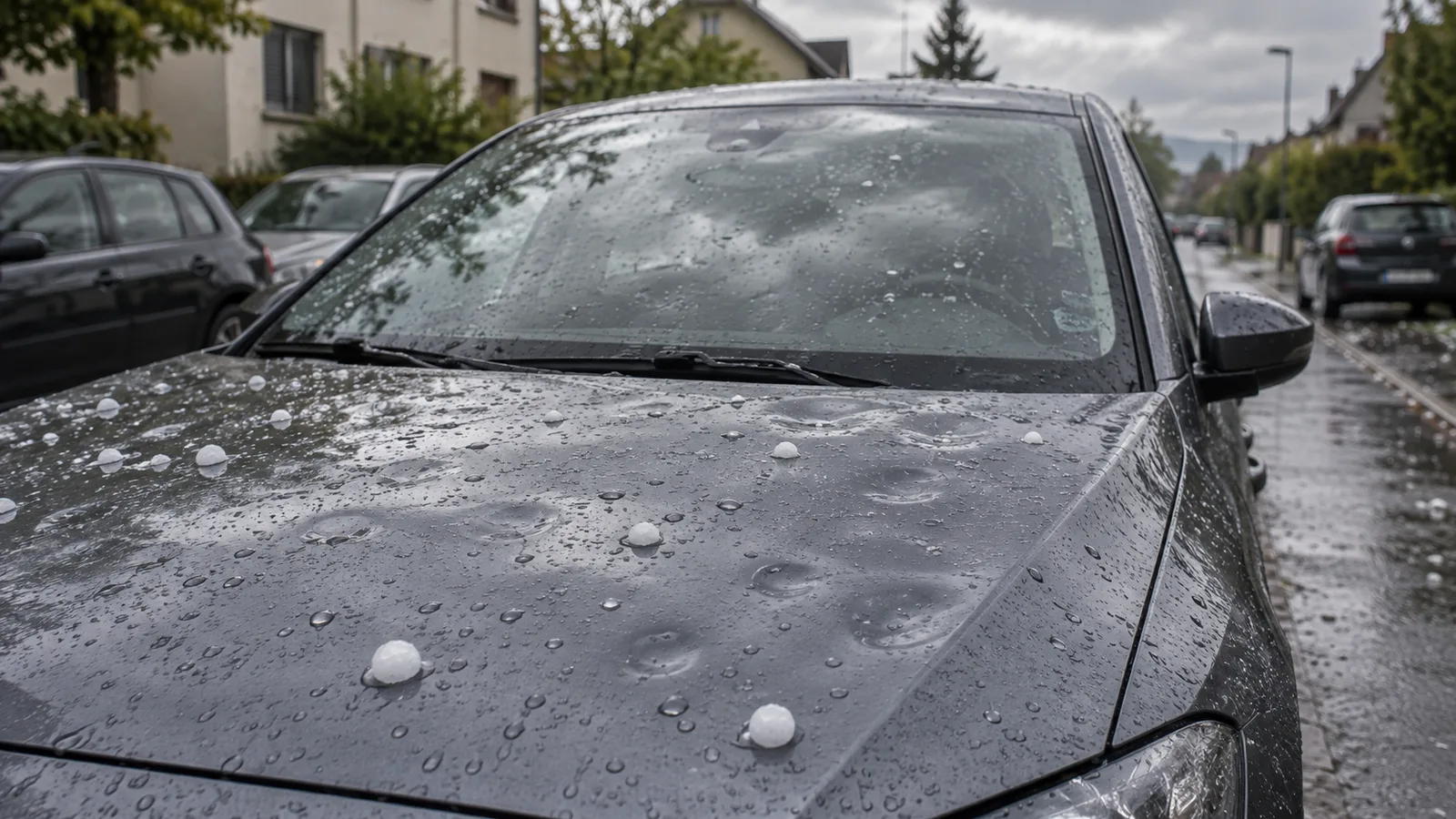
A hail storm hits many customers at once. For Helvetia Baloise, the storm of 28 August is therefore likely to mean a burden of 120 to 140 million francs. The insurer announced this on Thursday. The industry figures published at the same time show which losses carry the most weight: motor vehicles above all are driving up the cost of this event.
The group's figure is an estimate after reinsurance and before tax. It therefore describes the expected burden once the reinsurers' participation has been taken into account. It is not a final settlement.
The big bill is sitting in the car parks
On the same day, the Swiss Insurance Association (SVV) put the privately insured market loss at just under one billion francs. According to its initial estimate, more than 80 percent falls on motor vehicles; over 100,000 vehicles are likely to be affected. Bern, Solothurn, Aargau, Zurich and Thurgau were hit particularly hard.
Only around ten percent of the estimated total relates to losses covered by the Swiss Elemental Damage Pool. Other lines of insurance, such as business interruption and supplementary cover, account for the rest. The bill is therefore spread across different covers and is not carried entirely by one shared pool.
The billion-franc total does not capture every consequence of the storm either. Damage to buildings, which cantonal building insurers cover, is recorded separately and is missing from this estimate. The SVV compares the privately insured loss with the hail event of 25 August 2023 in Ticino: the current estimate is roughly twice as high.
Why no market share follows from this
Simply dividing Helvetia's up to 140 million francs by the industry total would be misleading. The group states a burden after reinsurance; the SVV estimates the privately insured market loss. The two figures describe different levels.
Without comparable figures before and after reinsurance, neither Helvetia's share of the original loss nor any particularly weak hedging can be derived from them. Nor is there evidence that the industry-wide split between vehicle and property damage is mirrored exactly in Helvetia Baloise's portfolio. That would require the insurer to disclose its own loss structure.

Hail does not explain the low half-year profit
According to the group, the burden will only be booked in the second half of 2026. The first half presented on Thursday remains unaffected by it. Anyone who explains the August storm with the decline in profit already reported is confusing the reporting periods.
In the first half, Helvetia Baloise posted an IFRS profit of 84.6 million francs. It was substantially burdened by write-downs of 671.7 million on intangible assets from the merger. In addition, the group reports adjusted "underlying earnings" of 631.6 million francs. This alternative metric excludes merger effects, among other things; it does not replace the reported profit.
Another pitfall lies in the half-year report: the comparative figures in the income statement for the first half of 2025 include only Helvetia as it stood then, while the current figures cover the merged group. A simple year-on-year comparison therefore also measures the changed size of the company.
Many policies are not the same as broad risk diversification
The August storm illustrates a fundamental problem of the insurance business: thousands of policies can be affected by the same event. What matters is therefore not only the number of customers, but also where their vehicles and other insured assets are located.
A merger can bring such portfolios together. Whether that created an inappropriate cluster risk in a specific case cannot be assessed from the published loss total. That would require, among other things, regional concentrations, modelled large losses and the terms of the reinsurance.
A large payout is not proof of failure in itself either: insurers take on contractually agreed risks precisely for the event of loss. What would need critical scrutiny is whether premiums, capital and hedging match the risks assumed.
The next storm has to be factored in
Looking at past bills is not enough for longer-term planning either. A study by Brennan and co-authors published in 2025 examines European hail tracks in climate simulations. In a scenario with three degrees of additional global warming compared with the simulated present-day climate, larger hail areas and more frequent very large hailstones are expected. That is a model projection, not an explanation of the specific August storm.
No specific premium increase can be derived for policyholders from the current figures. For Helvetia Baloise, what will be decisive is how the preliminary estimate develops and how the group limits the remaining risks. Only that information would show whether an excessive risk concentration lies behind a large loss bill.
Sources
- Helvetia Baloise: ad-hoc release on the half-year results, 17 September 2026
- Helvetia Baloise: half-year report 2026, in particular pages 6, 35 and 36
- SVV: first estimate of privately insured losses from 28 August, 17 September 2026
- Brennan et al.: «Insights from hailstorm track analysis in European climate change simulations», 2025
Research as of 17 September 2026.


