Hybrid Warfare Against Germany: Lessons for Switzerland
Germany struggles with Russian influence. Switzerland closely monitors the situation – also due to its own role.
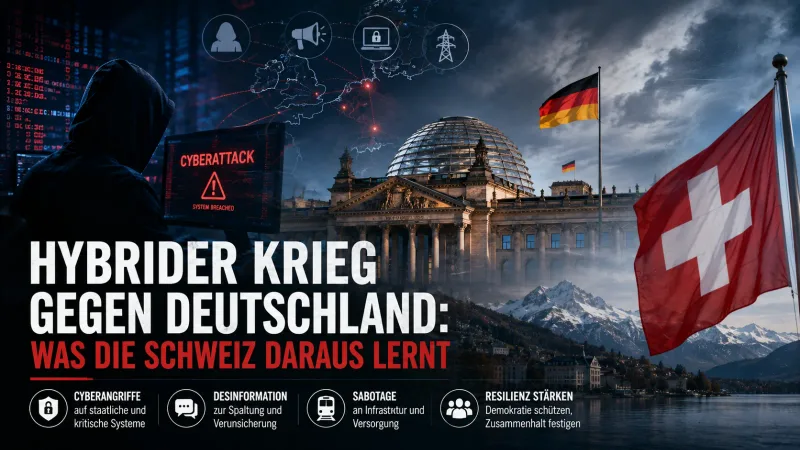
The term "hybrid warfare" is ubiquitous in security policy debates. It describes attacks that remain below the threshold of open military conflict: cyberattacks on government networks, disinformation campaigns, espionage, sabotage of critical infrastructure, and economic pressure. This threat situation has significantly increased in Germany in recent years. For Switzerland, whose prosperity is closely linked to Germany, the question arises whether it must prepare for similar scenarios.
Germany Targeted by Russian Operations
In German security circles, Russia is considered one of the greatest threats to internal security. Federal Chancellor Olaf Scholz spoke of a "Zeitenwende" (turning point) in his government statement to the Bundestag on February 27, 2022: "We are experiencing a turning point." The government reacted with a special fund for the Bundeswehr and a reorientation of security policy. A central role in this is the defense against hybrid attacks, which are often only recognized as such after a long time.
The threat is particularly evident in cyberspace. The German Federal Office for Information Security (BSI) has been warning for years about targeted attacks on authorities, political parties, and companies. In 2015, the Bundestag itself became the victim of a serious cyberattack attributed to Russian hackers. Since then, further incidents have become known, including alleged acts of sabotage on railway infrastructure. These attacks are rarely spectacular, but they undermine confidence in state institutions.
Germany's Response to the Threat
The German government is attempting to respond with a mix of technical defense measures and diplomatic instruments. A central element is the "National Security Strategy," adopted in 2023. It defines hybrid threats as part of the security policy agenda and establishes responsibilities. Defense Minister Boris Pistorius formulated the Bundeswehr's stance on this in January 2023 with a concise statement: "We must become fit for war."
However, defending against hybrid attacks is complex. The perpetrators operate in the grey area between war and peace, and evidence is often difficult to obtain. Germany therefore relies on a combination of public naming, diplomatic consequences, and the expansion of its own capabilities. This includes more personnel for cybersecurity, as well as raising public awareness to better recognize disinformation.
What Switzerland Can Learn from Germany
Switzerland is not a direct target of Russian retaliatory measures – at least not with comparable intensity. However, its close economic and social ties with Germany make it vulnerable. If, for example, logistics or energy supply were attacked in Germany, these disruptions would quickly impact Switzerland. Furthermore, Switzerland itself is regularly affected by cyberattacks, as shown by the situation reports from the Federal Office for Cybersecurity (BACS, formerly MELANI).
The Swiss security architecture traditionally relies on neutrality and armed neutrality. However, hybrid threats do not stop at national borders. Therefore, Swiss authorities closely monitor German experiences. Particular attention is paid to how democracies can defend themselves without betraying their own values. Transparency in dealing with disinformation and a resilient civil society are key terms here.
The confrontation will be ongoing. Germany and Switzerland face similar challenges: protecting critical infrastructure, ensuring the resilience of their societies, and cooperating with partners. Those who wage hybrid warfare do not primarily target territory but rather trust. Democracy can only withstand this attack if it names the danger – without succumbing to hysteria. Germany is attempting exactly this, with weaknesses but also with increasing professionalism. For Switzerland, this is a model worth observing.