Israel and Turkey Clash in Syria – What it Means for Switzerland
The power struggle over Syria intensifies.
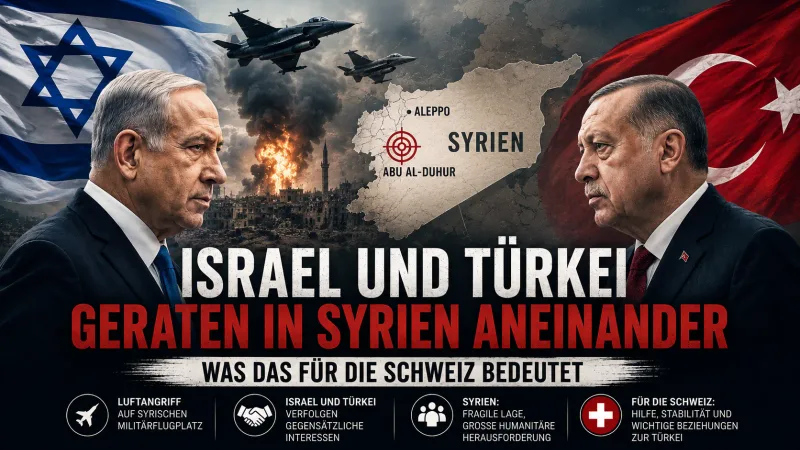
An Israeli airstrike on a Syrian military airbase has escalated tensions with Turkey. Ankara and Jerusalem are increasingly pursuing conflicting interests in Syria. For Switzerland, this involves not only the stability of a fragile region but also humanitarian aid and important relations with Turkey.
On August 18, Israel attacked the Syrian airbase Abu al-Duhur near Aleppo. According to Syrian sources, runways and base facilities were hit. No deaths or injuries were initially reported. Turkey condemned the attack as a violation of Syrian sovereignty. Washington also warned against further escalation.
A larger conflict underlies the attack: Since the fall of the Assad regime in late 2024, various actors have sought to secure their influence in the new Syria. Turkey supports the government of President Ahmed al-Sharaa and maintains military structures in the country's north. Israel, in turn, wants to prevent potentially hostile military forces from establishing themselves in its immediate vicinity.
What is Behind the Attack
The Israeli attack followed unusual direct contact between Israel and the new Syrian leadership. According to Reuters, Mossad chief Roman Gofman spoke with Syrian Foreign Minister Asaad al-Shaibani on August 14. The discussion centered on the growing Turkish military presence in Syria. Israel feared that Turkish weapons, drones, and possibly air defense systems could be stationed in Syria.
A few days later, Abu al-Duhur was bombed. Israel justified the action by concerns that Turkey could permanently expand its military presence there. Ankara rejected this explanation. The Syrian government also stated that no permanent Turkish military base was planned at the airbase. Only cooperation and training were envisioned.
This leaves a crucial question open: Was Israel aiming to prevent an imminent Turkish military deployment – or to send a fundamental signal to Ankara?
Syria Becomes the Scene of a New Power Struggle
The conflict is part of a larger reordering of the Middle East. With the end of Assad's rule, regional power dynamics have shifted. Iran is significantly weakened in Syria, and Hezbollah has lost influence. Simultaneously, Turkey is trying to deepen its relations with the new Syrian leadership.
Ankara supports Syria's political and economic reconstruction and considers the country central for security reasons. Kurdish forces in the north, in particular, play an important role for Turkey. Ankara views the Syrian Kurdish People's Protection Units and their associated structures as a security risk.
Israel pursues other goals. Jerusalem wants to prevent Syria from again becoming a platform for attacks against Israel or for the establishment of opposing military infrastructure. At the same time, Israel seeks to maintain its military freedom of action against Iran.
Thus, two security interests clash – in a country that has yet to find a stable post-war order itself.
Washington Caught Between Two Allies
The situation is particularly difficult for the USA. Both Israel and Turkey are among Washington's most important partners in the region. Turkey is also a NATO member.
US Special Envoy for Syria and Ambassador to Turkey, Tom Barrack, criticized the Israeli attack as an unnecessary escalation. Simultaneously, the USA is striving for a mechanism to prevent direct clashes between Israel, Turkey, and Syria.
Washington's need to mediate between its two partners shows how complicated the new situation has become. A direct military conflict between Israel and Turkey still appears unlikely. However, the more frequently both sides test their red lines in Syria, the greater the risk of miscalculation.
Much at Stake for Syria
For the Syrian population, the developments are particularly problematic. After years of civil war, the country remains in a fragile transitional phase. According to Switzerland, over 16 million people still rely on humanitarian aid. Simultaneously, the new government is trying to rebuild state structures and stabilize the economy.
New military confrontations could significantly hinder this process. Furthermore, any escalation carries the risk of new displacements.
What This Means for Switzerland
The direct military consequences for Switzerland are limited for now. Nevertheless, these developments have several dimensions for Bern.
Firstly, Switzerland is strongly committed to humanitarian efforts in the region. The Federal Department of Foreign Affairs even expanded its presence in Syria in 2026. In early July, the former humanitarian office in Damascus was upgraded to a cooperation office. Bern aims to further support the political transition process and economic stabilization.
In 2026, Switzerland also provided additional millions for humanitarian aid in Syria and neighboring countries. Further escalation would increase the need for international support.
Secondly, the conflict concerns an important partner of Switzerland: Turkey. Bilateral relations are close. In 2024, the trade volume between the two countries amounted to more than 10 billion Swiss francs; without gold, it was around 4 billion. Swiss companies have also invested approximately 4 billion Swiss francs in Turkey.
Increased regional instability could therefore have indirect consequences for trade, investments, and travel. However, there is no indication yet that the current dispute between Israel and Turkey is directly affecting Swiss trade.
No Immediate Conflict – But a Dangerous Pattern
The recent events do not mean that Israel and Turkey are on the brink of war. Both sides have an interest in avoiding direct confrontation. At the same time, mistrust is growing.
Israel increasingly observes the Turkish presence in Syria with concern. Ankara, in turn, views Israeli military actions on Syrian territory as a violation of Syrian sovereignty. The new Syrian leadership is caught between these interests.
Added to this is the role of the USA. Washington must prevent two of its most important partners in the region from entering a military conflict. The recent talks between Syria and Israel, mediated by the US, show that this attempt is already underway.
Switzerland Relies on Stability
For Bern, therefore, one thing is primarily in its interest: stabilizing Syria and preventing further escalation. While Switzerland does not possess the political influence of the USA or Turkey, it can contribute through humanitarian aid, diplomacy, and its long-standing experience with dialogue formats.
No Swiss mediation initiative between Israel and Turkey is currently known. Therefore, it would be incorrect to attribute a concrete mediator role to Bern at this stage.
The attack on Abu al-Duhur primarily shows how fragile the new order in Syria is. The power struggle between Israel and Turkey is therefore likely to concern more than just the region. Much is at stake for Switzerland: humanitarian aid, regional stability, and relations with an important trading partner.
Sources
- Reuters: Mossad Chief, Syrian Foreign Minister Discuss Turkish Military Deployments
- Reuters: US-Mediated Talks Between Syria and Israel
- Reuters: Israel and Turkey Escalate Warnings After Syrian Airbase Attack
- Merkur / Foreign Policy: Analysis of the Power Struggle Between Israel and Turkey
- EDA: Switzerland Expands Presence in Syria
- EDA: Bilateral Relations Switzerland–Turkey