Italy's Opposition Struggles for Unity – Meloni Gains Time
Giuseppe Conte and Elly Schlein fail to find common ground, benefiting Prime Minister Giorgia Meloni.
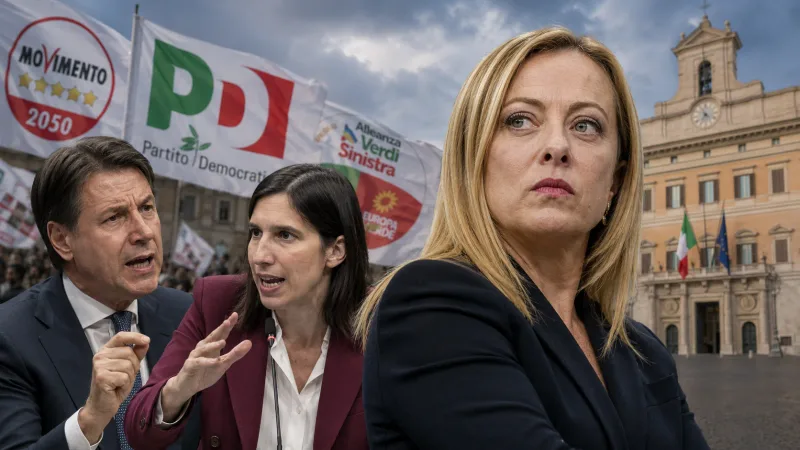
Giorgia Meloni has been Italy's Prime Minister since autumn 2022, and her government shows remarkable stability. In a country where governments frequently changed after World War II, Meloni could soon set a historic record. However, the next power struggle is already emerging ahead of the 2027 parliamentary election. It will be crucial whether the opposition can unite its forces.
At the center is the so-called "Campo largo", a potential broad center-left alliance. This includes Elly Schlein with the Partito Democratico (PD), Giuseppe Conte with the Five Star Movement (M5S), and the Verdi e Sinistra alliance, among others. During a joint appearance in Naples in July, the parties indicated they do not want mutual competition to divide them again.
Schlein and Conte: United Against Meloni – But How?
The two main actors of the potential alliance are Elly Schlein and Giuseppe Conte. Both aim to replace Meloni's right-wing coalition. However, their common ground partly ends there.
Disputes primarily concern the path to a joint candidacy. Schlein insists on first defining a common political program. Only then should decisions be made about the lead candidacy and potential primaries. Conte, however, wants to play a central role in the primaries and rejects certain models for their execution.
Differences also exist in foreign and security policy. The stance on the war in Ukraine and European defense policy particularly creates tension within the center-left camp. The differences are not insurmountable, but they highlight the difficulty in forming a common political alternative from multiple parties.
The Alliance Exists – The Rules Are Missing
However, there is no talk of a complete failure of the opposition. The parties already appear together and are working on a possible election strategy. In July, Schlein, Conte, and representatives of Verdi e Sinistra jointly launched the political campaign for the 2027 election in Naples.
The problem lies rather in the details: Who should lead the alliance? How will candidates be determined? Which program applies? And how far can a possible compromise go without losing one's own electorate?
The discussion about primaries, in particular, illustrates the difficulties. In August, debates continued over whether there should be a single ballot or a run-off procedure. Simultaneously, several names are being discussed for a potential lead candidacy.
Schlein is now trying to put the personnel discussion aside and focus more on political content. She recently warned against losing too much time on internal debates.
Meloni Remains the Strongest Force
For Giorgia Meloni, this situation is politically comfortable. Her party, Fratelli d'Italia, remains the strongest single party in polls. At the same time, her government has achieved exceptional stability by Italian standards.
However, this does not mean Meloni is without political risks. The economy is growing slowly, and the government faced setbacks in important reforms. Furthermore, new competition is emerging to Meloni's right: The Futuro Nazionale party of former General Roberto Vannacci is gaining traction in polls.
The government also faces a problem with young Italians. Polls show increasing dissatisfaction with Meloni in this age group. In the referendum on judicial reform in spring, young voters participated surprisingly strongly and largely rejected the reform.
A United Opposition Would Be Dangerous
This is precisely where the political tension lies ahead of the 2027 election. Meloni is currently stronger than any single opposition party. However, a united center-left list could create a very different balance of power.
The crucial question is therefore less about whether Conte or Schlein alone is stronger. The decisive factor is whether they succeed in bringing their parties, smaller progressive forces, and potentially other political groups onto a common course.
This is not an easy task. An alliance can mobilize additional voters, but it can also deter parts of its own supporters. Especially regarding Ukraine, defense issues, economic and social policy, and the relationship with the European Union, the parties' priorities sometimes differ.
Electoral Law Also Plays a Role
The dispute is further influenced by the planned reform of Italian electoral law. In July, Parliament passed a controversial reform, which the opposition criticizes as an attempt to improve Meloni's chances for another term.
The specific design of the electoral law can be crucial for whether large electoral alliances are beneficial or if parties focus more on their own lists. Thus, the question of opposition unity becomes not only a political but also a strategic problem.
Why This Development Is Important for Europe
Italy is the third-largest economy in the Eurozone and a central member state of the European Union. Political decisions made in Rome therefore have implications beyond national borders.
During her tenure, Meloni has shown a more pragmatic approach to the EU than some observers initially expected. At the same time, she pursues a distinctly conservative line on issues such as migration, security, and national sovereignty.
A new government would therefore not only change Italy's domestic policy. The Italian position on migration, defense, EU finances, and support for Ukraine could also shift.
What This Means for Switzerland?
This development is also relevant for Switzerland. Italy is an important trading partner and neighbor. Relations between Ticino and Lombardy are particularly close. Thousands of cross-border commuters cross the border daily. Additionally, there is freight traffic, tourism, energy, and cross-border rail transport.
Therefore, a stable and predictable government in Rome is of great importance for Bern and especially for Ticino. Changes in Italian tax, transport, or migration policy can directly affect the border region.
A political reordering in Rome could also influence cooperation between Switzerland and Italy on European and bilateral issues. It will be crucial whether a government emerges after the election with a clear majority that remains capable of action in the long term.
The Power Struggle Has Just Begun
The election is not yet decided, and even the exact date is still uncertain. The opposition has until 2027 to overcome its differences.
Meloni therefore cannot simply lean back. While her government is unusually stable, polls and political developments simultaneously indicate that the balance of power could shift.
The real question is therefore not whether Italy's opposition is currently divided. It is: Can Schlein, together with Conte and other opposition forces, transform this diversity into an electable alternative in time?
If successful, the 2027 Italian parliamentary election could be much more open than Giorgia Meloni's current strength suggests. If not, the Prime Minister is likely to benefit from the fragmentation of her opponents.
Sources
- Reuters: New stability record for Italy's Meloni may prove fleeting
- Reuters: Italian regional votes show no sign of opposition breakthrough
- Sky TG24: Campo largo in Naples – Launch of the 2027 campaign
- RaiNews: Campo largo – Dispute over primaries and program
- ANSA: Schlein postpones primaries debate
- Reuters: Meloni and young voters
- Reuters/Internazionale: Italian Parliament approves controversial electoral reform