MEM SMEs: Economy Improves, Skilled Labor Shortage Remains
The business climate index rises to its best level since spring 2024 – structural problems persist.
Swiss MEM SMEs See First Recovery – Skilled Labor Shortage Remains a Problem
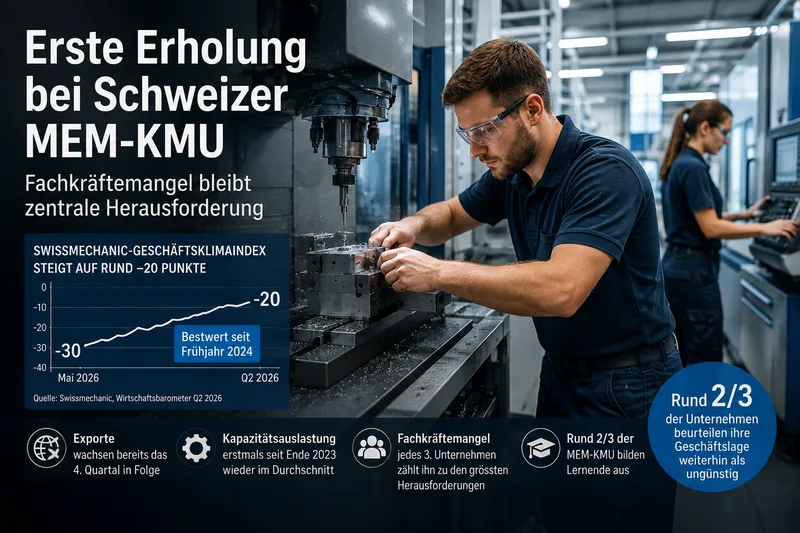
The Swiss Mechanical and Electrical Engineering and Metals Industry (MEM) sends first positive economic signals. In the second quarter of 2026, the economic situation for MEM SMEs slightly improved. The Swissmechanic business climate index rose to around minus 20 points, reaching its best value since spring 2024. However, a sustainable turnaround is not yet in sight.
The development shows a mixed picture. On the one hand, several key figures are improving: MEM SME exports have grown for the fourth consecutive quarter, capacity utilization is back at its long-term average for the first time since late 2023, and the use of short-time work has significantly decreased.
On the other hand, sentiment in the industry remains tense. Approximately two-thirds of companies still rate their current business situation as unfavorable. The Swiss MEM industry is no longer at its low point of recent months, but it is still far from a broad recovery.
Business Climate Improves Significantly
The Swissmechanic business climate index rose to approximately minus 20 points in the second quarter of 2026. In spring, the value was still around minus 30 points. This brings the index to its best level since spring 2024.
The increase is a positive signal for the many small and medium-sized enterprises in the Swiss MEM industry. At the same time, the index remains clearly in negative territory. Swissmechanic therefore explicitly warns against speaking of a turnaround just yet.
"The first positive signals are encouraging," explains Swissmechanic President Nicola Tettamanti. However, a sustainable turnaround requires stable economic policy conditions and reliable prospects for SMEs.
Exports Growing for Four Quarters Already
Exports are a significant bright spot. MEM SME exports increased for the fourth consecutive quarter in the second quarter.
There is also an improvement in production capacity utilization. It is back at its long-term average for the first time since late 2023. Concurrently, the use of short-time work has significantly decreased.
Thus, several indicators are improving simultaneously. For companies, this means relief after a prolonged period of weak demand and high uncertainty.
But Two-Thirds of Companies Remain Dissatisfied
However, the positive development should not obscure the fact that the situation remains difficult for many businesses.
Approximately two-thirds of surveyed companies still rate their business situation as unfavorable. Despite its improvement, the business climate index remains significantly below zero.
While concerns about order levels have somewhat decreased, another problem is moving back into focus: the shortage of skilled labor.
Skilled Labor Shortage Becomes More Prominent Again
Already every third company considers the skilled labor shortage one of its biggest challenges. This is particularly problematic for the MEM industry, as many activities require technical expertise and specialized training.
Companies face a long-term problem: it is not just about filling open positions. The situation is also becoming more difficult when it comes to finding young talent.
Increasing Difficulties in Finding Apprentices
Approximately two-thirds of MEM SMEs train apprentices and consider vocational education an important part of their HR strategy. At the same time, according to Swissmechanic, it is becoming increasingly difficult to find suitable young people for apprenticeships.
Many companies receive too few applications. Others find interested candidates, but their academic qualifications do not meet the requirements of the respective training.
Thus, securing young talent becomes a crucial future task for the industry. Swissmechanic Director Erich Sannemann summarizes the development: The skilled labor shortage does not start with open positions, but already where apprenticeships cannot be filled with suitable young people.
Vocational Education Becomes a Decisive Factor
For MEM companies, in-house training is therefore gaining further importance. Companies that cannot sufficiently find skilled workers on the job market must increasingly try to train them themselves and retain them long-term.
However, this presents additional challenges for businesses. Training apprentices requires time, qualified supervision, and corresponding investments. At the same time, companies must be able to fill their training positions with young people who meet the demands of technical professions.
Swissmechanic therefore sees a need for action regarding the framework conditions for vocational education. From the association's perspective, promoting young talent is an essential component to alleviate the skilled labor shortage long-term.
Why the Recovery is Not Yet a Turnaround
The current figures primarily show an improvement compared to the difficult situation of recent quarters. However, they do not mean that the problems of the MEM industry are solved.
The business climate index remains negative, and approximately two-thirds of companies continue to rate their situation as unfavorable. At the same time, businesses remain dependent on stable economic policy conditions and more reliable demand.
The fact that exports are now growing for four consecutive quarters and capacity utilization has reached its long-term average again is therefore primarily a signal of hope.
Over 65,000 Employees in the Swissmechanic MEM Industry
The industry's importance for the Swiss economy is significant. Swissmechanic represents more than 1,300 affiliated companies in the MEM industry. These collectively employ over 65,000 staff, including approximately 6,000 apprentices.
According to the association, the affiliated companies generate an annual turnover volume of approximately 15 billion Swiss Francs. Swissmechanic is divided into 13 regional sections and other specialized and service organizations.
What Companies Need Now
For Swissmechanic, the current improvement is therefore not yet sufficient. The association demands stable economic policy conditions and reliable prospects for companies.
Predictable framework conditions are particularly important for export-oriented Swiss SMEs. At the same time, businesses must address the challenges in recruiting skilled workers and apprentices.
Thus, two tasks are simultaneously paramount for the industry: in the short term, economic demand must further stabilize, and in the long term, the training of sufficient skilled workers must be ensured.
Swiss MEM Industry Remains Cautiously Optimistic
The second quarter of 2026 thus brings several positive signals for the first time in a while. Exports are rising, capacity utilization is improving, and short-time work is decreasing. The business climate has also brightened significantly.
At the same time, the situation remains difficult for many companies. The business climate index is still in negative territory, and approximately two-thirds of businesses rate their business situation as unfavorable.
The coming quarters will therefore be crucial. Only if the improvement in orders, exports, and utilization continues for a longer period can a sustainable recovery be truly discussed.
Conclusion
Swiss MEM SMEs can look at the economic outlook with slightly more optimism for the first time again. The business climate index rose to around minus 20 points, its highest level since spring 2024.
Exports are also developing positively: they are growing for the fourth consecutive quarter. Capacity utilization has reached its long-term average, and short-time work has significantly decreased.
However, a turnaround cannot yet be declared. Approximately two-thirds of companies still rate their business situation as unfavorable. Concurrently, the skilled labor shortage is gaining importance again. Finding suitable apprentices, in particular, is becoming more difficult for many businesses.
The Swiss MEM industry is thus at a potential turning point. Whether the first positive signals truly lead to a sustainable recovery depends on whether improved demand stabilizes and companies can simultaneously attract enough skilled workers for the future.
Sources
- Swissmechanic Switzerland: "Economic Outlook Brightens – Skilled Labor Shortage Persists," Media release of August 26, 2026.
- Swissmechanic Economic Barometer, second quarter 2026.