Mental Illnesses Almost Double Worldwide – What Does This Mean for Switzerland?
A Lancet study shows a near doubling. Vaud psychiatrist Friedrich Stiefel provides context.
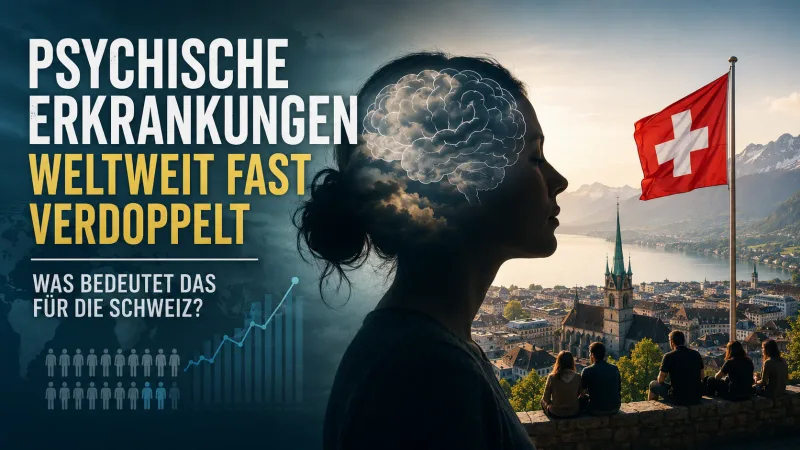
Mental Illnesses Almost Double Worldwide – What Does This Mean for Switzerland?
In 2023, 1.17 billion people worldwide lived with a mental illness. A new analysis in «The Lancet» shows an increase of about 95 percent since 1990. But does this truly mean the world is becoming mentally sicker? And what implications does this have for Switzerland?
The figure is striking: Approximately 1.17 billion people globally were affected by a mental illness in 2023. This is nearly one in seven people. The number has almost doubled since 1990.
Researchers analyzed data from 204 countries and territories, examining twelve different mental disorders. These include depression, anxiety disorders, and schizophrenia.
However, the seemingly simple statement «twice as many people with mental illnesses» hides a more complex development.
More Cases – Not Simply Double the Suffering
The world population has grown significantly since 1990 and has also aged. This alone means more people can suffer from a mental illness today. Researchers therefore also identified an age-standardized increase in prevalence of about 24 percent.
This is significantly less than the increase in absolute case numbers. Therefore, the development cannot be solely explained by mental illnesses occurring twice as often today.
Another factor is that mental illnesses are more frequently recognized today. People speak more openly about depression, anxiety disorders, or other mental health issues and are more likely to seek professional help. An increasing number of diagnosed cases can therefore partly indicate that a problem has become more visible.
What Applies to Switzerland?
This is where the story becomes particularly interesting. A doubling of mental illnesses in Switzerland cannot be concluded from The Lancet study.
The reason is the data situation. The National Health Report 2025 indicates that Switzerland lacks regular epidemiological surveys to reliably compare the frequency of mental illnesses over longer periods.
This means: We know that mental illnesses are a significant health problem in Switzerland. However, we cannot credibly claim that their frequency has also doubled here since 1990.
The Federal Office of Public Health estimates that up to one-third of the Swiss population may be affected by a mental illness within a year. At the same time, only about half of those affected receive treatment.
Thus, for Switzerland, a different question arises than just that of increasing case numbers: How many people are truly suffering – and how many of them are identified and treated?
Young People Particularly in Focus
The international study provides another important insight. Mental illnesses do not only affect adults. The highest age-standardized disease burden in 2023 was found among 15- to 19-year-olds.
Especially in adolescents, mental problems can have far-reaching consequences. They can affect education, social relationships, and later entry into professional life.
In Switzerland too, the mental health of young people is becoming an increasing concern. The National Health Report describes persistent mental stress, especially among children, adolescents, and young adults.
Why Diagnosis Figures May Be Rising
Vaud psychiatrist Friedrich Stiefel, Chief Physician of Consultative Psychiatry at Lausanne University Hospital, therefore warns against automatically equating rising diagnosis figures with a deterioration in the mental state of the entire population.
His explanation: Society deals with mental problems differently today. What was once hidden or not diagnosed at all is now more frequently addressed and treated.
At the same time, Stiefel observes increasing societal uncertainty. Energy, security, and climate issues could trigger fears in people. Experiences of loss might also play a role – especially when people cannot find a way to process these losses.
This creates a contradictory picture: More diagnoses can reflect both more recognized illnesses and an actual increase in psychological burdens. Both cannot be easily separated.
Depression and the Question of Loss
This question becomes particularly clear with depression. According to The Lancet analysis, depressive disorders are among the leading causes of mental disease burden worldwide.
Stiefel links depression, among other things, to loss. Grief is fundamentally a normal reaction to loss. However, if losses are very significant or recurrent and cannot be processed, a depressive development can arise.
This is not a simple explanation for depression – mental illnesses usually have many interconnected causes. But it shows how strongly societal changes and individual life situations can interact.
A Global Problem with Swiss Consequences
The scale of this development is also evident in another key figure: In 2023, mental illnesses caused approximately 171 million DALYs worldwide. This metric summarizes life years lost due to illness, disability, or premature death.
Mental illnesses are thus not a niche area of medicine. They rank among the most significant causes of health-impaired life years globally.
For Switzerland, this does not mean that a «doubling» can be immediately asserted. Rather, the study demonstrates why a solid data basis is so important.
What Switzerland Can Learn From This
The first consequence is therefore unspectacular but crucial: Switzerland needs to know more precisely how the mental health of its population is developing.
Regular and comparable data could show whether mental illnesses are actually becoming more common, whether more people are simply receiving diagnoses, or if both are changing simultaneously.
At the same time, care remains crucial. Those who receive early help have better chances that mental problems will not become entrenched. Prevention, low-threshold services, and an open approach to mental health can therefore be as important as the treatment itself.
The new Lancet study thus does not provide a simple answer to whether people are mentally sicker today than before. However, it impressively demonstrates the scale of the global challenge.
For Switzerland, the crucial question is therefore not: «Has the number of people with mental illnesses doubled?» But rather: «Do we even know precisely enough how the mental health of the population is changing – and are we doing enough to reach those who need help?»