Nördlich Lägern: What Is Decided – and What Is Not
The Nördlich Lägern site has been proposed under the sectoral plan procedure. That is an important step – but not a construction permit and not yet a final decision on a deep geological repository.
Nördlich Lägern is currently the central name in the Swiss debate over the disposal of radioactive waste. In 2022, the National Cooperative for the Disposal of Radioactive Waste (Nationale Genossenschaft für die Lagerung radioaktiver Abfälle) proposed the area as the site for a deep geological repository. That concentrated a years-long site search on a single region. It does not, however, mean that construction has been approved.
The distinction matters. The Sectoral Plan for Deep Geological Repositories (Sachplan geologische Tiefenlager) is meant to define where a deep repository is fundamentally possible and which spatial planning conditions apply. It is not a construction permit. Construction, operation and the later closure of a repository require further licensing procedures.
What the site decision means
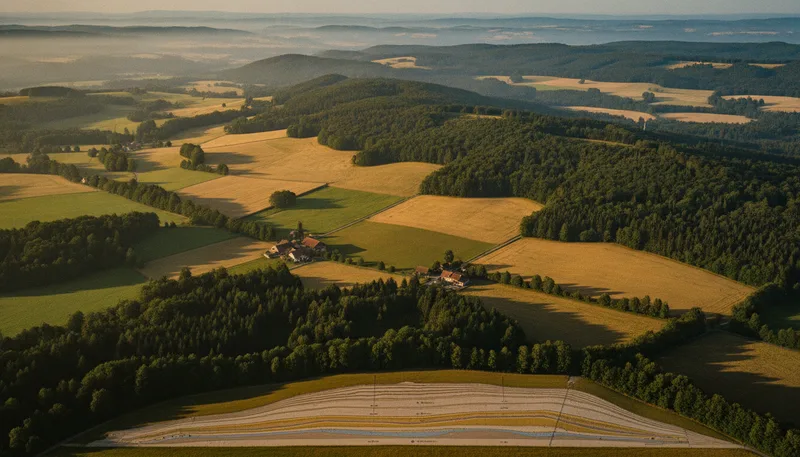
The Nördlich Lägern site lies in the Zürcher Unterland, close to the border with the canton of Aargau. What is decisive is not the landscape at the surface but the geology at great depth. The Opalinus Clay is considered suitable because it allows water to pass through only very slowly and, in combination with technical barriers, is intended to provide protection.
The Swiss concept relies on several barriers. Radioactive waste is placed in containers, encased in further materials and stored in a suitable rock body. No single component is supposed to guarantee protection on its own. What matters is how waste form, container, backfill and geology interact over very long periods.
This safety argument is the subject of ongoing technical reviews. It should not be confused with the question of whether the region accepts the project politically, or whether the later licences will actually be granted.
The sectoral plan is not a decision to build
The Swiss Federal Office of Energy (Bundesamt für Energie) conducts the site search within the framework of the Sectoral Plan for Deep Geological Repositories. Stage 3 focuses on in-depth investigations, the safety assessment and the preparation of the basis for the Federal Council's decision. The Swiss Federal Nuclear Safety Inspectorate (Eidgenössisches Nuklearsicherheitsinspektorat) assesses the safety-related aspects independently.
According to the current procedural schedule, the documents are to be opened for public inspection in 2028. Those affected can then comment and file objections. The Federal Council is expected to take the sectoral plan decision in 2029. That decision establishes the spatial planning designation. It does not, however, automatically answer all questions about financing, design and operation.
The repository project itself will later require a general licence under the Nuclear Energy Act. This licence is granted by the Federal Council and approved by Parliament. The optional referendum can be held against the approval decision. Only after that do further licences follow for construction, operation and closure.
Why the procedure takes so long
A deep repository is not simply a decision about a technical facility. It concerns radioactive waste that must remain safely isolated over very long periods, the trust of the host region and political legitimacy. The procedure therefore deliberately separates several questions: geological suitability, nuclear safety, spatial planning designation and democratic consent.
This can seem laborious, but it is a safeguard. A site proposal can be technically plausible and still trigger further reviews or political conflicts. Conversely, a political debate cannot replace a geological investigation. A durable decision needs both levels.
The region remains part of the procedure
The municipalities, cantons and organisations around Nördlich Lägern cannot reduce their concerns to a single statement. Questions about transport, landscape, information, waste shipments and long-term responsibility can be raised at different stages of the procedure. Regional participation does not replace a nuclear safety review, but it is important for the legitimacy of a project that will have an effect across generations.
For the Nördlich Lägern region, the next phase is therefore becoming concrete: the accurate headline is not “repository decided” but an ongoing procedure with clearly defined milestones. The site has been proposed, the safety review continues, and the decisive licences still lie ahead of the project. It is precisely in these procedures that it will become clear whether a site proposal turns into a deep repository that is socially and legally viable.