Outpatient Before Inpatient – Hospitals Still Need Both
Hospital planning changes – outpatient procedures complement inpatient care.
Bern – A procedure in the morning, home by evening: What sounded like an exception just a few years ago is increasingly becoming the norm in Swiss medicine. Surgical techniques have become gentler, anaesthesia safer, and follow-up checks can sometimes be organised outside the hospital.
Politics has further accelerated this development. Since 2019, the principle of «outpatient before inpatient» has applied at the federal level for specific procedures: The mandatory health insurance (OKP) generally only covers these treatments on an outpatient basis, provided there are no medical reasons for an inpatient stay.
However, current figures paint a surprising picture: Outpatient medicine is growing – and simultaneously, the inpatient sector is also expanding.
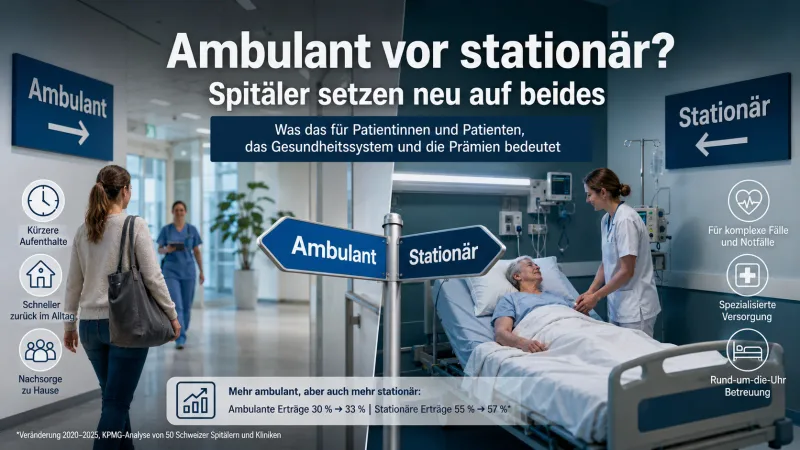
A recent KPMG analysis of the financial reports from 50 significant Swiss hospitals and clinic groups shows that the share of outpatient revenue increased from 30 to 33 percent within five years. Concurrently, the share of inpatient revenue rose from 55 to 57 percent. Therefore, it is difficult to speak of inpatient business being displaced.
The Swiss hospital of the future is therefore apparently not simply a hospital without beds. It is a hospital that must be able to do both: provide outpatient treatment and inpatient care.
Outpatient grows – but inpatient remains
This initially sounds contradictory. If more and more operations are performed on an outpatient basis, fewer people should actually remain in the hospital.
For certain procedures, this is exactly what happens. The current report by the Swiss Health Observatory Obsan shows, for example, that the number of inpatient cases for procedures affected by the «outpatient before inpatient» rule decreased from around 74,000 to approximately 50,500 cases. This represents a 31.8 percent reduction.
At the same time, patients with more complicated treatments remain in inpatient care.
The average length of stay and the case-mix index of the remaining inpatient cases have increased since 2019. Simply put: More often, the more complex cases remain in hospital.
This also explains why hospitals' inpatient revenues do not simply collapse, even though more treatments are carried out on an outpatient basis.
Thus, the shift to outpatient care does not replace the hospital. Instead, it changes its role.
What does this mean for the Swiss public?
For patients, this development can initially bring benefits.
Patients who do not need to stay overnight in hospital for a suitable procedure can return to their familiar surroundings more quickly. For many people, this means less disruption to daily life and potentially less burden from a hospital stay.
But outpatient does not automatically mean simpler.
Those who go home the same day need an environment there where recovery can proceed. Depending on the procedure, relatives, family doctors, Spitex, or other professionals may be more involved in follow-up care.
For a healthy person who quickly regains mobility after a minor operation, this can work very well.
For an elderly person, someone with multiple illnesses, or a patient with little support at home, the situation can look completely different.
Therefore, it cannot solely be about performing as many treatments as possible on an outpatient basis.
The decisive question is: For whom is outpatient care medically appropriate – and for whom is inpatient care the better solution?
This is precisely where one of the limits of outpatient shifting lies.
And then comes the cost question
Politically, «outpatient before inpatient» was also associated with the hope of making healthcare more affordable.
This sounds logical: An operation without an overnight stay often requires less hospital infrastructure and incurs lower costs than an inpatient stay.
However, the Swiss experience shows: The calculation is more complicated.
For the procedures affected by the «outpatient before inpatient» rule, inpatient costs decreased by approximately 149 million Swiss francs between 2018 and 2024. Simultaneously, outpatient costs increased by around 202 million Swiss francs. Overall, the costs for these procedures even rose slightly.
This does not mean that outpatient medicine is inherently more expensive.
However, it means that a shift alone is not yet a guarantee for decreasing overall costs.
For example, if more treatments are performed on an outpatient basis, additional services may arise. Volume and price effects can also partially or completely offset savings. Obsan points out exactly this.
This is particularly important for premium payers
Here lies a crucial point in the Swiss healthcare system.
Today, outpatient services are entirely financed through premiums from the mandatory health insurance. For inpatient hospital services, however, the cantons cover at least 55 percent of the costs; a maximum of 45 percent is financed by health insurance and thus through premiums.
Thus, a treatment can be medically reasonably shifted from inpatient to outpatient care – and simultaneously, this changes who pays the bill.
This can explain why an outpatient shift does not automatically lead to lower health insurance premiums.
On the contrary: If a treatment is moved from the inpatient to the outpatient sector, a larger portion of the costs today falls directly on the health insurers.
This creates a problem that goes beyond a single operation: The Swiss financing system has long created differing incentives for outpatient and inpatient medicine.
2028 will therefore be a decisive year
This is where the next major healthcare reform comes into play: unified financing of healthcare services, EFAS.
The Swiss population approved the reform in 2024. From 2028, outpatient and inpatient services covered by mandatory health insurance will be financed according to a uniform key. Cantons will cover at least 26.9 percent of net costs, insurers a maximum of 73.1 percent.
This changes a central incentive.
In the future, if a patient is treated on an outpatient basis instead of as an inpatient, it will no longer automatically mean that the health insurer covers practically the entire bill, while the canton pays a large portion for inpatient treatment.
Outpatient and inpatient care are to be brought closer together financially.
This could improve conditions for medically appropriate outpatient treatments to actually be promoted – and not simply because the financing system favours a particular form of treatment.
The BAG also expects EFAS to relieve premium payers in the long term. However, the magnitude is a prognosis and not a guarantee. The BAG itself points to the uncertainty of future cost developments.
The new tariff system also plays a role
Furthermore, a new tariff system for outpatient medical services has been in effect since January 1, 2026. TARDOC and outpatient flat fees have replaced TARMED.
One of the goals is to remunerate outpatient medicine more appropriately and in line with current practices, and to correct perverse incentives of the old system.
An important requirement here is that the change in the tariff model itself must be cost-neutral. The BAG therefore demands monitoring and adjustment mechanisms.
However, here too: cost-neutrality during a tariff change does not mean that overall healthcare costs automatically decrease. If more services are provided, more people are treated, or medical possibilities expand, total expenditures can still rise.
Hospitals thus face a difficult balancing act
For hospital planning, this development represents a challenge.
A hospital cannot simply drastically reduce its inpatient beds just because more and more procedures are possible on an outpatient basis. It must still be able to treat severe illnesses, emergencies, and complex operations.
At the same time, it requires modern outpatient structures – surgical centres, day clinics, appropriate staff planning, and efficient follow-up care.
This leads to a remarkable conclusion:
Hospitals do not need less medicine, but different forms of medicine.
Outpatient centres for standardised procedures. Inpatient structures for complex cases. And in between, a functional connection between hospital, family doctor, nursing, and other care providers.
The real question is therefore not «outpatient or inpatient»
Swiss healthcare policy faces a fundamental reorganisation.
Current developments show: The slogan «outpatient before inpatient» falls short. For certain procedures, the shift has clearly worked. At the same time, inpatient business continues to grow overall.
The future is therefore likely to be called «outpatient plus inpatient».
For patients, this can mean more choices and shorter hospital stays. For hospitals, it means new demands. For the BAG and healthcare policy, however, the most difficult question arises: How can the medically appropriate treatment be promoted without simply shifting costs from one area to another?
And for premium payers, this is precisely crucial.
Because in the end, it does not matter whether a treatment is designated as «outpatient» or «inpatient» on the bill.
What matters is what the entire healthcare system pays for it – and what portion of that ends up with all of us through the next health insurance premium.