Reference Interest Rate Remains at 1.25 Percent: What Tenants Should Check Now
No Automatic Rent Reduction – But Existing Claims Still Possible
For tenants, September brings neither new relief nor an additional interest rate shock. The Federal Office for Housing maintains the mortgage reference interest rate at 1.25 percent. However, behind this unspectacular figure lies an important practical question: Is one's own rent already calculated at this level – or is one still paying based on a higher rate?
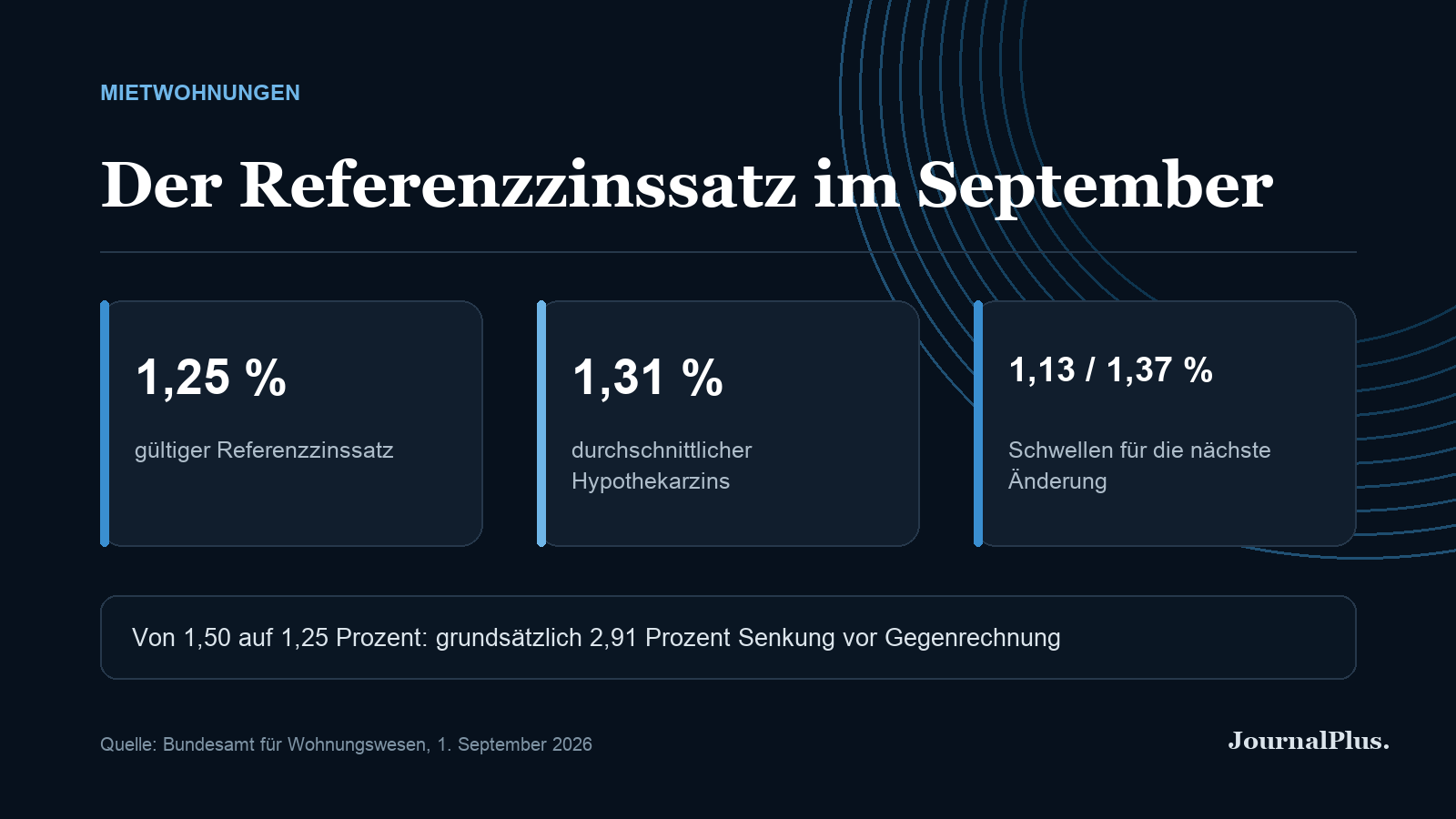
The reference interest rate is based on the average interest rate of domestic mortgages. This average currently stands at 1.31 percent. Only if it falls below 1.13 percent or rises above 1.37 percent will the reference value, rounded to quarter percentage points, change. Until then, it remains at 1.25 percent.
No Automatic Adjustment
An unchanged reference interest rate does not create a new general entitlement to a rent reduction. Nevertheless, it is worth looking at the rental agreement and the latest rent notification. If the current net rent is still based on a reference interest rate of 1.5 percent or higher, a claim for reduction may still exist. The change from 1.5 to 1.25 percent typically corresponds to a reduction of 2.91 percent in calculation.
However, this figure is not equivalent to the final rent reduction. Landlords may offset a portion of inflation as well as increased maintenance and operating costs. Value-enhancing investments or other contractually permissible costs can also play a role. Special rules apply to indexed or staggered rental agreements and certain subsidized apartments.
How to Practically Check
Anyone who identifies a potential claim must act proactively. The Federal Office for Housing recommends requesting a reduction from the landlord in writing for the next termination date – ideally by registered mail. The landlord has 30 days to respond. If there is no reply or the calculation is not convincing, tenants can contact the cantonal conciliation authority. These procedures are generally free of charge.
A clear calculation is crucial. The net rent should be considered separately from utility costs. Furthermore, it is important to check which reference interest rates formed the basis for previous increases. General online calculators can provide an initial orientation but do not replace professional advice in complex cases.
Why the Rate Reacts So Slowly
Many households wonder why the reference interest rate remains stable, even though individual mortgage offers fluctuate more significantly. The reason lies in its design: the average includes a large portfolio of existing mortgages with different terms. New, cheaper or more expensive agreements only gradually change the overall value. This dampens abrupt swings – both upwards and downwards.
What This Means for Swiss Households
For a household with 2500 Swiss Francs net rent, 2.91 percent would computationally be about 73 Swiss Francs per month. After permissible offsets, the effective reduction can be smaller. Conversely, tenants do not need to fear a new reference interest rate-related increase due to the current publication.
The most important message is therefore: Not the headline, but the individual situation is decisive. Those already at 1.25 percent should wait for now. Those who still have a higher rate in their contract should check their documents and consider a reasoned request. And those who are newly signing a rental agreement should pay attention to which reference interest rate is stated therein. In a tight housing market, this does not replace a structural solution – but it can make a noticeable difference in the household budget.