Swiss Rental Prices: Data Unclear
New FSO Figures Pending – Claims Unverified
Housing Shortage in Switzerland: Vacancy Rate Drops to Just 1 Percent
The Swiss housing market is becoming increasingly tight. In 2025, the vacancy rate fell to exactly 1 percent. At the same time, rents continue to rise – particularly for newly listed properties. The official figures from the Federal Statistical Office thus present a different picture than previously depicted: data is already available, but a distinction must be made between existing rental agreements and new rental offers.
Only One in a Hundred Dwellings is Vacant
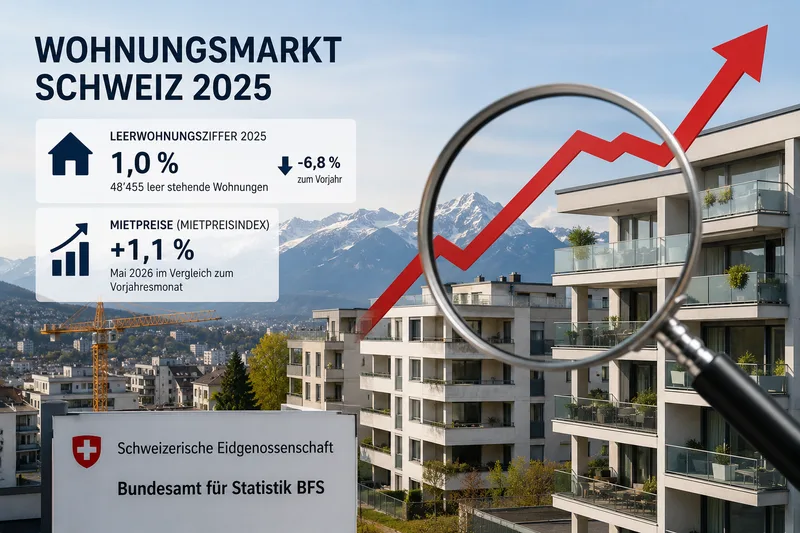
On June 1, 2025, 48,455 vacant dwellings were counted in Switzerland. This corresponds to a vacancy rate of exactly 1 percent of the total housing stock. Compared to the previous year, the number of vacant dwellings decreased by 3,519 or 6.8 percent.
This continued a trend that has been ongoing for several years. The vacancy rate has decreased every year since 2021. Overall, it fell by 0.72 percentage points during this period. Switzerland thus has significantly fewer available dwellings than a few years ago.
The situation is particularly strained in large cities and economically attractive regions. On June 1, 2025, the vacancy rate was, for example, only 0.34 percent in Geneva, 0.42 percent in Zug, and 0.48 percent in the Canton of Zurich.
In contrast, some regions still show significantly higher vacancy rates. In Jura, the rate was 3.03 percent, and in Solothurn, it was 2.05 percent. The Swiss average therefore conceals considerable regional differences.
Supply of Rental Dwellings Also Shrinks
The shortage is particularly evident in rental dwellings. On the reference date of June 1, 2025, 37,194 unoccupied dwellings were offered for rent. This was 3,229 fewer than a year prior – a decrease of around 8 percent.
This development is relevant because the vacancy rate does not simply measure how many dwellings are physically unoccupied. The Federal Statistical Office (FSO) only considers dwellings actively offered for long-term rent or purchase. A vacant dwelling held back for future owner-occupancy, for example, is not included in the vacancy rate.
The statistics primarily describe how much living space is available on the market. This supply is steadily decreasing in many regions.
Rents Are Rising – But Not Uniformly
An important distinction is necessary for rental prices. The FSO Rental Price Index measures the development of rents for existing rental dwellings and is part of the National Consumer Price Index. It is surveyed quarterly.
Official FSO figures show that residential rents continue to contribute to inflation in 2026. In May 2026, residential rents in the Rental Price Index were 1.1 percent higher than in the same month last year. In February 2026, the increase was 1.2 percent.
The frequently cited figure of 2.3 percent should not simply be referred to as “2025 rent increase.” It originates from a different statistic: according to Fahrländer Partner Raumentwicklung, rents for new leases in new constructions rose by 2.3 percent in the fourth quarter of 2025 compared to the same quarter of the previous year. For older buildings, the increase was even 3.8 percent.
This development can be particularly relevant for prospective tenants. Someone who has lived in the same dwelling for years experiences a different price trend than someone looking for a new dwelling today.
Why Prospective Tenants May Feel Price Pressure More Strongly
The difference between existing rents and offered rents is crucial. The FSO Rental Price Index reflects the development of rents in the existing housing stock. For a new dwelling on the market, however, the price can be more strongly influenced by current demand and limited supply.
Current market data confirms this pressure. The Homegate Rent Index from Swiss Marketplace Group and Zürcher Kantonalbank showed an increase in advertised rents of 2.5 percent compared to the previous year in June 2026. In some cantons, the increase was significantly higher.
However, these figures are not directly comparable with the FSO Rental Price Index. They measure different segments of the rental housing market. Precisely for this reason, reporting on housing costs should not cite just a single percentage.
Reference Interest Rate Relieves Tenants – At Least Partially
The mortgage reference interest rate plays an important role for existing rental agreements. It has stood at 1.25 percent since September 2025 and remained unchanged in the publication of June 1, 2026.
If the reference interest rate falls, this can generally trigger a claim for a rent reduction. Conversely, rising reference rates can lead to rent increases. However, the actual rent of an individual tenancy depends on other factors, including the previous reference rate, inflation, and maintenance and operating costs.
The most recent interest rate reductions have therefore not automatically led to an equally strong relief for all tenants.
What Is the Federal Council Planning?
A classic “rent cap” like the German model cannot currently be spoken of in Switzerland. Swiss tenancy law already includes rules against abusive rents and provides various mechanisms to limit rent adjustments.
At the same time, tenancy law is a highly controversial political issue. In 2026, the Federal Council is working, among other things, on a review of the rent model. This concerns how rents should be adjusted in the future and whether the current model still adequately reflects today's reality.
Furthermore, the Federal Council prepared an adjustment to the rules on permissible returns in tenancy law at the beginning of 2026. This aims to improve legal certainty, particularly in calculating permissible returns.
In parallel, various initiatives on tenancy law are underway in Parliament. These range from measures against abusive rents to demands for stronger tenant rights.
Housing Scarcity Remains the Central Problem
The FSO figures primarily show one thing: the problem of the Swiss housing market is not solely about how much the average rent increases. Crucially, it is also about how many dwellings are available at all.
When the vacancy rate drops to 1 percent and, at the same time, fewer rental dwellings are offered, the situation worsens particularly for people seeking a new home. Households with lower purchasing power, families, and individuals who must change their place of residence for professional or personal reasons are especially affected.
The Federal Housing Office (BWO) also describes the situation on the Swiss housing market as strained. The scarcity is particularly noticeable for prospective tenants with lower purchasing power.
For Tenants, Development Is More Important Than the Inflation Rate
General inflation only provides part of the picture. The average annual inflation in Switzerland was only 0.2 percent in 2025. Nevertheless, individual households can be significantly more burdened if their rent increases or they need to find a new dwelling.
This is because the National Consumer Price Index reflects a broad basket of goods. However, an individual household does not spend exactly the same amount on all goods and services as the statistical average household.
Therefore, for a family that spends a large portion of its income on housing, a rent increase can impact the budget much more significantly than the general inflation rate suggests.
Switzerland Has a Regional Housing Problem
Official figures also clarify that there is not one single Swiss housing market. Significant differences exist between Geneva, Zurich, Zug, the Central Plateau, Western Switzerland, and structurally weaker regions.
While some cantons show vacancy rates well over 2 percent, other regions experience almost full occupancy. Particularly where jobs and population are growing strongly, available housing is scarce.
This presents a difficult problem for policymakers: more protection against rent increases can temporarily relieve individual households. At the same time, additional housing is needed to improve the supply-demand balance in the long term.
What the Figures Mean for Switzerland
The latest available data paints a clear picture: the Swiss housing shortage has further intensified. The vacancy rate fell to 1 percent in 2025. Simultaneously, the supply of vacant rental dwellings is decreasing.
Average rents in the existing housing stock continue to rise, while the situation for new rentals appears even more strained in many regions. A single figure like “2.3 percent rent increase” is therefore insufficient to describe the entire Swiss rental market.
For tenants, the combination of limited supply, rising advertised rents, and high housing costs remains particularly problematic. The reference interest rate of 1.25 percent can partially relieve existing rental agreements but does not solve the fundamental problem of housing scarcity.
Conclusion
The original statement that no official figures on the housing situation for 2025 were available is outdated. The FSO has already published the 2025 vacancy figures. The vacancy rate stands at 1 percent – the fifth consecutive decline.
Current official data on rents is also available. They show a further increase in residential rents, while available living space remains scarce.
The crucial question for Switzerland is therefore not whether there is a rent increase at all. The figures confirm it. The political challenge lies rather in how additional housing can be created, existing housing kept affordable, and tenants protected from abusive rents.
There is no simple solution. Tenancy law, housing construction, immigration, spatial planning, financing, and regional differences are interconnected. However, it is clear: with a vacancy rate of just one percent, the Swiss housing market remains strained in 2026.
Sources
- Bundesamt für Statistik (BFS): Vacant Dwelling Census 2025 – 48,455 vacant dwellings, vacancy rate 1.0 percent.
- Bundesamt für Statistik (BFS): Rental Price Index – quarterly survey of rental prices in Switzerland.
- Bundesamt für Statistik (BFS): National Consumer Price Index – residential rents and annual inflation 2025.
- Bundesamt für Wohnungswesen (BWO): Mortgage Reference Interest Rate – current rate 1.25 percent.
- Bundesamt für Wohnungswesen (BWO): Tenancy law policy and ongoing work on the further development of tenancy law.
- Fahrländer Partner Raumentwicklung (FPRE): Development of new contract rents in the fourth quarter of 2025.