Special Program Boosts Energy Efficiency in Non-Profit Housing
71 Loans, 2,413 Renovated Apartments: Federal Government Reports Positive Results. Energy Consumption Decreased by 75 Percent.
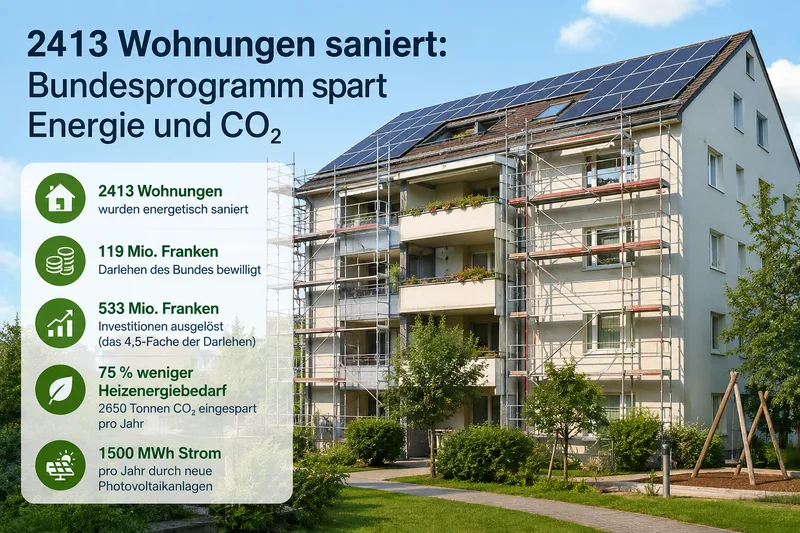
The federal government's special program to promote energy efficiency in non-profit housing shows positive results. Between 2021 and 2025, the Federal Office of Housing (BWO) approved 71 loans totaling 119 million Swiss francs. These funds supported the renovation of 2,413 apartments. The triggered investments by developers amounted to 533 million Swiss francs – 4.5 times the loan funds deployed.
Goal: Accelerated Renovation with Affordable Rents
The Fonds de Roulement (FDR) is a federal instrument designed to promote non-profit housing construction. It grants loans to non-profit developers for new construction, acquisition, and renovation. The 2021–2025 special program aimed to accelerate energy-efficient renovations. "The program's objective was to speed up the energy-related renewal of non-profit housing stock while preserving affordable living space," writes the BWO. To achieve this, FDR loans were interest-free for the first ten years.
Significant Progress in Energy Efficiency
The evaluation of GEAK-Plus reports shows: The analyzed buildings, with an energy reference area of 180,000 square meters, largely meet new construction standards after renovation. 95 percent comply with the requirements for overall energy efficiency. Heating energy consumption decreased by an average of 75 percent. This saves approximately 2,650 tons of CO2 annually. Additionally, new photovoltaic systems on the roofs produce about 1,500 megawatt-hours of electricity per year.

Between 2021 and 2025, the special program accounted for about one-third of all approved FDR loans. For renovation projects, three-quarters were supported through this special program. On average, 220,000 Swiss francs were invested per apartment.
Moderate Rents Despite High Investments
The interest-free loans kept rent increases in check. "Thanks to the interest-free loans during the first ten years, the rent increase remained moderate despite the extensive investments, and the apartments remain affordable even after renovation," states the BWO. Renovations were primarily carried out while occupied. In a few cases, developers offered alternative accommodation, allowing tenants to return after the renovation.
The special program has now concluded. The final report is available in German. Questions remain regarding the exact regional distribution of the supported apartments and the rent development in Swiss francs and percentage terms. The BWO does not provide figures on these points.
The experience from this program could serve as a model for future funding instruments. Non-profit housing demonstrates that energy-efficient renovation and affordable rents are compatible. The combination of interest-free loans and long-term investment has proven effective.

Sources
- Special program strengthens energy efficiency in non-profit housing (Primary source, 2026-08-24, researched on 2026-08-25)
- news.google.com (Secondary source, researched on 2026-08-25)
- news.google.com (Secondary source, researched on 2026-08-25)
- news.google.com (Secondary source, researched on 2026-08-25)
- news.google.com (Secondary source, researched on 2026-08-25)
- news.google.com (Secondary source, researched on 2026-08-25)