Swiss Life Considers Job Cuts: What Drives the Restructuring
The insurer reviews processes and personnel.
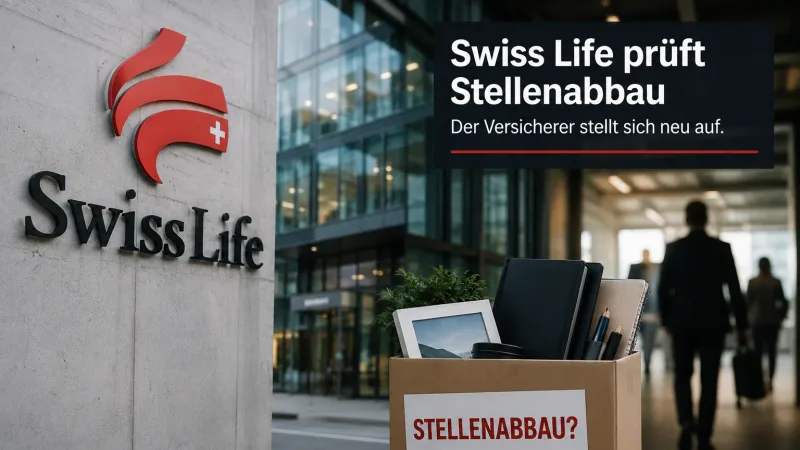
A major reorganization is imminent at Swiss Life Switzerland. Media reports mention mass redundancies, but the company itself has only confirmed a review of structures and personnel. It is clear that internal vacant positions have only been filled selectively for months. Concrete measures are to be announced during the third quarter of 2026.
A major organizational restructuring is emerging at Swiss Life Switzerland. The financial portal Inside Paradeplatz reported at the end of August, citing an insider, that the insurer is preparing for massive job cuts. A “mass dismissal” and a “big bang” are mentioned. However, the report does not provide a concrete number of affected jobs.
Swiss Life confirms part of the report – albeit in a much more cautious manner. The company states that it regularly reviews its organization, processes, and the deployment of resources and personnel. The goal is to strengthen its market position and continue to grow profitably.
Therefore, job cuts are not confirmed, but also not ruled out.
Vacant Positions Are Already Being Filled Selectively
Another company statement is particularly revealing. Swiss Life Switzerland announced that internal vacant positions have only been filled “very selectively” since the beginning of 2026. This aims to minimize potential job cuts and utilize natural attrition.
Additionally, Swiss Life has internally announced that it expects to communicate concrete measures during the third quarter. At the end of August, a decision is thus imminent – but its form remains open.
This is precisely where the difference lies between the portrayal by Inside Paradeplatz and the official communication: while the portal announces extensive reductions, Swiss Life speaks of an ongoing review and upcoming measures.
McKinsey as Part of the Analysis
Inside Paradeplatz links the consulting firm McKinsey to the restructuring. According to the report, the consulting firm has been analyzing processes and structures at Swiss Life Switzerland for months. This involves questions such as which activities are necessary, where processes could be accelerated, and which tasks could be automated.
Such an analysis alone is not proof of impending mass layoffs. Large insurers regularly review their operations. The industry faces pressure from digitalization, artificial intelligence, and increasing demands for efficiency.
For an insurer, this particularly affects internal services: standardized administrative tasks can increasingly be digitized or automated. Simultaneously, customer advisory services, sales, and claims processing are changing.
Swiss Life Not Under Acute Financial Pressure
The economic context is important. Available figures do not suggest a classic restructuring driven by financial distress.
The Swiss Life Group achieved an operating profit of 1.83 billion Swiss francs in 2025. Premium income rose to 20.9 billion Swiss francs. The solvency ratio at the end of 2025 was 213 percent, well above the strategic target range of 140 to 190 percent.
Business continued to develop positively in the first quarter of 2026: Swiss Life reported premium growth of five percent and fee income growth of six percent compared to the same quarter last year.
This suggests that potential staff reductions should not be equated with an acute existential or earnings crisis.
How Big Is Swiss Life in Switzerland?
The significance of a potential restructuring is nevertheless considerable. At the end of 2025, the Swiss Life Group employed 12,313 people worldwide. Of these, 4,436 worked in Switzerland. The so-called core workforce comprised 4,265 people.
The number of employees in Switzerland has even increased in recent years: the core workforce grew from 4,009 people at the end of 2023 to 4,234 at the end of 2024 and 4,265 at the end of 2025.
Therefore, a potential reduction would primarily represent a correction of previous personnel development – if jobs are indeed cut.
Roman Stein is the CEO of Swiss Life Switzerland. He has led the Swiss business since March 2024.
What Does This Mean for Employees?
For employees, it is primarily crucial which areas will be affected by the announced reorganization.
It is not yet known:
- how many jobs could actually be eliminated,
- which departments would be affected,
- whether layoffs or primarily natural attrition are planned,
- whether management positions will be reorganized,
- and if a social plan will be necessary.
As long as Swiss Life has not communicated these points, it would be journalistically incorrect to speak of a definite mass redundancy.
Nevertheless, the current situation means uncertainty for employees. Especially where positions are no longer refilled, a reorganization can become visible over several months before concrete terminations are issued.
An Industry Issue – Not Just a Swiss Life Case
The process also represents a larger shift in the Swiss insurance industry. Insurers possess large amounts of standardized data and processes. Artificial intelligence and automation can therefore long-term change activities previously performed by humans.
This does not necessarily mean fewer jobs. Employees can also transition to new tasks. Companies, for example, require more specialists for data analysis, IT, cybersecurity, and digital customer support.
The challenge is to manage this transition in a socially responsible way.
What Becomes Crucial Now
The coming weeks should reveal whether the confirmed organizational review will indeed lead to significant job cuts.
The current facts can be summarized as follows: Swiss Life Switzerland is reviewing its structures, selectively filling internal vacancies, and plans to announce concrete measures in the third quarter. The company has not yet confirmed mass redundancies.
For the Swiss insurance industry, a major reorganization would nevertheless be a signal. It would show the extent to which digitalization and efficiency pressure now also affect large, economically successful insurers.
JournalPlus will monitor Swiss Life's announced measures and assess how many jobs are actually affected.
Note: This article distinguishes between confirmed information from Swiss Life and unverified information from the Inside Paradeplatz report.